




Sketch, label and describe the spirogyra.
Answer
 Verified
611.1k+ views
Hint: Spirogyra is found in the freshwater. It is the filamentous algae. It has spiral shape and contains chloroplasts. It contains cell wall, plasma membrane, nucleus, chloroplast, pyrenoids and vacuole. They appear as the floating slimy masses and also referred to as scum.
Complete answer:
The free floating green algae in freshwater are called spirogyra. The structure of the spirogyra is filamentous. It contains spiral shaped chloroplasts.
Vegetative body structure of spirogyra is explained below:
(a)External features:
-Spirogyra has an unbranched and filamentous vegetative body structure.
-It has a long, slender and multicellular plant body.
-The filamentous body contains numerous elongated and identical cells which are arranged vertically. -Filament is usually surrounded by a membrane of mucilage
-Protoplasm: Following parts are present in protoplasm:
-Plasma membrane: It is situated just below the cell wall. It covers the inner matters of the protoplasm.
(b)Internal Features: Cytoplasm is situated inside the cell wall which is a jelly like substance and present very close to the plasma membrane.
-Cell vacuole: Each cell has a large vacuole placed at the centre.
-Nucleus: Each all contains a single nucleus. It remains suspended within the cytoplasm with the help of some cytoplasm strains.
The silvery granules present in each chloroplast are called pyrenoids.
-Chloroplast: Chloroplasts of this all are long and flattened as tape. They appear in spiral shape around the saciole. Usually the number of chloroplasts may vary from one to seven.
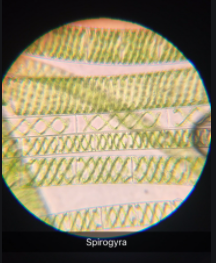
Note: The holdfast or hapteta are present at the posterior end of the filament these are the unicellular compressed part by which the plant body remains attached with any substratum. A plenty of protein piles up in the pyrenoids are present in spirogyra. Starch is deposited as recent food around the pyrenoids. Spirogyra makes their own food as they contain chloroplast. It is also called water silk, mermaid’s tresses, or pond scum.
Complete answer:
The free floating green algae in freshwater are called spirogyra. The structure of the spirogyra is filamentous. It contains spiral shaped chloroplasts.
Vegetative body structure of spirogyra is explained below:
(a)External features:
-Spirogyra has an unbranched and filamentous vegetative body structure.
-It has a long, slender and multicellular plant body.
-The filamentous body contains numerous elongated and identical cells which are arranged vertically. -Filament is usually surrounded by a membrane of mucilage
-Protoplasm: Following parts are present in protoplasm:
-Plasma membrane: It is situated just below the cell wall. It covers the inner matters of the protoplasm.
(b)Internal Features: Cytoplasm is situated inside the cell wall which is a jelly like substance and present very close to the plasma membrane.
-Cell vacuole: Each cell has a large vacuole placed at the centre.
-Nucleus: Each all contains a single nucleus. It remains suspended within the cytoplasm with the help of some cytoplasm strains.
The silvery granules present in each chloroplast are called pyrenoids.
-Chloroplast: Chloroplasts of this all are long and flattened as tape. They appear in spiral shape around the saciole. Usually the number of chloroplasts may vary from one to seven.
Note: The holdfast or hapteta are present at the posterior end of the filament these are the unicellular compressed part by which the plant body remains attached with any substratum. A plenty of protein piles up in the pyrenoids are present in spirogyra. Starch is deposited as recent food around the pyrenoids. Spirogyra makes their own food as they contain chloroplast. It is also called water silk, mermaid’s tresses, or pond scum.
Recently Updated Pages
Master Class 11 English: Engaging Questions & Answers for Success

Master Class 11 Social Science: Engaging Questions & Answers for Success
Master Class 11 Maths: Engaging Questions & Answers for Success
Master Class 11 Biology: Engaging Questions & Answers for Success
Master Class 11 Physics: Engaging Questions & Answers for Success
Master Class 11 Chemistry: Engaging Questions & Answers for Success
Trending doubts
One Metric ton is equal to kg A 10000 B 1000 C 100 class 11 physics CBSE
What is cell theory Who formulated it class 11 biology CBSE
Phyllotaxy is the arrangement of ALeaflets BLeaves class 11 biology CBSE
Difference Between Prokaryotic Cells and Eukaryotic Cells
The symbiotic association of fungi and algae is called class 11 biology CBSE
Cell theory was formulated by A Schleiden and Schwann class 11 biology CBSE