




What is Skeleton ? Draw a diagram to show the human skeleton.
Answer
 Verified
608.4k+ views
Hint: It is the hard structure that supports the body of a living thing. An external or internal protective framework of bones, cartilage, or other rigid material supporting or containing, the organs of the human body.
Complete answer:
The human body is supported by a framework of bones known as a skeleton. Along with tendons, ligaments and cartilage, it constitutes the skeletal system. The human skeleton is the internal framework of the human body. It is composed of around 270 bones at birth that get decreased to 206 bones by adulthood as some bones get fused together. All the bones when they are joined together make the skeletal system of the body. The bones of a human or an animal considered as a whole, together forming the framework of the body. If humans don’t have a skeleton then the body would be flat as the skeleton gives the body its frame. The skeletal system or skeleton is under the skin, the muscle and the tissue of the body. The skeleton supports the skin, muscle, and tissue, and all the organs that are inside the body. The skeleton protects important internal organs like the brain, heart and lungs. The important parts of a human body are the head, the spine, the chest, the abdomen, the arms and hands and the legs and feet.
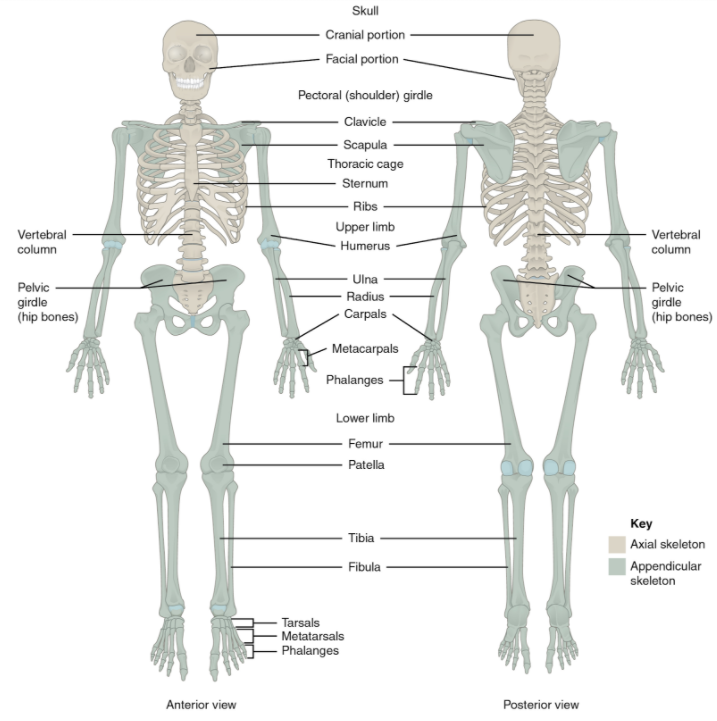
Bones of head : The head bones all together are called the skull, which protects the brain, the eyes and the inside parts of the ears. The bones of this part of the head are called the cranium.
Bones of Spine: The spine supports the head, the chest and the structure that carriers the arms. It is made of small bones called vertebrae. The spine all together is called the spinal column.
Bones of pelvis: The pelvic bones are carried by the legs bones and they support the spinal column. This part of the body is made of the sacrum and the two pelvic bones which are joined to it on either side.
Bones of the chest: The chest is called the thorax, and the vertebrae that are part of it are the thoracic vertebrae. All together the thorax protects the heart, lungs and stomach.
Bones of limbs: Arms and legs both have a thicker bone at the top and two thinner bones at the bottom.
Bones of arms: The upper bone is the humerus. The small bones of the wrist are called carpals and the bones inside the hand are called metacarpals. The finger bones are called metacarpals.
Bones of the legs : The upper bone of the leg, the longest bone in the body is called the femur. The small bones that join the foot are called the tarsals. The bones inside the foot are the metatarsals. The toe bones are called phalanges like finger bones.
Note:
The human skeleton performs six major functions : support, movement, protection, production of blood cells, storage of minerals, and endocrine regulation.
The human female pelvis is also different from that of males in order to facilitate childbirth. Unlike most primates, human males do not have penile bones.
Complete answer:
The human body is supported by a framework of bones known as a skeleton. Along with tendons, ligaments and cartilage, it constitutes the skeletal system. The human skeleton is the internal framework of the human body. It is composed of around 270 bones at birth that get decreased to 206 bones by adulthood as some bones get fused together. All the bones when they are joined together make the skeletal system of the body. The bones of a human or an animal considered as a whole, together forming the framework of the body. If humans don’t have a skeleton then the body would be flat as the skeleton gives the body its frame. The skeletal system or skeleton is under the skin, the muscle and the tissue of the body. The skeleton supports the skin, muscle, and tissue, and all the organs that are inside the body. The skeleton protects important internal organs like the brain, heart and lungs. The important parts of a human body are the head, the spine, the chest, the abdomen, the arms and hands and the legs and feet.
Bones of head : The head bones all together are called the skull, which protects the brain, the eyes and the inside parts of the ears. The bones of this part of the head are called the cranium.
Bones of Spine: The spine supports the head, the chest and the structure that carriers the arms. It is made of small bones called vertebrae. The spine all together is called the spinal column.
Bones of pelvis: The pelvic bones are carried by the legs bones and they support the spinal column. This part of the body is made of the sacrum and the two pelvic bones which are joined to it on either side.
Bones of the chest: The chest is called the thorax, and the vertebrae that are part of it are the thoracic vertebrae. All together the thorax protects the heart, lungs and stomach.
Bones of limbs: Arms and legs both have a thicker bone at the top and two thinner bones at the bottom.
Bones of arms: The upper bone is the humerus. The small bones of the wrist are called carpals and the bones inside the hand are called metacarpals. The finger bones are called metacarpals.
Bones of the legs : The upper bone of the leg, the longest bone in the body is called the femur. The small bones that join the foot are called the tarsals. The bones inside the foot are the metatarsals. The toe bones are called phalanges like finger bones.
Note:
The human skeleton performs six major functions : support, movement, protection, production of blood cells, storage of minerals, and endocrine regulation.
The human female pelvis is also different from that of males in order to facilitate childbirth. Unlike most primates, human males do not have penile bones.
Recently Updated Pages
Master Class 12 Economics: Engaging Questions & Answers for Success

Master Class 12 English: Engaging Questions & Answers for Success
Master Class 12 Social Science: Engaging Questions & Answers for Success
Master Class 12 Maths: Engaging Questions & Answers for Success
Master Class 12 Physics: Engaging Questions & Answers for Success
Master Class 12 Business Studies: Engaging Questions & Answers for Success
Trending doubts
The ratio of E to B in electromagnetic waves is equal class 12 physics CBSE
Which of the following is referred to as the Evil Quartet class 12 biology CBSE
What causes instant death by hanging class 12 biology CBSE
Percentage of photosynthetically active radiation PAR class 12 biology CBSE
The electric field due to a uniformly charged nonconducting class 12 physics CBSE
One megawatt is equal to how many units of electri class 12 physics CBSE