




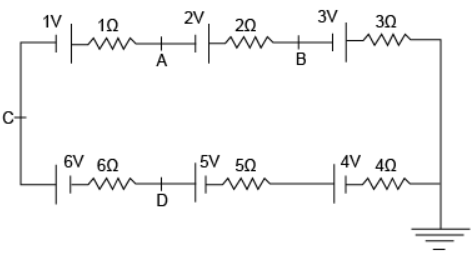
Six batteries of increasing emf and increasing internal resistance are as shown in figure.
Table 1 Table - 2 (a) Potential of point A (p) Zero (b) Potential of point B (q) 2 V (c) Potential of point C (r) 4 V (d) Potential of point D (s) 6 V
A. a - p; b - p; c - p,d-p
B. a-p,b-s,c-q
C. a-q,b-q,c-s
D. a-r,b-r,c-p
| Table 1 | Table - 2 |
| (a) Potential of point A | (p) Zero |
| (b) Potential of point B | (q) 2 V |
| (c) Potential of point C | (r) 4 V |
| (d) Potential of point D | (s) 6 V |
Answer
 Verified
598.2k+ views
Hint: In order to find the solution of above numerical we need to understand the diagram, according to the figure the six batteries are connected such that increases in internal resistance and emf. We need to use the formula of potential so we can easily solve this problem.
Complete step by step answer:
From the above diagram WKT the potential difference of ground is equal,
${V_{Ground}} = {V_{Ground}}$
The equivalent resistance is equal to the emf and I be the current flowing through the circuit
We calculate the current by using,
${R_{eq}} = {E_{eq}}$
$IV = {E_{eq}}$
$\
\implies I(21) = 21 \\
\implies I = 1\Omega \\
\ $
To calculate the potential difference through point A is
By using this formula, we apply this formula for each case
$emf = (R + r)I$
$\
{V_A} - {V_G} = - 2 + 2 \times 1 - 3 + 3 \times 1 \\
\implies {V_A} - {V_G} = 0 \\
\implies {V_A} = 0 \\
\ $
To calculate the potential difference through point B is
$\
{V_B} - {V_G} = - 3 + 3 \times 1 \\
\implies {V_B} - {V_G} = 0 \\
\implies {V_B} = 0 \\
\ $
To calculate the potential difference through point C is
$\
{V_C} - {V_G} = 1 + 1 \times 1 - 2 + 2 \times 1 - 3 + 3 \times 1 \\
\implies {V_C} - {V_G} = 0 \\
\implies {V_C} = 0 \\
\ $
To calculate the potential difference through point D is
$\
{V_D} - {V_G} = 5 - 1 \times 5 + 4 - 1 \times 4 \\
\implies {V_D} - {V_G} = 0 \\
\implies {V_D} = 0 \\
\ $
So, the correct answer is “Option A”.
Note:
The terminal potential difference across the cell is always less than emf of a cell.
Commonly the Internal resistance is the opposition offered by the flow of charges by the cells and batteries are responsible for generating the heat.
Complete step by step answer:
From the above diagram WKT the potential difference of ground is equal,
${V_{Ground}} = {V_{Ground}}$
The equivalent resistance is equal to the emf and I be the current flowing through the circuit
We calculate the current by using,
${R_{eq}} = {E_{eq}}$
$IV = {E_{eq}}$
$\
\implies I(21) = 21 \\
\implies I = 1\Omega \\
\ $
To calculate the potential difference through point A is
By using this formula, we apply this formula for each case
$emf = (R + r)I$
$\
{V_A} - {V_G} = - 2 + 2 \times 1 - 3 + 3 \times 1 \\
\implies {V_A} - {V_G} = 0 \\
\implies {V_A} = 0 \\
\ $
To calculate the potential difference through point B is
$\
{V_B} - {V_G} = - 3 + 3 \times 1 \\
\implies {V_B} - {V_G} = 0 \\
\implies {V_B} = 0 \\
\ $
To calculate the potential difference through point C is
$\
{V_C} - {V_G} = 1 + 1 \times 1 - 2 + 2 \times 1 - 3 + 3 \times 1 \\
\implies {V_C} - {V_G} = 0 \\
\implies {V_C} = 0 \\
\ $
To calculate the potential difference through point D is
$\
{V_D} - {V_G} = 5 - 1 \times 5 + 4 - 1 \times 4 \\
\implies {V_D} - {V_G} = 0 \\
\implies {V_D} = 0 \\
\ $
So, the correct answer is “Option A”.
Note:
The terminal potential difference across the cell is always less than emf of a cell.
Commonly the Internal resistance is the opposition offered by the flow of charges by the cells and batteries are responsible for generating the heat.
Recently Updated Pages
Master Class 12 Business Studies: Engaging Questions & Answers for Success

Master Class 12 Chemistry: Engaging Questions & Answers for Success
Master Class 12 Biology: Engaging Questions & Answers for Success
Class 12 Question and Answer - Your Ultimate Solutions Guide
Master Class 11 Social Science: Engaging Questions & Answers for Success
Master Class 11 Chemistry: Engaging Questions & Answers for Success
Trending doubts
Name the crygenes that control cotton bollworm and class 12 biology CBSE
Ribosomal RNA is actively synthesised in A Nucleoplasm class 12 biology CBSE
How many molecules of ATP and NADPH are required information class 12 biology CBSE
In a transcription unit the promoter is said to be class 12 biology CBSE
The number of chromosomes in male grasshopper is a class 12 biology CBSE
Verhulst Pearl logistic growth described by the equation class 12 biology CBSE