




Single-cell protein can be obtained from which of these organisms?
(a) Bacteria
(b) Algae
(c) Fungi
(d) All of these
Answer
 Verified
595.5k+ views
Hint: Single-cell proteins are an efficient source of protein for humans and animals. These are produced from microbes that have a very large amount of high- quality proteins. These microbes are mainly grown in agricultural as well as human and animal wastes, so it’s environmentally friendly as well.
Complete step by step answer:
Bacteria, algae, and fungi all are single-celled organisms that produce single-cell proteins. These proteins are generally used as dietary supplements. The production of these proteins from the single-celled organism is known as single-cell culture.
Therefore, the correct answer is option (d) all of these.
Additional Information: Single-cell proteins are derived from purely microbial organisms mainly single-celled. It is a refined or edible protein that can be used as a supplement for both humans and animals.
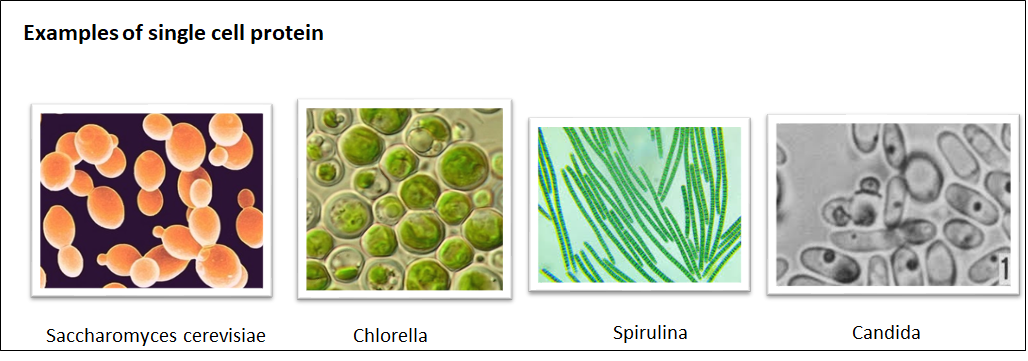
The microbes used for the production of these proteins are mainly algae, fungi, yeast, and bacteria which have very high protein content in their biomass. They are grown using substrates like agricultural waste like wood shavings, corn cobs, etc and also in human and animal wastes. The organisms use the carbon and nitrogen present in these and convert them into high- quality protein. These proteins offer a plausible solution to the protein deficiency that is faced by the whole of humanity.
The process is done in the following steps:
- Selecting a suitable strain
- Fermentation
- Harvesting
- Post- harvest treatment, and
- SCP processing of food.
Some microbes are listed below that are used for the production of single- cell proteins:
1. Fungi e.g. Aspergillus niger, Rhizopus cyclopean, etc.
2. Algae e.g. Chlondrus crispus, spirulina etc.
3. Bacteria e.g. Lactobacillus, Pseudomonas fluorescens, etc.
4. Yeast e.g. Saccharomyces cerevisiae.
Note: Apart from using as a food supplement, single- cell proteins are used for many other purposes such as:
- Therapeutic and medicinal purpose
- Cosmetic products
- Poultry, etc.
In this era of the high global population, malnutrition has become a serious issue for mankind. Therefore, these proteins have become a very popular and important source for everyone.
Here's a chart of different organisms and the dry amount of protein they contain in %:
Complete step by step answer:
Bacteria, algae, and fungi all are single-celled organisms that produce single-cell proteins. These proteins are generally used as dietary supplements. The production of these proteins from the single-celled organism is known as single-cell culture.
Therefore, the correct answer is option (d) all of these.
Additional Information: Single-cell proteins are derived from purely microbial organisms mainly single-celled. It is a refined or edible protein that can be used as a supplement for both humans and animals.
The microbes used for the production of these proteins are mainly algae, fungi, yeast, and bacteria which have very high protein content in their biomass. They are grown using substrates like agricultural waste like wood shavings, corn cobs, etc and also in human and animal wastes. The organisms use the carbon and nitrogen present in these and convert them into high- quality protein. These proteins offer a plausible solution to the protein deficiency that is faced by the whole of humanity.
The process is done in the following steps:
- Selecting a suitable strain
- Fermentation
- Harvesting
- Post- harvest treatment, and
- SCP processing of food.
Some microbes are listed below that are used for the production of single- cell proteins:
1. Fungi e.g. Aspergillus niger, Rhizopus cyclopean, etc.
2. Algae e.g. Chlondrus crispus, spirulina etc.
3. Bacteria e.g. Lactobacillus, Pseudomonas fluorescens, etc.
4. Yeast e.g. Saccharomyces cerevisiae.
Note: Apart from using as a food supplement, single- cell proteins are used for many other purposes such as:
- Therapeutic and medicinal purpose
- Cosmetic products
- Poultry, etc.
In this era of the high global population, malnutrition has become a serious issue for mankind. Therefore, these proteins have become a very popular and important source for everyone.
Here's a chart of different organisms and the dry amount of protein they contain in %:
| Fungi | Bacteria | Yeast | Algae |
| 30- 45 | 50- 65 | 45- 55 | 40- 60 |
Recently Updated Pages
Master Class 11 Social Science: Engaging Questions & Answers for Success

Master Class 11 Physics: Engaging Questions & Answers for Success
Master Class 11 Maths: Engaging Questions & Answers for Success
Master Class 11 Economics: Engaging Questions & Answers for Success
Master Class 11 Computer Science: Engaging Questions & Answers for Success
Master Class 11 Chemistry: Engaging Questions & Answers for Success
Trending doubts
One Metric ton is equal to kg A 10000 B 1000 C 100 class 11 physics CBSE
There are 720 permutations of the digits 1 2 3 4 5 class 11 maths CBSE
1 Quintal is equal to a 110 kg b 10 kg c 100kg d 1000 class 11 physics CBSE
State and prove Bernoullis theorem class 11 physics CBSE
Difference Between Prokaryotic Cells and Eukaryotic Cells
Discuss the various forms of bacteria class 11 biology CBSE