




How do you simplify \[\sin \left( {\dfrac{\pi }{3}} \right)\] ?
Answer
 Verified
598.2k+ views
Hint:
For simplifying this we will use the equilateral triangle and from there we will get the value for the perpendicular and the hypotenuse. As we know sine can be represented as a perpendicular side upon hypotenuse. So by using this we will be able to find the value for \[\sin \left( {\dfrac{\pi }{3}} \right)\] .
Formula used:
The values used in the question,
$\sqrt 3 = 1.732$
\[\sin \left( {\dfrac{\pi }{3}} \right) = \sin {60^ \circ }\]
$\sin = \dfrac{{Opposite{\text{ side}}}}{{Hypotenuse}}$
Complete Step by Step Solution:
Let us assume an equilateral having the side as $a$ .
So, now we will draw a perpendicular bisector from one point to the opposite side,
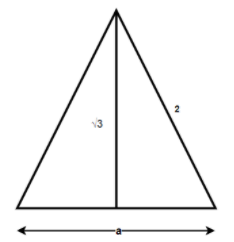
Then we have the two right-angled triangles and the length that will be hypotenuse, the adjacent side will become $\dfrac{a}{2}$ and the opposite side to the angle will be equal to $\left( {\dfrac{a}{2}} \right) \times \sqrt 3 $ .
And we know that $\pi $ is equal to ${180^ \circ }$ ,
Therefore, \[\sin \left( {\dfrac{\pi }{3}} \right) = \sin {60^ \circ }\]
And the sine can be written as
$ \Rightarrow \sin = \dfrac{{Opposite{\text{ side}}}}{{Hypotenuse}}$
So on substituting the values and solving it, we get the value as
$ \Rightarrow \sin {60^ \circ } = \dfrac{{\sqrt 3 }}{2}$
And we also know that $\sqrt 3 = 1.732$
So on substituting the values, we get
$ \Rightarrow \sin {60^ \circ } = \dfrac{{1.732}}{2}$
And on dividing it, we get
$ \Rightarrow \sin {60^ \circ } = 0.86660$
Therefore, on simplifying \[\sin \left( {\dfrac{\pi }{3}} \right)\], we get $0.86660$
Note:
There is more than one way to get the value for \[\sin \left( {\dfrac{\pi }{3}} \right)\] . If the unit circle is given to us then from this also we can get the value of it. Some of the other options by which we can get the answer will be by using a calculator is allowed during exams, by drawing the approximate graph, and also by using the Taylor series and calculating for the first several terms we will get the value for \[\sin \left( {\dfrac{\pi }{3}} \right)\].
For simplifying this we will use the equilateral triangle and from there we will get the value for the perpendicular and the hypotenuse. As we know sine can be represented as a perpendicular side upon hypotenuse. So by using this we will be able to find the value for \[\sin \left( {\dfrac{\pi }{3}} \right)\] .
Formula used:
The values used in the question,
$\sqrt 3 = 1.732$
\[\sin \left( {\dfrac{\pi }{3}} \right) = \sin {60^ \circ }\]
$\sin = \dfrac{{Opposite{\text{ side}}}}{{Hypotenuse}}$
Complete Step by Step Solution:
Let us assume an equilateral having the side as $a$ .
So, now we will draw a perpendicular bisector from one point to the opposite side,
Then we have the two right-angled triangles and the length that will be hypotenuse, the adjacent side will become $\dfrac{a}{2}$ and the opposite side to the angle will be equal to $\left( {\dfrac{a}{2}} \right) \times \sqrt 3 $ .
And we know that $\pi $ is equal to ${180^ \circ }$ ,
Therefore, \[\sin \left( {\dfrac{\pi }{3}} \right) = \sin {60^ \circ }\]
And the sine can be written as
$ \Rightarrow \sin = \dfrac{{Opposite{\text{ side}}}}{{Hypotenuse}}$
So on substituting the values and solving it, we get the value as
$ \Rightarrow \sin {60^ \circ } = \dfrac{{\sqrt 3 }}{2}$
And we also know that $\sqrt 3 = 1.732$
So on substituting the values, we get
$ \Rightarrow \sin {60^ \circ } = \dfrac{{1.732}}{2}$
And on dividing it, we get
$ \Rightarrow \sin {60^ \circ } = 0.86660$
Therefore, on simplifying \[\sin \left( {\dfrac{\pi }{3}} \right)\], we get $0.86660$
Note:
There is more than one way to get the value for \[\sin \left( {\dfrac{\pi }{3}} \right)\] . If the unit circle is given to us then from this also we can get the value of it. Some of the other options by which we can get the answer will be by using a calculator is allowed during exams, by drawing the approximate graph, and also by using the Taylor series and calculating for the first several terms we will get the value for \[\sin \left( {\dfrac{\pi }{3}} \right)\].
Recently Updated Pages
Master Class 12 Economics: Engaging Questions & Answers for Success

Master Class 12 English: Engaging Questions & Answers for Success
Master Class 12 Social Science: Engaging Questions & Answers for Success
Master Class 12 Maths: Engaging Questions & Answers for Success
Master Class 12 Physics: Engaging Questions & Answers for Success
Master Class 10 English: Engaging Questions & Answers for Success
Trending doubts
Explain the Treaty of Vienna of 1815 class 10 social science CBSE
Why is it 530 pm in india when it is 1200 afternoon class 10 social science CBSE
What is the full form of POSCO class 10 social science CBSE
Define Potential, Developed, Stock and Reserved resources
Which Country Has the Largest Border with India?
Choose the feminine form of the given noun Fox AFoxess class 10 english CBSE