




Simplify $ \sin \left( {{\cot }^{-1}}\left( \tan \left( {{\cos }^{-1}}x \right) \right) \right) $ .
Answer
 Verified
575.1k+ views
Hint:
We are given $ \sin \left( {{\cot }^{-1}}\left( \tan \left( {{\cos }^{-1}}x \right) \right) \right) $ we are asked to simplify it. To simplify we will use trigonometric ratios $ \cos \theta $ . Then we will use $ \tan \theta =\dfrac{\text{Perpendicular}}{\text{Base}} $ . After that we also require $ \tan \left( {{\tan }^{-1}}\left( \theta \right) \right)=\theta $ to simplify, after this we will follow the same step but with trigonometric ratio $ \sin \theta $ and then we use $ \sin \left( {{\sin }^{-1}}\theta \right)=\theta $ to get the final simplified answer.
Complete step by step answer:
We are given $ \sin \left( {{\cot }^{-1}}\left( \tan \left( {{\cos }^{-1}}x \right) \right) \right) $ . We are asked to find the simplified value of it.
Before we move further, we need to understand inverse trigonometry and trigonometry.
Let $ {{\cos }^{-1}}x=\theta \cdots \cdots \left( 1 \right) $ then we will get $ \cos \theta =x $ which can be written as $ \cos \theta =\dfrac{x}{1} $ .
As we know, $ \cos \theta =\dfrac{\text{Base}}{\text{Hypotenuse}} $ so considering x as base and 1 as hypotenuse.
Now as we know that $ \tan \left( {{\tan }^{-1}}\left( \theta \right) \right)=\theta $ so our equation becomes, \[\sin \left( {{\cot }^{-1}}\left( \dfrac{\sqrt{1-{{x}^{2}}}}{x} \right) \right)\left( as\text{ tan}\left( {{\tan }^{-1}}\left( \dfrac{\sqrt{1-{{x}^{2}}}}{x} \right) \right)=\dfrac{\sqrt{1-{{x}^{2}}}}{x} \right)\].
Now again consider \[\left( {{\cot }^{-1}}\left( \dfrac{\sqrt{1-{{x}^{2}}}}{x} \right) \right)=\theta \cdots \cdots \cdots \left( 3 \right)\] so we get, \[\cot \theta =\dfrac{\sqrt{1-{{x}^{2}}}}{x}\].
As \[\cot \theta =\dfrac{\text{Base}}{\text{Perpendicular}}\] so consider base as \[\sqrt{1-{{x}^{2}}}\] and perpendicular as x, so we get the triangle as
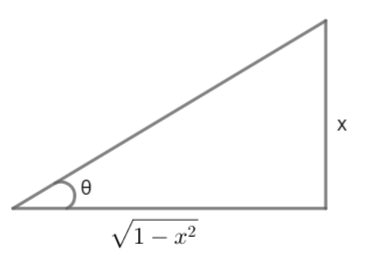
We will find value of hypotenuse using Pythagoras theorem, which says $ {{H}^{2}}={{P}^{2}}+{{B}^{2}} $ as P = x and B = \[\sqrt{1-{{x}^{2}}}\], So
\[\begin{align}
& {{H}^{2}}={{\left( \sqrt{1-{{x}^{2}}} \right)}^{2}}+{{x}^{2}} \\
& \Rightarrow {{H}^{2}}=1-{{x}^{2}}+{{x}^{2}} \\
& \Rightarrow {{H}^{2}}=1 \\
\end{align}\]
Now using P = x and H = 1 we will find $ \sin \theta $ .
We construct a triangle,
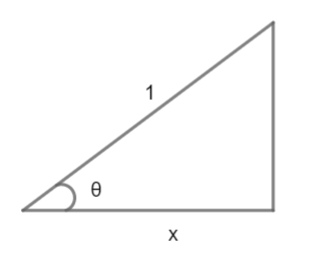
Using Pythagoras theorem which says $ {{H}^{2}}={{P}^{2}}+{{B}^{2}} $ we get, $ {{1}^{2}}={{x}^{2}}+{{P}^{2}} $ .
Now simplifying we get, $ {{1}^{2}}-{{x}^{2}}={{P}^{2}} $ .
Simplifying for P we get, $ P=\sqrt{1-{{x}^{2}}} $ .
Now using $ P=\sqrt{1-{{x}^{2}}} $ and B = x, we will find the value of $ \tan \theta $ .
As we know $ \tan \theta =\dfrac{\text{Perpendicular}}{\text{Base}} $ so $ \tan \theta =\dfrac{\sqrt{1-{{x}^{2}}}}{\text{x}} $ .
So we get the values as $ \theta ={{\tan }^{-1}}\left( \dfrac{\sqrt{1-{{x}^{2}}}}{\text{x}} \right)\cdots \cdots \cdots \left( 2 \right) $ .
Now comparing (1) and (2) we get that $ {{\cos }^{-1}}x={{\tan }^{-1}}\left( \dfrac{\sqrt{1-{{x}^{2}}}}{\text{x}} \right)\cdots \cdots \cdots \left( * \right) $ .
So our initial equation becomes $ \sin \left( {{\cot }^{-1}}\left( \tan \left( {{\cos }^{-1}}x \right) \right) \right)=\sin \left( {{\cot }^{-1}}\left( \tan \left( {{\tan }^{-1}}\left( \dfrac{\sqrt{1-{{x}^{2}}}}{\text{x}} \right) \right) \right) \right) $ using (*).
We know $ \sin \theta =\dfrac{\text{Perpendicular}}{\text{Hypotenuse}} $ so will take P = x and H = 1, so $ \sin \theta =\dfrac{\text{x}}{\text{1}} $ .
So we get the values as $ \theta ={{\sin }^{-1}}\left( \dfrac{\text{x}}{\text{1}} \right)\cdots \cdots \cdots \left( 4 \right) $ .
Now using (3) and (4) we get $ {{\sin }^{-1}}\left( \dfrac{\text{x}}{\text{1}} \right)={{\cot }^{-1}}\left( \dfrac{\sqrt{1-{{x}^{2}}}}{x} \right) $ .
So our equation becomes $ \sin \left( {{\sin }^{-1}}\left( \dfrac{\text{x}}{\text{1}} \right) \right)\left( \text{as }{{\cot }^{-1}}\left( \dfrac{\sqrt{1-{{x}^{2}}}}{x} \right)={{\sin }^{-1}}\left( \dfrac{\text{x}}{\text{1}} \right) \right) $ .
We know $ sin\left( {{\sin }^{-1}}\theta \right)=\theta $ s so we get, $ \Rightarrow \dfrac{x}{1}\left( \text{as }\sin \left( {{\sin }^{-1}}\left( \dfrac{\text{x}}{\text{1}} \right) \right)=\dfrac{x}{1} \right) $ .
Hence we get $ \sin \left( {{\cot }^{-1}}\left( \tan \left( {{\cos }^{-1}}x \right) \right) \right)=x $ .
Note:
While simplifying these types of questions, we must know about trigonometry along with inverse trigonometry. While solving, always keep track of the solution and the concept. Too many calculations are there so the focus is much needed. While using Pythagoras theorem, always remember we need the value of H or P, not their square. So root is always needed.
We are given $ \sin \left( {{\cot }^{-1}}\left( \tan \left( {{\cos }^{-1}}x \right) \right) \right) $ we are asked to simplify it. To simplify we will use trigonometric ratios $ \cos \theta $ . Then we will use $ \tan \theta =\dfrac{\text{Perpendicular}}{\text{Base}} $ . After that we also require $ \tan \left( {{\tan }^{-1}}\left( \theta \right) \right)=\theta $ to simplify, after this we will follow the same step but with trigonometric ratio $ \sin \theta $ and then we use $ \sin \left( {{\sin }^{-1}}\theta \right)=\theta $ to get the final simplified answer.
Complete step by step answer:
We are given $ \sin \left( {{\cot }^{-1}}\left( \tan \left( {{\cos }^{-1}}x \right) \right) \right) $ . We are asked to find the simplified value of it.
Before we move further, we need to understand inverse trigonometry and trigonometry.
Let $ {{\cos }^{-1}}x=\theta \cdots \cdots \left( 1 \right) $ then we will get $ \cos \theta =x $ which can be written as $ \cos \theta =\dfrac{x}{1} $ .
As we know, $ \cos \theta =\dfrac{\text{Base}}{\text{Hypotenuse}} $ so considering x as base and 1 as hypotenuse.
Now as we know that $ \tan \left( {{\tan }^{-1}}\left( \theta \right) \right)=\theta $ so our equation becomes, \[\sin \left( {{\cot }^{-1}}\left( \dfrac{\sqrt{1-{{x}^{2}}}}{x} \right) \right)\left( as\text{ tan}\left( {{\tan }^{-1}}\left( \dfrac{\sqrt{1-{{x}^{2}}}}{x} \right) \right)=\dfrac{\sqrt{1-{{x}^{2}}}}{x} \right)\].
Now again consider \[\left( {{\cot }^{-1}}\left( \dfrac{\sqrt{1-{{x}^{2}}}}{x} \right) \right)=\theta \cdots \cdots \cdots \left( 3 \right)\] so we get, \[\cot \theta =\dfrac{\sqrt{1-{{x}^{2}}}}{x}\].
As \[\cot \theta =\dfrac{\text{Base}}{\text{Perpendicular}}\] so consider base as \[\sqrt{1-{{x}^{2}}}\] and perpendicular as x, so we get the triangle as
We will find value of hypotenuse using Pythagoras theorem, which says $ {{H}^{2}}={{P}^{2}}+{{B}^{2}} $ as P = x and B = \[\sqrt{1-{{x}^{2}}}\], So
\[\begin{align}
& {{H}^{2}}={{\left( \sqrt{1-{{x}^{2}}} \right)}^{2}}+{{x}^{2}} \\
& \Rightarrow {{H}^{2}}=1-{{x}^{2}}+{{x}^{2}} \\
& \Rightarrow {{H}^{2}}=1 \\
\end{align}\]
Now using P = x and H = 1 we will find $ \sin \theta $ .
We construct a triangle,
Using Pythagoras theorem which says $ {{H}^{2}}={{P}^{2}}+{{B}^{2}} $ we get, $ {{1}^{2}}={{x}^{2}}+{{P}^{2}} $ .
Now simplifying we get, $ {{1}^{2}}-{{x}^{2}}={{P}^{2}} $ .
Simplifying for P we get, $ P=\sqrt{1-{{x}^{2}}} $ .
Now using $ P=\sqrt{1-{{x}^{2}}} $ and B = x, we will find the value of $ \tan \theta $ .
As we know $ \tan \theta =\dfrac{\text{Perpendicular}}{\text{Base}} $ so $ \tan \theta =\dfrac{\sqrt{1-{{x}^{2}}}}{\text{x}} $ .
So we get the values as $ \theta ={{\tan }^{-1}}\left( \dfrac{\sqrt{1-{{x}^{2}}}}{\text{x}} \right)\cdots \cdots \cdots \left( 2 \right) $ .
Now comparing (1) and (2) we get that $ {{\cos }^{-1}}x={{\tan }^{-1}}\left( \dfrac{\sqrt{1-{{x}^{2}}}}{\text{x}} \right)\cdots \cdots \cdots \left( * \right) $ .
So our initial equation becomes $ \sin \left( {{\cot }^{-1}}\left( \tan \left( {{\cos }^{-1}}x \right) \right) \right)=\sin \left( {{\cot }^{-1}}\left( \tan \left( {{\tan }^{-1}}\left( \dfrac{\sqrt{1-{{x}^{2}}}}{\text{x}} \right) \right) \right) \right) $ using (*).
We know $ \sin \theta =\dfrac{\text{Perpendicular}}{\text{Hypotenuse}} $ so will take P = x and H = 1, so $ \sin \theta =\dfrac{\text{x}}{\text{1}} $ .
So we get the values as $ \theta ={{\sin }^{-1}}\left( \dfrac{\text{x}}{\text{1}} \right)\cdots \cdots \cdots \left( 4 \right) $ .
Now using (3) and (4) we get $ {{\sin }^{-1}}\left( \dfrac{\text{x}}{\text{1}} \right)={{\cot }^{-1}}\left( \dfrac{\sqrt{1-{{x}^{2}}}}{x} \right) $ .
So our equation becomes $ \sin \left( {{\sin }^{-1}}\left( \dfrac{\text{x}}{\text{1}} \right) \right)\left( \text{as }{{\cot }^{-1}}\left( \dfrac{\sqrt{1-{{x}^{2}}}}{x} \right)={{\sin }^{-1}}\left( \dfrac{\text{x}}{\text{1}} \right) \right) $ .
We know $ sin\left( {{\sin }^{-1}}\theta \right)=\theta $ s so we get, $ \Rightarrow \dfrac{x}{1}\left( \text{as }\sin \left( {{\sin }^{-1}}\left( \dfrac{\text{x}}{\text{1}} \right) \right)=\dfrac{x}{1} \right) $ .
Hence we get $ \sin \left( {{\cot }^{-1}}\left( \tan \left( {{\cos }^{-1}}x \right) \right) \right)=x $ .
Note:
While simplifying these types of questions, we must know about trigonometry along with inverse trigonometry. While solving, always keep track of the solution and the concept. Too many calculations are there so the focus is much needed. While using Pythagoras theorem, always remember we need the value of H or P, not their square. So root is always needed.
Recently Updated Pages
Basicity of sulphurous acid and sulphuric acid are

Master Class 10 English: Engaging Questions & Answers for Success
Master Class 10 Social Science: Engaging Questions & Answers for Success
Master Class 10 Computer Science: Engaging Questions & Answers for Success
Class 10 Question and Answer - Your Ultimate Solutions Guide
Master Class 10 General Knowledge: Engaging Questions & Answers for Success
Trending doubts
Which country won the ICC Men's ODI World Cup in 2023?
In cricket, how many legal balls are there in a standard over?
A boat goes 24 km upstream and 28 km downstream in class 10 maths CBSE
What does "powerplay" mean in limited-overs cricket?
What is the "Powerplay" in T20 cricket?
Which are the three major ports of Tamil Nadu A Chennai class 10 social science CBSE