




How do you simplify $\left( {{{\sec }^2}x} \right) - \left( {{{\tan }^2}x} \right)$ ?
Answer
 Verified
575.7k+ views
Hint:
Start with assuming a right-angled triangle $\Delta MNP$ with an angle “theta” $\left( \theta \right)$. Use the triangle to define the trigonometric ratios. Now use Pythagoras theorem in the triangle and obtain an expression in the square of sine and cosine. Now take the given expression and expand the secant and tangent in the form of sine and cosine function. Substitute the known value and find the simplified expression.
Complete step by step answer:
Here in this problem, we are given a trigonometric expression $\left( {{{\sec }^2}x} \right) - \left( {{{\tan }^2}x} \right)$ . And we need to simplify this using the trigonometric identities and properties.
Before starting with the solution we must understand a few concepts about the trigonometric ratios like secant and tangent. Trigonometric Ratios are defined as the values of all the trigonometric functions based on the value of the ratio of sides in a right-angled triangle. The ratios of sides of a right-angled triangle for any of its acute angles are known as the trigonometric ratios of that particular angle.
Let us consider a right-angled triangle $\Delta MNP$ with an angle as “theta” $\left( \theta \right)$
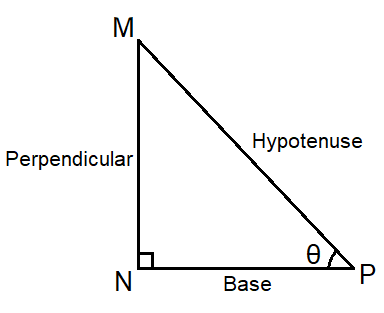
For the angle $\theta $, the side MN will be the opposite side, NP will be the adjacent side and MP is the hypotenuse.
According to the definitions of the trigonometric ratios, we have:
$\sin \theta = \dfrac{{Perpendicular}}{{Hypotenuse}} = \dfrac{{MN}}{{MP}}$ and \[\cos ec\theta = \dfrac{1}{{\sin \theta }} = \dfrac{{Hypotenuse}}{{Perpendicular}} = \dfrac{{MP}}{{MN}}\]
$\cos \theta = \dfrac{{Base}}{{Hypotenuse}} = \dfrac{{NP}}{{MP}}$ and $\sec \theta = \dfrac{1}{{\cos \theta }} = \dfrac{{Hypotenuse}}{{Base}} = \dfrac{{MP}}{{NP}}$
$\tan \theta = \dfrac{{\sin \theta }}{{\cos \theta }} = \dfrac{{\dfrac{{Perpendicular}}{{Hypotenuse}}}}{{\dfrac{{Perpendicular}}{{Hypotenuse}}}} = \dfrac{{MN}}{{NP}}$
According to the Pythagoras theorem, which states that “In a right-angled triangle, the square of the hypotenuse side is equal to the sum of squares of the other two sides“.
Now by using Pythagoras theorem in the triangle $\Delta MNP$ we get:
$ \Rightarrow M{P^2} = M{N^2} + N{P^2}$
By dividing both sides of the equation by $M{P^2}$ , we have:
$ \Rightarrow \dfrac{{M{P^2}}}{{M{P^2}}} = \dfrac{{M{N^2}}}{{M{P^2}}} + \dfrac{{N{P^2}}}{{M{P^2}}} \Rightarrow {\left( {\dfrac{{MN}}{{MP}}} \right)^2} + {\left( {\dfrac{{NP}}{{MP}}} \right)^2} = 1$
But according to the definition, we already know $\sin \theta = \dfrac{{MN}}{{MP}}{\text{ and }}\cos \theta = \dfrac{{NP}}{{MP}}$
So by substituting these values, we get:
$ \Rightarrow {\left( {\dfrac{{MN}}{{MP}}} \right)^2} + {\left( {\dfrac{{NP}}{{MP}}} \right)^2} = 1 \Rightarrow {\left( {\sin \theta } \right)^2} + {\left( {\cos \theta } \right)^2} = 1$
Therefore, we get a relation ${\sin ^2}\theta + {\cos ^2}\theta = 1 \Rightarrow {\cos ^2}\theta = 1 - {\sin ^2}\theta $
Now let us consider the given expression that is needed to be simplified
$ \Rightarrow \left( {{{\sec }^2}x} \right) - \left( {{{\tan }^2}x} \right)$
Using the definition of secant and tangent we get:
$ \Rightarrow \left( {{{\sec }^2}x} \right) - \left( {{{\tan }^2}x} \right) = {\left( {\dfrac{1}{{\cos \theta }}} \right)^2} - {\left( {\dfrac{{{{\sin }^2}\theta }}{{{{\cos }^2}\theta }}} \right)^2}$
Since both the fractions have the same denominators, we can combine them to have a single fraction:
$ \Rightarrow {\left( {\dfrac{1}{{\cos \theta }}} \right)^2} - {\left( {\dfrac{{\sin \theta }}{{\cos \theta }}} \right)^2} = \dfrac{{\left( {1 - {{\sin }^2}\theta } \right)}}{{{{\cos }^2}\theta }}$
From the above-obtained relation, we already have the value ${\cos ^2}\theta = \left( {1 - {{\sin }^2}\theta } \right)$
$ \Rightarrow \dfrac{{\left( {1 - {{\sin }^2}\theta } \right)}}{{{{\cos }^2}\theta }} = \dfrac{{{{\cos }^2}\theta }}{{{{\cos }^2}\theta }} = 1$
Thus, we simplified the expression as $\left( {{{\sec }^2}x} \right) - \left( {{{\tan }^2}x} \right) = 1$.
Note:
In this question, the use of the triangle $\Delta MNP$ to define the trigonometric ratios was the crucial part of the solution. An alternative approach for the same problem can be to use the equation ${\sin ^2}\theta + {\cos ^2}\theta = 1$ and divide the whole equation with ${\cos ^2}\theta $ . This will give you an expression that can be evaluated using the values $\sec \theta = \dfrac{1}{{\cos \theta }}{\text{ and }}\tan \theta = \dfrac{{\sin \theta }}{{\cos \theta }}$.
Start with assuming a right-angled triangle $\Delta MNP$ with an angle “theta” $\left( \theta \right)$. Use the triangle to define the trigonometric ratios. Now use Pythagoras theorem in the triangle and obtain an expression in the square of sine and cosine. Now take the given expression and expand the secant and tangent in the form of sine and cosine function. Substitute the known value and find the simplified expression.
Complete step by step answer:
Here in this problem, we are given a trigonometric expression $\left( {{{\sec }^2}x} \right) - \left( {{{\tan }^2}x} \right)$ . And we need to simplify this using the trigonometric identities and properties.
Before starting with the solution we must understand a few concepts about the trigonometric ratios like secant and tangent. Trigonometric Ratios are defined as the values of all the trigonometric functions based on the value of the ratio of sides in a right-angled triangle. The ratios of sides of a right-angled triangle for any of its acute angles are known as the trigonometric ratios of that particular angle.
Let us consider a right-angled triangle $\Delta MNP$ with an angle as “theta” $\left( \theta \right)$
For the angle $\theta $, the side MN will be the opposite side, NP will be the adjacent side and MP is the hypotenuse.
According to the definitions of the trigonometric ratios, we have:
$\sin \theta = \dfrac{{Perpendicular}}{{Hypotenuse}} = \dfrac{{MN}}{{MP}}$ and \[\cos ec\theta = \dfrac{1}{{\sin \theta }} = \dfrac{{Hypotenuse}}{{Perpendicular}} = \dfrac{{MP}}{{MN}}\]
$\cos \theta = \dfrac{{Base}}{{Hypotenuse}} = \dfrac{{NP}}{{MP}}$ and $\sec \theta = \dfrac{1}{{\cos \theta }} = \dfrac{{Hypotenuse}}{{Base}} = \dfrac{{MP}}{{NP}}$
$\tan \theta = \dfrac{{\sin \theta }}{{\cos \theta }} = \dfrac{{\dfrac{{Perpendicular}}{{Hypotenuse}}}}{{\dfrac{{Perpendicular}}{{Hypotenuse}}}} = \dfrac{{MN}}{{NP}}$
According to the Pythagoras theorem, which states that “In a right-angled triangle, the square of the hypotenuse side is equal to the sum of squares of the other two sides“.
Now by using Pythagoras theorem in the triangle $\Delta MNP$ we get:
$ \Rightarrow M{P^2} = M{N^2} + N{P^2}$
By dividing both sides of the equation by $M{P^2}$ , we have:
$ \Rightarrow \dfrac{{M{P^2}}}{{M{P^2}}} = \dfrac{{M{N^2}}}{{M{P^2}}} + \dfrac{{N{P^2}}}{{M{P^2}}} \Rightarrow {\left( {\dfrac{{MN}}{{MP}}} \right)^2} + {\left( {\dfrac{{NP}}{{MP}}} \right)^2} = 1$
But according to the definition, we already know $\sin \theta = \dfrac{{MN}}{{MP}}{\text{ and }}\cos \theta = \dfrac{{NP}}{{MP}}$
So by substituting these values, we get:
$ \Rightarrow {\left( {\dfrac{{MN}}{{MP}}} \right)^2} + {\left( {\dfrac{{NP}}{{MP}}} \right)^2} = 1 \Rightarrow {\left( {\sin \theta } \right)^2} + {\left( {\cos \theta } \right)^2} = 1$
Therefore, we get a relation ${\sin ^2}\theta + {\cos ^2}\theta = 1 \Rightarrow {\cos ^2}\theta = 1 - {\sin ^2}\theta $
Now let us consider the given expression that is needed to be simplified
$ \Rightarrow \left( {{{\sec }^2}x} \right) - \left( {{{\tan }^2}x} \right)$
Using the definition of secant and tangent we get:
$ \Rightarrow \left( {{{\sec }^2}x} \right) - \left( {{{\tan }^2}x} \right) = {\left( {\dfrac{1}{{\cos \theta }}} \right)^2} - {\left( {\dfrac{{{{\sin }^2}\theta }}{{{{\cos }^2}\theta }}} \right)^2}$
Since both the fractions have the same denominators, we can combine them to have a single fraction:
$ \Rightarrow {\left( {\dfrac{1}{{\cos \theta }}} \right)^2} - {\left( {\dfrac{{\sin \theta }}{{\cos \theta }}} \right)^2} = \dfrac{{\left( {1 - {{\sin }^2}\theta } \right)}}{{{{\cos }^2}\theta }}$
From the above-obtained relation, we already have the value ${\cos ^2}\theta = \left( {1 - {{\sin }^2}\theta } \right)$
$ \Rightarrow \dfrac{{\left( {1 - {{\sin }^2}\theta } \right)}}{{{{\cos }^2}\theta }} = \dfrac{{{{\cos }^2}\theta }}{{{{\cos }^2}\theta }} = 1$
Thus, we simplified the expression as $\left( {{{\sec }^2}x} \right) - \left( {{{\tan }^2}x} \right) = 1$.
Note:
In this question, the use of the triangle $\Delta MNP$ to define the trigonometric ratios was the crucial part of the solution. An alternative approach for the same problem can be to use the equation ${\sin ^2}\theta + {\cos ^2}\theta = 1$ and divide the whole equation with ${\cos ^2}\theta $ . This will give you an expression that can be evaluated using the values $\sec \theta = \dfrac{1}{{\cos \theta }}{\text{ and }}\tan \theta = \dfrac{{\sin \theta }}{{\cos \theta }}$.
Recently Updated Pages
Master Class 10 Social Science: Engaging Questions & Answers for Success

Master Class 10 Science: Engaging Questions & Answers for Success
Master Class 10 Maths: Engaging Questions & Answers for Success
Master Class 10 General Knowledge: Engaging Questions & Answers for Success
Master Class 10 Computer Science: Engaging Questions & Answers for Success
Class 10 Question and Answer - Your Ultimate Solutions Guide
Trending doubts
What is the full form of PNG A Petrol Natural Gas B class 10 chemistry CBSE
Explain the Treaty of Vienna of 1815 class 10 social science CBSE
In cricket, how many legal balls are there in a standard over?
Why is there a time difference of about 5 hours between class 10 social science CBSE
Who Won 36 Oscar Awards? Record Holder Revealed
What is the median of the first 10 natural numbers class 10 maths CBSE