




S.I unit of electric current is
A. Ampere
B. Volt
C. Farad
D. Coulomb
Answer
 Verified
638.4k+ views
Hint: In this question, we will first see the definition of ampere that is it is the total amount current due to 1 Coulomb of charge passing through a circuit for 1 second that is $1ampere = \dfrac{{1Columb}}{{1\sec }}$.
Step-By-Step answer:
The S.I unit of current is Ampere. Ampere is denoted by the letter A in the International System of Units. This term is given after the name of a French physicist/mathematician, André-Marie Ampèrein.
We all know that
$Current = \dfrac{{Ch\arg e}}{{time}} = \dfrac{{Columb}}{{\sec }}$
So the SI unit for electric current is Coulomb per Second that is known as Ampere.
We can define 1 ampere as it is the total amount of current that is produced When 1 coulomb of charge is passed through a wire of uniform cross-sectional area for 1 second time as shown in figure 1.
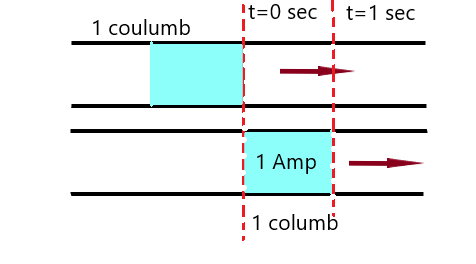
Figure 1
$1ampere = \dfrac{{1Columb}}{{1\sec }}$
There is one more very famous definition of 1 ampere that is When two current-carrying parallel infinitely long wires are placed such that the distance between them is one meter and the direction of current and amount of current in both the wires is the same then They will exert force on each other because each wire will have its own magnetic field. When this value of force between them becomes $2 \times {10^{ - 7}}$ newton/m 1 ampere of the current will be passing through each one of the two. This can be seen in figure 1.
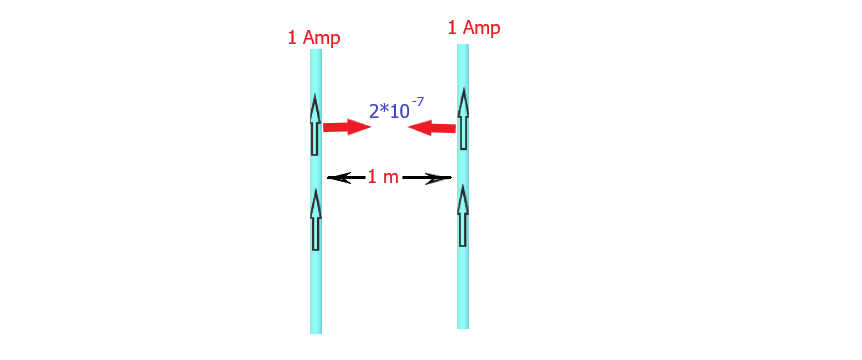
Figure 1
Note: For these types of questions we need to know the definition of some basic units for different electricity-related terms such as ampere (A), volts (V), Ohms $\left( \Omega \right)$, Siemens (S), Columb (C). It will be helpful for us to know the expression force due to the current-carrying conductor and what is the nature of the force.
Step-By-Step answer:
The S.I unit of current is Ampere. Ampere is denoted by the letter A in the International System of Units. This term is given after the name of a French physicist/mathematician, André-Marie Ampèrein.
We all know that
$Current = \dfrac{{Ch\arg e}}{{time}} = \dfrac{{Columb}}{{\sec }}$
So the SI unit for electric current is Coulomb per Second that is known as Ampere.
We can define 1 ampere as it is the total amount of current that is produced When 1 coulomb of charge is passed through a wire of uniform cross-sectional area for 1 second time as shown in figure 1.
Figure 1
$1ampere = \dfrac{{1Columb}}{{1\sec }}$
There is one more very famous definition of 1 ampere that is When two current-carrying parallel infinitely long wires are placed such that the distance between them is one meter and the direction of current and amount of current in both the wires is the same then They will exert force on each other because each wire will have its own magnetic field. When this value of force between them becomes $2 \times {10^{ - 7}}$ newton/m 1 ampere of the current will be passing through each one of the two. This can be seen in figure 1.
Figure 1
Note: For these types of questions we need to know the definition of some basic units for different electricity-related terms such as ampere (A), volts (V), Ohms $\left( \Omega \right)$, Siemens (S), Columb (C). It will be helpful for us to know the expression force due to the current-carrying conductor and what is the nature of the force.
Recently Updated Pages
Master Class 11 English: Engaging Questions & Answers for Success

Master Class 11 Social Science: Engaging Questions & Answers for Success
Master Class 11 Maths: Engaging Questions & Answers for Success
Master Class 11 Chemistry: Engaging Questions & Answers for Success
Master Class 11 Biology: Engaging Questions & Answers for Success
Master Class 11 Physics: Engaging Questions & Answers for Success
Trending doubts
One Metric ton is equal to kg A 10000 B 1000 C 100 class 11 physics CBSE
Difference Between Prokaryotic Cells and Eukaryotic Cells
Find the value of the expression given below sin 30circ class 11 maths CBSE
1 ton equals to A 100 kg B 1000 kg C 10 kg D 10000 class 11 physics CBSE
Two of the body parts which do not appear in MRI are class 11 biology CBSE
Draw a diagram of nephron and explain its structur class 11 biology CBSE