




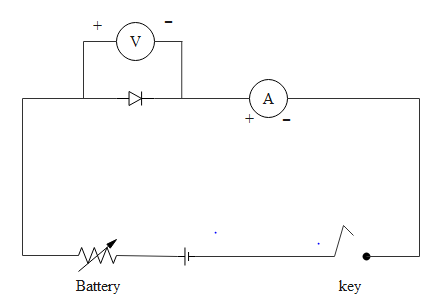
Shown below is an experimental set up with a semiconductor diode
(i) Identify the experiment
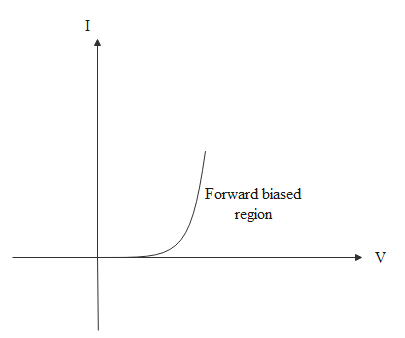
(ii) Draw the resulting graph
Answer
 Verified
627k+ views
Hint: If we combine two extrinsic semiconductors we get diodes. Extrinsic semiconductor in which electrons are excess are called n-type semiconductor whereas extrinsic semiconductor in which holes are excess are called p-type semiconductor. They conduct electricity only in forward bias
Complete step by step answer:
Diodes are the combination of intrinsic semiconductors. By sandwiching the extrinsic semiconductors we get diodes. Now at the sandwiched region, charge carriers from the p- type semiconductor i.e holes will move to the n type side and that region gets the positive charge, while electrons from the n- type goes to the p- region and that ragion gains negative charge. Due to this positive and negative charges at the sandwiched region carries some voltage called barrier voltage.
If p type semiconductor is connected to a positive terminal of the battery then that is forward bias. It is clearly shown in the below diagram
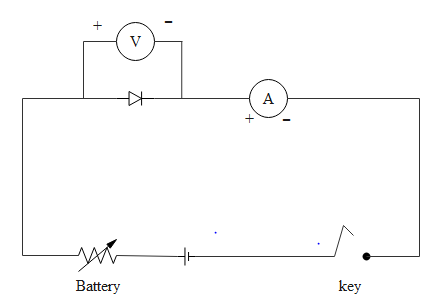
So this experiment indicates current flow through diodes only in forward bias.
The base end of the triangle type diode structure denotes the p-type semiconductor, while the sharp edge of the triangle denotes the n- type of the semiconductor. In the above diagram, it is clearly shown that p type is connected to positive terminal while n type to negative terminal.
The plot of biased voltage and current for the forward bias will be
Note:
In the plot initially for some voltage difference, even though voltage difference increases the current will increase because that voltage difference is compensated by the barrier potential. Current increases only after the voltage difference overcomes the barrier potential. After that even for small increases in voltage, current increases much significantly.
Complete step by step answer:
Diodes are the combination of intrinsic semiconductors. By sandwiching the extrinsic semiconductors we get diodes. Now at the sandwiched region, charge carriers from the p- type semiconductor i.e holes will move to the n type side and that region gets the positive charge, while electrons from the n- type goes to the p- region and that ragion gains negative charge. Due to this positive and negative charges at the sandwiched region carries some voltage called barrier voltage.
If p type semiconductor is connected to a positive terminal of the battery then that is forward bias. It is clearly shown in the below diagram
So this experiment indicates current flow through diodes only in forward bias.
The base end of the triangle type diode structure denotes the p-type semiconductor, while the sharp edge of the triangle denotes the n- type of the semiconductor. In the above diagram, it is clearly shown that p type is connected to positive terminal while n type to negative terminal.
The plot of biased voltage and current for the forward bias will be
Note:
In the plot initially for some voltage difference, even though voltage difference increases the current will increase because that voltage difference is compensated by the barrier potential. Current increases only after the voltage difference overcomes the barrier potential. After that even for small increases in voltage, current increases much significantly.
Recently Updated Pages
Basicity of sulphurous acid and sulphuric acid are

Master Class 12 Economics: Engaging Questions & Answers for Success
Master Class 12 Biology: Engaging Questions & Answers for Success
Master Class 11 English: Engaging Questions & Answers for Success
Master Class 11 Physics: Engaging Questions & Answers for Success
Master Class 11 Computer Science: Engaging Questions & Answers for Success
Trending doubts
Draw a labelled sketch of the human eye class 12 physics CBSE
The chemical formula of tear gas is A CO Cl 2 B C 10 class 12 chemistry CBSE
Draw ray diagrams each showing i myopic eye and ii class 12 physics CBSE
Which are the Top 10 Largest Countries of the World?
Differentiate between homogeneous and heterogeneous class 12 chemistry CBSE
Which is the correct genotypic ratio of mendel dihybrid class 12 biology CBSE