




Show that three circles can be drawn to touch a parabola and also to touch at the focus a given straight line passing through the focus, and prove that the tangents at the point of contact with the parabola form an equilateral triangle.
Answer
 Verified
583.8k+ views
Hint: We find the equation of the circle and the line passing through the centre. Then we try to find the slope of the line. Also, we use the centre on the line as it passes through that. We find a relation between the angles to find the characteristics of the triangle.
Complete step by step answer:
We know the equation to the circle which passes through the focus $\left( a,0 \right)$ and also that which touches the parabola ${{y}^{2}}=4ax$ at $\left( a{{t}^{2}},2at \right)$ will be of the form ${{x}^{2}}+{{y}^{2}}-ax\left( 3{{t}^{2}}+1 \right)-ay\left( 3t-{{t}^{3}} \right)+3{{a}^{2}}{{t}^{2}}=0$ and equation of any line through point $\left( a,0 \right)$ is given by $y=\dfrac{\sin \alpha }{\cos \alpha }\left( x-a \right)$. Here the slope m is of the form $\tan \alpha $.
Simplifying the equation, we get that $x\sin \alpha -y\cos \alpha =a\sin \alpha $.
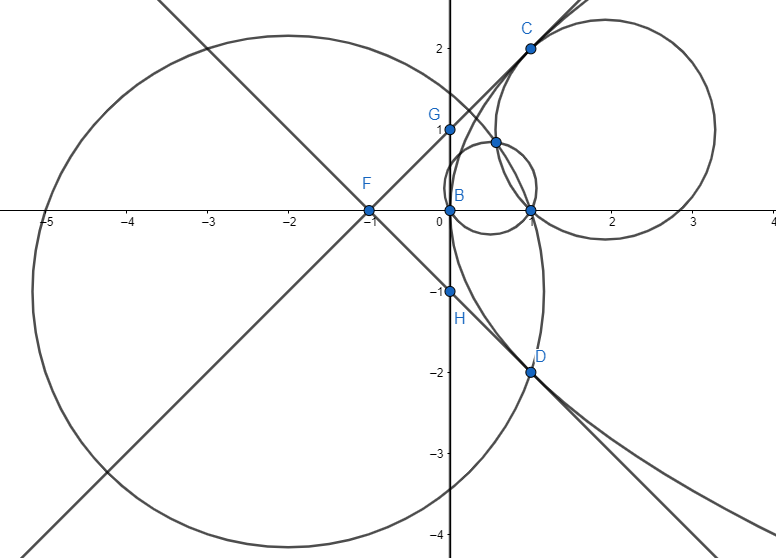
The perpendicular line of the equation will be $x\cos \alpha +y\sin \alpha =a\cos \alpha $ as the slope will negative inverse.
Now from the equation of circle we get the centre as $\left\{ \dfrac{a\left( 3{{t}^{2}}+1 \right)}{2},\dfrac{a\left( 3t-{{t}^{3}} \right)}{2} \right\}$.
Since the given line passes through the centre, we put the values and get
$\dfrac{a\left( 3{{t}^{2}}+1 \right)}{2}\cos \alpha +\dfrac{a\left( 3t-{{t}^{3}} \right)}{2}\sin \alpha =a\cos \alpha $.
We now solve it
$\begin{align}
& \dfrac{a\left( 3{{t}^{2}}+1 \right)}{2}\cos \alpha +\dfrac{a\left( 3t-{{t}^{3}} \right)}{2}\sin \alpha =a\cos \alpha \\
& \Rightarrow \left( 3{{t}^{2}}+1 \right)\cos \alpha +\left( 3t-{{t}^{3}} \right)\sin \alpha =2\cos \alpha \\
& \Rightarrow \left( 3t-{{t}^{3}} \right)\sin \alpha =\left( 1-3{{t}^{2}} \right)\cos \alpha \\
& \Rightarrow \dfrac{\cos \alpha }{\sin \alpha }=\cot \alpha =\dfrac{3t-{{t}^{3}}}{1-3{{t}^{2}}} \\
\end{align}$
Now we put $t=\tan \beta $ to make the equation $\cot \alpha =\dfrac{3t-{{t}^{3}}}{1-3{{t}^{2}}}=\dfrac{3\tan \beta -{{\left( \tan \beta \right)}^{3}}}{1-3{{\left( \tan \beta \right)}^{2}}}$
From the trigonometrical formula of $\tan 3\beta $ we use it to get $\cot \alpha =\dfrac{3\tan \beta -{{\left( \tan \beta \right)}^{3}}}{1-3{{\left( \tan \beta \right)}^{2}}}=\tan 3\beta $.
Now we solve for $\beta $.
We get $\tan 3\beta =\cot \alpha =\tan \left( \dfrac{\pi }{2}-\alpha \right)$.
Solving and taking principal solution we get $3\beta =\left( \dfrac{\pi }{2}-\alpha \right),\pi +\left( \dfrac{\pi }{2}-\alpha \right),2\pi +\left( \dfrac{\pi }{2}-\alpha \right)$.
Let’s assume there are three roots ${{\beta }_{1}},{{\beta }_{2}},{{\beta }_{3}}$ and they are respectively
\[{{\beta }_{1}}=\dfrac{\left( \dfrac{\pi }{2}-\alpha \right)}{3},{{\beta }_{2}}=\dfrac{\left( \dfrac{3\pi }{2}-\alpha \right)}{3},{{\beta }_{3}}=\dfrac{\left( \dfrac{5\pi }{2}-\alpha \right)}{3}\].
From observation we can see \[{{\beta }_{2}}-{{\beta }_{1}}=\dfrac{\left( \dfrac{3\pi }{2}-\alpha \right)}{3}-\dfrac{\left( \dfrac{\pi }{2}-\alpha \right)}{3}=\dfrac{\pi }{3}=\dfrac{\left( \dfrac{5\pi }{2}-\alpha \right)}{3}-\dfrac{\left( \dfrac{3\pi }{2}-\alpha \right)}{3}={{\beta }_{3}}-{{\beta }_{2}}\]
Therefore, the three normal are inclined at $\dfrac{\pi }{3}={{60}^{\circ }}$. So, the angles between the tangents are also $\dfrac{\pi }{3}={{60}^{\circ }}$. So, this is an equilateral triangle.
Note:
We need to memorise the equation of the line equation to form the centre on the line. We take the principal value instead of general values. The angles are inside the circular region. So, we don’t need to consider all the angles.
Complete step by step answer:
We know the equation to the circle which passes through the focus $\left( a,0 \right)$ and also that which touches the parabola ${{y}^{2}}=4ax$ at $\left( a{{t}^{2}},2at \right)$ will be of the form ${{x}^{2}}+{{y}^{2}}-ax\left( 3{{t}^{2}}+1 \right)-ay\left( 3t-{{t}^{3}} \right)+3{{a}^{2}}{{t}^{2}}=0$ and equation of any line through point $\left( a,0 \right)$ is given by $y=\dfrac{\sin \alpha }{\cos \alpha }\left( x-a \right)$. Here the slope m is of the form $\tan \alpha $.
Simplifying the equation, we get that $x\sin \alpha -y\cos \alpha =a\sin \alpha $.
The perpendicular line of the equation will be $x\cos \alpha +y\sin \alpha =a\cos \alpha $ as the slope will negative inverse.
Now from the equation of circle we get the centre as $\left\{ \dfrac{a\left( 3{{t}^{2}}+1 \right)}{2},\dfrac{a\left( 3t-{{t}^{3}} \right)}{2} \right\}$.
Since the given line passes through the centre, we put the values and get
$\dfrac{a\left( 3{{t}^{2}}+1 \right)}{2}\cos \alpha +\dfrac{a\left( 3t-{{t}^{3}} \right)}{2}\sin \alpha =a\cos \alpha $.
We now solve it
$\begin{align}
& \dfrac{a\left( 3{{t}^{2}}+1 \right)}{2}\cos \alpha +\dfrac{a\left( 3t-{{t}^{3}} \right)}{2}\sin \alpha =a\cos \alpha \\
& \Rightarrow \left( 3{{t}^{2}}+1 \right)\cos \alpha +\left( 3t-{{t}^{3}} \right)\sin \alpha =2\cos \alpha \\
& \Rightarrow \left( 3t-{{t}^{3}} \right)\sin \alpha =\left( 1-3{{t}^{2}} \right)\cos \alpha \\
& \Rightarrow \dfrac{\cos \alpha }{\sin \alpha }=\cot \alpha =\dfrac{3t-{{t}^{3}}}{1-3{{t}^{2}}} \\
\end{align}$
Now we put $t=\tan \beta $ to make the equation $\cot \alpha =\dfrac{3t-{{t}^{3}}}{1-3{{t}^{2}}}=\dfrac{3\tan \beta -{{\left( \tan \beta \right)}^{3}}}{1-3{{\left( \tan \beta \right)}^{2}}}$
From the trigonometrical formula of $\tan 3\beta $ we use it to get $\cot \alpha =\dfrac{3\tan \beta -{{\left( \tan \beta \right)}^{3}}}{1-3{{\left( \tan \beta \right)}^{2}}}=\tan 3\beta $.
Now we solve for $\beta $.
We get $\tan 3\beta =\cot \alpha =\tan \left( \dfrac{\pi }{2}-\alpha \right)$.
Solving and taking principal solution we get $3\beta =\left( \dfrac{\pi }{2}-\alpha \right),\pi +\left( \dfrac{\pi }{2}-\alpha \right),2\pi +\left( \dfrac{\pi }{2}-\alpha \right)$.
Let’s assume there are three roots ${{\beta }_{1}},{{\beta }_{2}},{{\beta }_{3}}$ and they are respectively
\[{{\beta }_{1}}=\dfrac{\left( \dfrac{\pi }{2}-\alpha \right)}{3},{{\beta }_{2}}=\dfrac{\left( \dfrac{3\pi }{2}-\alpha \right)}{3},{{\beta }_{3}}=\dfrac{\left( \dfrac{5\pi }{2}-\alpha \right)}{3}\].
From observation we can see \[{{\beta }_{2}}-{{\beta }_{1}}=\dfrac{\left( \dfrac{3\pi }{2}-\alpha \right)}{3}-\dfrac{\left( \dfrac{\pi }{2}-\alpha \right)}{3}=\dfrac{\pi }{3}=\dfrac{\left( \dfrac{5\pi }{2}-\alpha \right)}{3}-\dfrac{\left( \dfrac{3\pi }{2}-\alpha \right)}{3}={{\beta }_{3}}-{{\beta }_{2}}\]
Therefore, the three normal are inclined at $\dfrac{\pi }{3}={{60}^{\circ }}$. So, the angles between the tangents are also $\dfrac{\pi }{3}={{60}^{\circ }}$. So, this is an equilateral triangle.
Note:
We need to memorise the equation of the line equation to form the centre on the line. We take the principal value instead of general values. The angles are inside the circular region. So, we don’t need to consider all the angles.
Recently Updated Pages
Master Class 10 Computer Science: Engaging Questions & Answers for Success

Master Class 10 General Knowledge: Engaging Questions & Answers for Success
Master Class 10 English: Engaging Questions & Answers for Success
Master Class 10 Social Science: Engaging Questions & Answers for Success
Master Class 10 Maths: Engaging Questions & Answers for Success
Master Class 10 Science: Engaging Questions & Answers for Success
Trending doubts
What is the median of the first 10 natural numbers class 10 maths CBSE
Which women's tennis player has 24 Grand Slam singles titles?
Who is the Brand Ambassador of Incredible India?
Why is there a time difference of about 5 hours between class 10 social science CBSE
Write a letter to the principal requesting him to grant class 10 english CBSE
State and prove converse of BPT Basic Proportionality class 10 maths CBSE