




Show that the tangents drawn at the end of a chord subtend congruent angles with the chord.
Answer
 Verified
627.6k+ views
Hint: To solve the question, we have to represent the given information in diagrammatic format to analyse the triangles formed. To those triangles apply the SAS (Side- Angle- Side) so that we can relate the angles of the triangles formed by chords and tangents. To solve further, apply the property of congruent triangle which states that all corresponding sides and angles of congruent triangle are equal and thus, we can arrive at the proof of the given statement.
Complete step-by-step answer:
Let O be the centre of the circle. Let AB and AC be the tangents drawn to the circle and let BC be the chord of the circle.
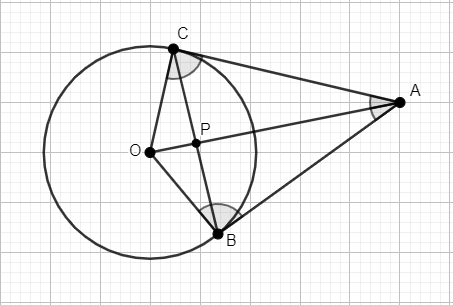
Consider \[\Delta AOB,\Delta AOC\]
OB = OC
Since the lengths of OB and OC are equal to the radius of the circle.
OA = OA since the common side of both triangles
\[\angle OCA=\angle OBA\]
Since the tangents AB, AC subtend the right angle on the circle.
We know that SSA (Side- Side- Angle) symmetry means that two triangles are congruent when two corresponding sides and one corresponding angle of the triangles are equal.
Thus, we get \[\Delta AOB,\Delta AOC\] are congruent triangles.
\[\Delta AOB\approx \Delta AOC\]
We know that in a congruent triangle, all corresponding sides and angles are equal. Thus, we get
AC = AB
\[\angle CAP=\angle BAP\]
Consider \[\Delta PAB,\Delta PAC\]
PA = PA since the common side
By SAS (Side- Angle- Side) symmetry, we get \[\Delta PAB,\Delta PAC\] are congruent triangles.
\[\Delta PAB\approx \Delta PAC\]
We know that in a congruent triangle, all corresponding angles are equal. Thus, we get
\[\angle PCA=\angle PBA\]
Thus, the tangents drawn at the end of a chord subtend congruent angles with the chord.
Hence, proved.
Note: The possibility of mistake can be, not applying the SAS (Side- Angle- Side) symmetry to the given triangles. The other possibility of mistake can be not applying the property of congruent triangle which states that all corresponding sides and angles of congruent triangle are equal. The alternative way of solving the question is by applying isosceles property to the triangle formed by the tangents drawn from an external point.
Complete step-by-step answer:
Let O be the centre of the circle. Let AB and AC be the tangents drawn to the circle and let BC be the chord of the circle.
Consider \[\Delta AOB,\Delta AOC\]
OB = OC
Since the lengths of OB and OC are equal to the radius of the circle.
OA = OA since the common side of both triangles
\[\angle OCA=\angle OBA\]
Since the tangents AB, AC subtend the right angle on the circle.
We know that SSA (Side- Side- Angle) symmetry means that two triangles are congruent when two corresponding sides and one corresponding angle of the triangles are equal.
Thus, we get \[\Delta AOB,\Delta AOC\] are congruent triangles.
\[\Delta AOB\approx \Delta AOC\]
We know that in a congruent triangle, all corresponding sides and angles are equal. Thus, we get
AC = AB
\[\angle CAP=\angle BAP\]
Consider \[\Delta PAB,\Delta PAC\]
PA = PA since the common side
By SAS (Side- Angle- Side) symmetry, we get \[\Delta PAB,\Delta PAC\] are congruent triangles.
\[\Delta PAB\approx \Delta PAC\]
We know that in a congruent triangle, all corresponding angles are equal. Thus, we get
\[\angle PCA=\angle PBA\]
Thus, the tangents drawn at the end of a chord subtend congruent angles with the chord.
Hence, proved.
Note: The possibility of mistake can be, not applying the SAS (Side- Angle- Side) symmetry to the given triangles. The other possibility of mistake can be not applying the property of congruent triangle which states that all corresponding sides and angles of congruent triangle are equal. The alternative way of solving the question is by applying isosceles property to the triangle formed by the tangents drawn from an external point.
Recently Updated Pages
Basicity of sulphurous acid and sulphuric acid are

Master Class 10 English: Engaging Questions & Answers for Success
Master Class 10 Social Science: Engaging Questions & Answers for Success
Master Class 10 Computer Science: Engaging Questions & Answers for Success
Class 10 Question and Answer - Your Ultimate Solutions Guide
Master Class 10 General Knowledge: Engaging Questions & Answers for Success
Trending doubts
Which country won the ICC Men's ODI World Cup in 2023?
In cricket, how many legal balls are there in a standard over?
Explain the Treaty of Vienna of 1815 class 10 social science CBSE
A boat goes 24 km upstream and 28 km downstream in class 10 maths CBSE
What does "powerplay" mean in limited-overs cricket?
What is the "Powerplay" in T20 cricket?