




Show that the points (−4, −4), (−2, −4), (4,0) and (2,3) are not the vertices points of a rectangle.
Answer
 Verified
641.1k+ views
HINT- Proceed the solution of this question with the assumption that this polygon will be a rectangle, so it has to fulfill all the conditions of the rectangle, if any single condition doesn’t get fulfilled, then we can say it will not be a rectangle.
Complete step-by-step answer:
Let, rectangle be ABCD, where A= (−4, −4), B= (−2, −4), C= (4,0) and D = (2,3)
In Rectangle, opposite sides are equal and diagonals are equal.
Let the coordinates of point M $\left( {{{\text{x}}_1},{{\text{y}}_1}} \right)$ and N $\left( {{{\text{x}}_2},{{\text{y}}_2}} \right)$
So Distance between two points M and N will be = \[\sqrt {{{\left( {{{\text{x}}_2} - {{\text{x}}_1}} \right)}^2} + {{\left( {{{\text{y}}_2} - {{\text{y}}_1}} \right)}^2}} \]………….(1)
A= (−4, −4), B= (−2, −4)
Here, \[{{\text{x}}_1} = - 4,{{\text{y}}_1} = - 4,{{\text{x}}_2} = - 2,{{\text{y}}_2} = - 4\]
So length of side AB= $\sqrt {{{\left( { - 2 - ( - 4)} \right)}^2} + {{\left( { - 4 - ( - 4)} \right)}^2}} {\text{ = }}\sqrt {4 + 0} {\text{ = 2 }}$
using formula (1)
B= (−2, −4), C= (4,0)
Here, \[{{\text{x}}_1} = - 2,{{\text{y}}_1} = - 4,{{\text{x}}_2} = 4,{{\text{y}}_2} = 0\]
So length of side BC= $\sqrt {{{\left( {4 - ( - 2)} \right)}^2} + {{\left( {0 - ( - 4)} \right)}^2}} {\text{ = }}\sqrt {36 + 16} {\text{ = }}\sqrt {{\text{52 }}} = 2\sqrt {13} $
using formula (1)
C= (4,0), D= (2,3)
Here, \[{{\text{x}}_1} = 4,{{\text{y}}_1} = 0,{{\text{x}}_2} = 2,{{\text{y}}_2} = 3\]
So length of side CD= $\sqrt {{{\left( {2 - (4)} \right)}^2} + {{\left( {3 - (0)} \right)}^2}} {\text{ = }}\sqrt {4 + 9} {\text{ = }}\sqrt {13} $
using formula (1)
D= (2,3), A= (−4, −4),
Here, \[{{\text{x}}_1} = 2,{{\text{y}}_1} = 3,{{\text{x}}_2} = - 4,{{\text{y}}_2} = - 4\]
So length of side DA= $\sqrt {{{\left( { - 4 - (2)} \right)}^2} + {{\left( { - 4 - (3)} \right)}^2}} {\text{ = }}\sqrt {36 + 49} {\text{ = }}\sqrt {85} $
Here, after calculating the length of all the sides,
Opposite sides are AB =2 cm and CD= $\sqrt {13} $ cm which are not equal and other
Opposite sides are BC =2$\sqrt {13} $ cm and DA= $\sqrt {85} $cm which are also not equal.
Hence the side's condition failed to prove its rectangle.
using formula (1)
A= (−4, −4), C= (4,0)
Here, \[{{\text{x}}_1} = - 4,{{\text{y}}_1} = - 4,{{\text{x}}_2} = 4,{{\text{y}}_2} = 0\]
So length of diagonal AC= $\sqrt {{{\left( {4 - ( - 4)} \right)}^2} + {{\left( {0 - ( - 4)} \right)}^2}} {\text{ = }}\sqrt {64 + 16} {\text{ = }}\sqrt {80} {\text{ = 4}}\sqrt 5 $
using formula (1)
B= (−2, −4), D= (2,3)
Here, \[{{\text{x}}_1} = - 2,{{\text{y}}_1} = - 4,{{\text{x}}_2} = 2,{{\text{y}}_2} = 3\]
So length of diagonal BD= $\sqrt {{{\left( {2 - ( - 2)} \right)}^2} + {{\left( {3 - ( - 4)} \right)}^2}} {\text{ = }}\sqrt {16 + 49} {\text{ = }}\sqrt {65} {\text{ }}$
Here, after calculating the length of both the diagonals AC=$4\sqrt 5 $ and BD = $\sqrt {65} $ which are not equal.
Hence even diagonal conditions failed to prove it rectangle.
Hence this polygon will not be a rectangle.
Note- There are also other properties which prove its rectangle, like adjacent sides of rectangles, makes an interior angle of 90 degrees and its diagonals bisect each other. Hence we can also verify these conditions to prove it rectangle.
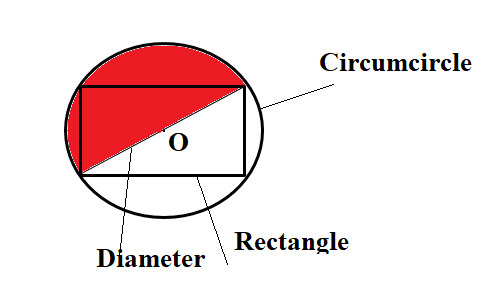
A diagonal of a rectangle is a diameter of its circumcircle so geometrically we can also prove it a rectangle.
Complete step-by-step answer:
Let, rectangle be ABCD, where A= (−4, −4), B= (−2, −4), C= (4,0) and D = (2,3)
In Rectangle, opposite sides are equal and diagonals are equal.
Let the coordinates of point M $\left( {{{\text{x}}_1},{{\text{y}}_1}} \right)$ and N $\left( {{{\text{x}}_2},{{\text{y}}_2}} \right)$
So Distance between two points M and N will be = \[\sqrt {{{\left( {{{\text{x}}_2} - {{\text{x}}_1}} \right)}^2} + {{\left( {{{\text{y}}_2} - {{\text{y}}_1}} \right)}^2}} \]………….(1)
A= (−4, −4), B= (−2, −4)
Here, \[{{\text{x}}_1} = - 4,{{\text{y}}_1} = - 4,{{\text{x}}_2} = - 2,{{\text{y}}_2} = - 4\]
So length of side AB= $\sqrt {{{\left( { - 2 - ( - 4)} \right)}^2} + {{\left( { - 4 - ( - 4)} \right)}^2}} {\text{ = }}\sqrt {4 + 0} {\text{ = 2 }}$
using formula (1)
B= (−2, −4), C= (4,0)
Here, \[{{\text{x}}_1} = - 2,{{\text{y}}_1} = - 4,{{\text{x}}_2} = 4,{{\text{y}}_2} = 0\]
So length of side BC= $\sqrt {{{\left( {4 - ( - 2)} \right)}^2} + {{\left( {0 - ( - 4)} \right)}^2}} {\text{ = }}\sqrt {36 + 16} {\text{ = }}\sqrt {{\text{52 }}} = 2\sqrt {13} $
using formula (1)
C= (4,0), D= (2,3)
Here, \[{{\text{x}}_1} = 4,{{\text{y}}_1} = 0,{{\text{x}}_2} = 2,{{\text{y}}_2} = 3\]
So length of side CD= $\sqrt {{{\left( {2 - (4)} \right)}^2} + {{\left( {3 - (0)} \right)}^2}} {\text{ = }}\sqrt {4 + 9} {\text{ = }}\sqrt {13} $
using formula (1)
D= (2,3), A= (−4, −4),
Here, \[{{\text{x}}_1} = 2,{{\text{y}}_1} = 3,{{\text{x}}_2} = - 4,{{\text{y}}_2} = - 4\]
So length of side DA= $\sqrt {{{\left( { - 4 - (2)} \right)}^2} + {{\left( { - 4 - (3)} \right)}^2}} {\text{ = }}\sqrt {36 + 49} {\text{ = }}\sqrt {85} $
Here, after calculating the length of all the sides,
Opposite sides are AB =2 cm and CD= $\sqrt {13} $ cm which are not equal and other
Opposite sides are BC =2$\sqrt {13} $ cm and DA= $\sqrt {85} $cm which are also not equal.
Hence the side's condition failed to prove its rectangle.
using formula (1)
A= (−4, −4), C= (4,0)
Here, \[{{\text{x}}_1} = - 4,{{\text{y}}_1} = - 4,{{\text{x}}_2} = 4,{{\text{y}}_2} = 0\]
So length of diagonal AC= $\sqrt {{{\left( {4 - ( - 4)} \right)}^2} + {{\left( {0 - ( - 4)} \right)}^2}} {\text{ = }}\sqrt {64 + 16} {\text{ = }}\sqrt {80} {\text{ = 4}}\sqrt 5 $
using formula (1)
B= (−2, −4), D= (2,3)
Here, \[{{\text{x}}_1} = - 2,{{\text{y}}_1} = - 4,{{\text{x}}_2} = 2,{{\text{y}}_2} = 3\]
So length of diagonal BD= $\sqrt {{{\left( {2 - ( - 2)} \right)}^2} + {{\left( {3 - ( - 4)} \right)}^2}} {\text{ = }}\sqrt {16 + 49} {\text{ = }}\sqrt {65} {\text{ }}$
Here, after calculating the length of both the diagonals AC=$4\sqrt 5 $ and BD = $\sqrt {65} $ which are not equal.
Hence even diagonal conditions failed to prove it rectangle.
Hence this polygon will not be a rectangle.
Note- There are also other properties which prove its rectangle, like adjacent sides of rectangles, makes an interior angle of 90 degrees and its diagonals bisect each other. Hence we can also verify these conditions to prove it rectangle.
A diagonal of a rectangle is a diameter of its circumcircle so geometrically we can also prove it a rectangle.
Recently Updated Pages
Master Class 12 Business Studies: Engaging Questions & Answers for Success

Master Class 12 Biology: Engaging Questions & Answers for Success
Master Class 12 Chemistry: Engaging Questions & Answers for Success
Class 12 Question and Answer - Your Ultimate Solutions Guide
Master Class 11 Social Science: Engaging Questions & Answers for Success
Master Class 11 English: Engaging Questions & Answers for Success
Trending doubts
Explain the Treaty of Vienna of 1815 class 10 social science CBSE
Which Indian city is known as the "City of Victory"?
Which instrument is used to measure the Blood Pressure?
Who Won 36 Oscar Awards? Record Holder Revealed
What is the median of the first 10 natural numbers class 10 maths CBSE
Why is it 530 pm in india when it is 1200 afternoon class 10 social science CBSE