




Show that (a, b, c), (b, c, a) and (c, a, b) are the vertices of an equilateral triangle.
Answer
 Verified
642.9k+ views
Hint: We have to use distance formula in this problem the distance between points $(x_1, y_1, z_1)$ and $(x_2, y_2, z_2)$ is given by-
$$\mathrm d=\sqrt{\left({\mathrm x}_2-{\mathrm x}_1\right)^2+\left({\mathrm y}_2-{\mathrm y}_1\right)^2+\left({\mathrm z}_2-{\mathrm z}_1\right)^2}$$
Complete step-by-step solution -
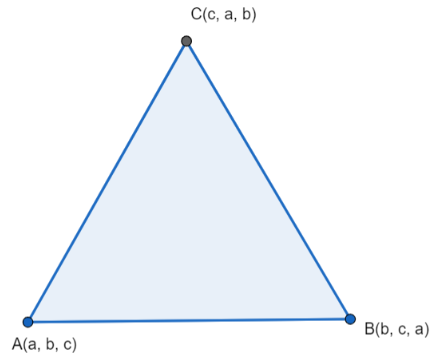
Let the points be A(a, b, c), B(b, c, a) and C(c, a, b). An equilateral triangle has all three sides equal. To prove that they form an equilateral triangle, we can prove that the distance between these three points is equal. We can do this by using the distance formula-
$$\mathrm{AB}=\sqrt{\left(\mathrm b-\mathrm a\right)^2+\left(\mathrm c-\mathrm b\right)^2+\left(\mathrm a-\mathrm c\right)^2}\\\mathrm{BC}=\sqrt{\left(\mathrm c-\mathrm b\right)^2+\left(\mathrm a-\mathrm c\right)^2+\left(\mathrm b-\mathrm a\right)^2}\\\mathrm{CA}=\sqrt{\left(\mathrm a-\mathrm c\right)^2+\left(\mathrm b-\mathrm a\right)^2+\left(\mathrm c-\mathrm b\right)^2}$$.
Here AB=BC=AC.
We can see that all the three terms in AB, BC and CA are the same. Hence, the final distance will be the same between all the three points. This shows that they form an equilateral triangle and lie at its vertices.
Hence, proved.
Note: Instead of proving their distances equal, we can also use a longer method to prove our statement. This can be done by proving that all the three lines formed by the points are at an equal angle from each other.
$$\mathrm d=\sqrt{\left({\mathrm x}_2-{\mathrm x}_1\right)^2+\left({\mathrm y}_2-{\mathrm y}_1\right)^2+\left({\mathrm z}_2-{\mathrm z}_1\right)^2}$$
Complete step-by-step solution -
Let the points be A(a, b, c), B(b, c, a) and C(c, a, b). An equilateral triangle has all three sides equal. To prove that they form an equilateral triangle, we can prove that the distance between these three points is equal. We can do this by using the distance formula-
$$\mathrm{AB}=\sqrt{\left(\mathrm b-\mathrm a\right)^2+\left(\mathrm c-\mathrm b\right)^2+\left(\mathrm a-\mathrm c\right)^2}\\\mathrm{BC}=\sqrt{\left(\mathrm c-\mathrm b\right)^2+\left(\mathrm a-\mathrm c\right)^2+\left(\mathrm b-\mathrm a\right)^2}\\\mathrm{CA}=\sqrt{\left(\mathrm a-\mathrm c\right)^2+\left(\mathrm b-\mathrm a\right)^2+\left(\mathrm c-\mathrm b\right)^2}$$.
Here AB=BC=AC.
We can see that all the three terms in AB, BC and CA are the same. Hence, the final distance will be the same between all the three points. This shows that they form an equilateral triangle and lie at its vertices.
Hence, proved.
Note: Instead of proving their distances equal, we can also use a longer method to prove our statement. This can be done by proving that all the three lines formed by the points are at an equal angle from each other.
Recently Updated Pages
Master Class 11 English: Engaging Questions & Answers for Success

Master Class 11 Social Science: Engaging Questions & Answers for Success
Master Class 11 Maths: Engaging Questions & Answers for Success
Master Class 11 Chemistry: Engaging Questions & Answers for Success
Master Class 11 Biology: Engaging Questions & Answers for Success
Master Class 11 Physics: Engaging Questions & Answers for Success
Trending doubts
Explain the Treaty of Vienna of 1815 class 10 social science CBSE
Why is it 530 pm in india when it is 1200 afternoon class 10 social science CBSE
What is the full form of CNG A Complete Natural Gas class 10 social science CBSE
In cricket, what is a "Yorker" designed to do?
What is the full form of POSCO class 10 social science CBSE
Define Potential, Developed, Stock and Reserved resources