




Show graphically that each of the following system of equations has infinitely many solutions :
$\begin{align}
& x-2y=5 \\
& 3x-6y=15 \\
\end{align}$
Answer
 Verified
577.5k+ views
Hint: First draw the graph of the two given equations. To draw that straight line graph, we need at least two points. So, choose one of the equations and substitute x = 0, determine y, then substitute y = 0, determine x. Now, apply the same process for the second equation. Plot the graph using the points obtained. Now, if the graph of these equations is coincident to each other then the system of equations has infinitely many solutions. In case they are parallel but not coincident, then they will have no solution. If the lines in the graph intersect at a particular point, they have a unique solution.
Complete step-by-step solution:
Let us assume the two equations as :
$\begin{align}
& x-2y=5\ldots \ldots \ldots \left( i \right) \\
& 3x-6y=15\ldots \ldots \ldots \left( ii \right) \\
\end{align}$
Considering equation (i),
$x-2y=5$
Substituting x = 0, we get,
$\begin{align}
& -2y=5 \\
& \Rightarrow y=\dfrac{-5}{2} \\
\end{align}$
Substituting y = 0, we get,
$\Rightarrow x=5$
Therefore, the two points are : $A\left( 5,0 \right)$ and $B\left( 0,\dfrac{-5}{2} \right)$ .
Now, considering the equation (ii),
$3x-6y=15$
Substituting x = 0, we get,
$\begin{align}
& -6y=15 \\
& \Rightarrow y=\dfrac{-15}{6} \\
& \Rightarrow y=\dfrac{-5}{2} \\
\end{align}$
Substituting y = 0, we get,
$\begin{align}
& 3x=15 \\
& \Rightarrow x=\dfrac{15}{3} \\
& \Rightarrow x=5 \\
\end{align}$
Therefore, the points are : $C\left( 5,0 \right)$ and $D\left( 0,\dfrac{-5}{2} \right)$.
So, the graph of the two equations can be plotted as :
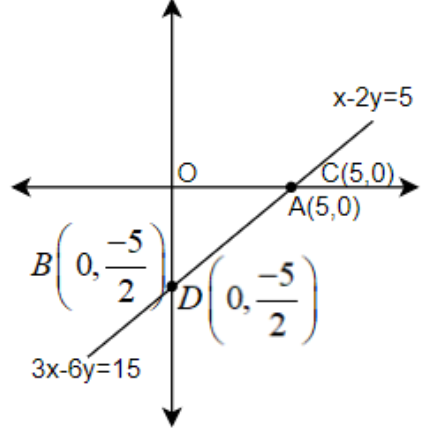
Clearly, we can see that the two lines are coincident with each other. Hence, they intersect at each and every point and therefore the system of equations has infinitely many solutions.
Note: There is another method to check the consistency or inconsistency of a system of equations without the use of graphs. To apply this method, write the two equations in the form : ${{a}_{1}}x+{{b}_{1}}y+{{c}_{1}}=0$ and ${{a}_{2}}x+{{b}_{2}}y+{{c}_{2}}=0$ respectively. Now, consider the ratios : $\dfrac{{{a}_{1}}}{{{a}_{2}}},\dfrac{{{b}_{1}}}{{{b}_{2}}}$ and $\dfrac{{{c}_{1}}}{{{c}_{2}}}$. From here three cases can arise:
Case (i) : If $\dfrac{{{a}_{1}}}{{{a}_{2}}}\ne \dfrac{{{b}_{1}}}{{{b}_{2}}}$, then the system has a unique solution.
Case (ii) : If $\dfrac{{{a}_{1}}}{{{a}_{2}}}=\dfrac{{{b}_{1}}}{{{b}_{2}}}\ne \dfrac{{{c}_{1}}}{{{c}_{2}}}$, then the system has no solution.
Case (iii) : If $\dfrac{{{a}_{1}}}{{{a}_{2}}}=\dfrac{{{b}_{1}}}{{{b}_{2}}}=\dfrac{{{c}_{1}}}{{{c}_{2}}}$, then the system has infinitely many solutions.
As we can see that the above question has a situation of case (iii), therefore, the system of equations has infinitely many solutions.
Complete step-by-step solution:
Let us assume the two equations as :
$\begin{align}
& x-2y=5\ldots \ldots \ldots \left( i \right) \\
& 3x-6y=15\ldots \ldots \ldots \left( ii \right) \\
\end{align}$
Considering equation (i),
$x-2y=5$
Substituting x = 0, we get,
$\begin{align}
& -2y=5 \\
& \Rightarrow y=\dfrac{-5}{2} \\
\end{align}$
Substituting y = 0, we get,
$\Rightarrow x=5$
Therefore, the two points are : $A\left( 5,0 \right)$ and $B\left( 0,\dfrac{-5}{2} \right)$ .
Now, considering the equation (ii),
$3x-6y=15$
Substituting x = 0, we get,
$\begin{align}
& -6y=15 \\
& \Rightarrow y=\dfrac{-15}{6} \\
& \Rightarrow y=\dfrac{-5}{2} \\
\end{align}$
Substituting y = 0, we get,
$\begin{align}
& 3x=15 \\
& \Rightarrow x=\dfrac{15}{3} \\
& \Rightarrow x=5 \\
\end{align}$
Therefore, the points are : $C\left( 5,0 \right)$ and $D\left( 0,\dfrac{-5}{2} \right)$.
So, the graph of the two equations can be plotted as :
Clearly, we can see that the two lines are coincident with each other. Hence, they intersect at each and every point and therefore the system of equations has infinitely many solutions.
Note: There is another method to check the consistency or inconsistency of a system of equations without the use of graphs. To apply this method, write the two equations in the form : ${{a}_{1}}x+{{b}_{1}}y+{{c}_{1}}=0$ and ${{a}_{2}}x+{{b}_{2}}y+{{c}_{2}}=0$ respectively. Now, consider the ratios : $\dfrac{{{a}_{1}}}{{{a}_{2}}},\dfrac{{{b}_{1}}}{{{b}_{2}}}$ and $\dfrac{{{c}_{1}}}{{{c}_{2}}}$. From here three cases can arise:
Case (i) : If $\dfrac{{{a}_{1}}}{{{a}_{2}}}\ne \dfrac{{{b}_{1}}}{{{b}_{2}}}$, then the system has a unique solution.
Case (ii) : If $\dfrac{{{a}_{1}}}{{{a}_{2}}}=\dfrac{{{b}_{1}}}{{{b}_{2}}}\ne \dfrac{{{c}_{1}}}{{{c}_{2}}}$, then the system has no solution.
Case (iii) : If $\dfrac{{{a}_{1}}}{{{a}_{2}}}=\dfrac{{{b}_{1}}}{{{b}_{2}}}=\dfrac{{{c}_{1}}}{{{c}_{2}}}$, then the system has infinitely many solutions.
As we can see that the above question has a situation of case (iii), therefore, the system of equations has infinitely many solutions.
Recently Updated Pages
Master Class 10 Computer Science: Engaging Questions & Answers for Success

Master Class 10 General Knowledge: Engaging Questions & Answers for Success
Master Class 10 English: Engaging Questions & Answers for Success
Master Class 10 Social Science: Engaging Questions & Answers for Success
Master Class 10 Maths: Engaging Questions & Answers for Success
Master Class 10 Science: Engaging Questions & Answers for Success
Trending doubts
What is the median of the first 10 natural numbers class 10 maths CBSE
Which women's tennis player has 24 Grand Slam singles titles?
Who is the Brand Ambassador of Incredible India?
Why is there a time difference of about 5 hours between class 10 social science CBSE
Write a letter to the principal requesting him to grant class 10 english CBSE
State and prove converse of BPT Basic Proportionality class 10 maths CBSE