




Shell is internal in
A. Loligo
B. Chiton
C. Dentalium
D. Unio
Answer
 Verified
513k+ views
Hint: A shell is a hard, protective outer layer usually created by an animal that lives in the sea. It is typically composed of calcium carbonate or chitin. Most shells found on beaches are the shells of marine mollusks, partly because these shells are usually made of calcium carbonate, and endure better than shells made of chitin.
Complete Answer:
The structure of Unio comprises a bivalve shell and a false mantle lining the shell. The body of Dentalium is bilaterally symmetrical and enclosed in a tubular shell open at both ends. The body of chiton is elliptical and convex on the dorsal and flat on the ventral surface. Shell is present on the dorsal side and is made up of 8 transverse and overlapping calcareous plates arranged in linear-zones. The shell of Loligo is internal, feather-like and membranous.
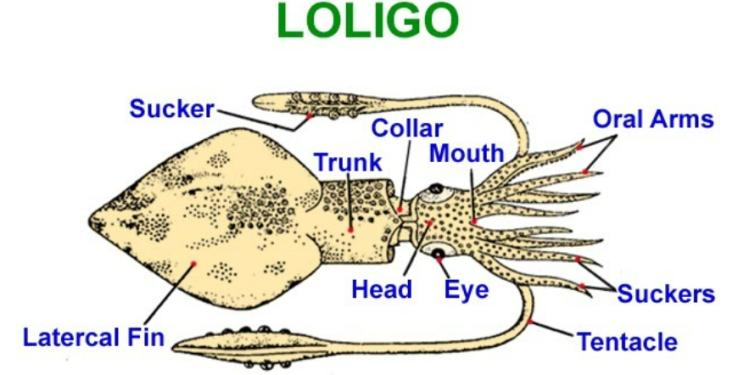
The body of Loligo is long, slender, pigmented and tapering. A fin is present along its postero-lateral edges and its shell is internal. The body is divisible into the head, collar (neck) and trunk. Head bears a pair of large bulging eyes, four pairs of thick and small arms and a pair of long, slender, clubbed tentacles. Each arm is convex on the outer side and flattened on the inner side. They also bear four rows of cup-like suckers which are also present on the clubbed end of tentacles. The tentacles, arms and a funnel are modifications of the foot. The animal is capable of changing colour and is used as food and bait.
So, the correct answer is ‘Loligo’.
Note:
A seashell is usually the exoskeleton of an invertebrate (an animal without a backbone). It can be found in the seas around Europe extending through the Red sea towards the East African coast. It is widespread in the Atlantic Ocean.
Complete Answer:
The structure of Unio comprises a bivalve shell and a false mantle lining the shell. The body of Dentalium is bilaterally symmetrical and enclosed in a tubular shell open at both ends. The body of chiton is elliptical and convex on the dorsal and flat on the ventral surface. Shell is present on the dorsal side and is made up of 8 transverse and overlapping calcareous plates arranged in linear-zones. The shell of Loligo is internal, feather-like and membranous.
The body of Loligo is long, slender, pigmented and tapering. A fin is present along its postero-lateral edges and its shell is internal. The body is divisible into the head, collar (neck) and trunk. Head bears a pair of large bulging eyes, four pairs of thick and small arms and a pair of long, slender, clubbed tentacles. Each arm is convex on the outer side and flattened on the inner side. They also bear four rows of cup-like suckers which are also present on the clubbed end of tentacles. The tentacles, arms and a funnel are modifications of the foot. The animal is capable of changing colour and is used as food and bait.
So, the correct answer is ‘Loligo’.
Note:
A seashell is usually the exoskeleton of an invertebrate (an animal without a backbone). It can be found in the seas around Europe extending through the Red sea towards the East African coast. It is widespread in the Atlantic Ocean.
Recently Updated Pages
Master Class 11 Business Studies: Engaging Questions & Answers for Success

Master Class 11 Computer Science: Engaging Questions & Answers for Success
Master Class 11 Economics: Engaging Questions & Answers for Success
Master Class 11 Social Science: Engaging Questions & Answers for Success
Master Class 11 English: Engaging Questions & Answers for Success
Master Class 11 Chemistry: Engaging Questions & Answers for Success
Trending doubts
Draw a diagram of nephron and explain its structur class 11 biology CBSE
Explain zero factorial class 11 maths CBSE
Chemical formula of Bleaching powder is A Ca2OCl2 B class 11 chemistry CBSE
Name the part of the brain responsible for the precision class 11 biology CBSE
The growth of tendril in pea plants is due to AEffect class 11 biology CBSE
One Metric ton is equal to kg A 10000 B 1000 C 100 class 11 physics CBSE