




What is the shape of the graph \[{{r}^{2}}=-\cos \theta \]?
Answer
 Verified
540.3k+ views
Hint: For solving this question you should know about the graph of \[-\cos \theta \] and the range of this graph. And in this question if we find the range of \[-\cos \theta \] then it will be \[\dfrac{\pi }{2}\] to \[\dfrac{3\pi }{2}\]. And if we plot the graph for this then it becomes a loop and the reason for the loop is because the values of \[-\cos \theta \] will always vary within the range of -1 to 1. And thus we get a looped shape for this.
Complete step by step answer:
According to our question we have to find the shape of the graph of \[{{r}^{2}}=-\cos \theta \].
If we want to make a graph for \[{{r}^{2}}=-\cos \theta \], then first we will find the range of \[-\cos \theta \].
If we see the graph of \[\cos \theta \], then:

So, the range of cosine function is -1 to 1.
If we see to \[-\cos \theta \] then the range of \[-\cos \theta \] is \[-1\le -\cos \theta \le 1\] and the domain is \[\left( -\infty ,\infty \right),\left\{ \theta |\theta \in R \right\}\].
So, the graph of \[-\cos \theta \] is:

As per question \[{{r}^{2}}=-\cos \theta \], so the shape will be symmetrical about the initial line and \[{{r}^{2}}=-\cos \theta \ge 0,\theta \in \left( \dfrac{\pi }{2},\dfrac{3\pi }{2} \right)\], where \[\cos \theta \le 0\].
So, here if we see the value of \[-\cos \theta \] at different angles then:
At \[\dfrac{\pi }{2}:-\cos \theta =0;\left( 0,\dfrac{\pi }{2} \right)\]
At \[\dfrac{2\pi }{3}:-\cos \theta =\dfrac{1}{\sqrt{2}}:\left( \dfrac{1}{\sqrt{2}},\dfrac{2\pi }{3} \right)\]
At \[\dfrac{3\pi }{4}:-\cos \theta =\dfrac{1}{\sqrt{\sqrt{2}}};\left( \dfrac{1}{\sqrt{\sqrt{2}}},\dfrac{3\pi }{4} \right)\]
At \[\dfrac{5\pi }{6}:-\cos \theta =\sqrt{\dfrac{\sqrt{3}}{2}};\left( \sqrt{\dfrac{\sqrt{3}}{2}},\dfrac{5\pi }{6} \right)\]
At \[\pi :-\cos \theta =1;\left( 1,\pi \right)\]
Symmetry about the axis \[\theta =\pi \] will be used to draw the other half of the loop.
We considered only \[r=\sqrt{-\cos \theta }\ge \theta \] for making the loop we did not consider the non – positive \[r=\sqrt{-\cos \theta }\le \theta \], for the opposite loop, for the same \[\theta \in \left( \dfrac{\pi }{2},\dfrac{3\pi }{2} \right)\].
So, here the r is a single values function of \[\theta \].
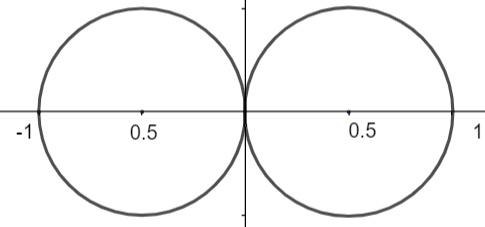
So, the shape of \[{{r}^{2}}=\left( -\cos \theta \right)\] is a looped shape.
Note: While solving this question you should be careful about the domain and the range of the given function because only these both will decide the graph of a function. And it will provide the shape. And the graph for every function is different from each other, so always draw a fresh new graph.
Complete step by step answer:
According to our question we have to find the shape of the graph of \[{{r}^{2}}=-\cos \theta \].
If we want to make a graph for \[{{r}^{2}}=-\cos \theta \], then first we will find the range of \[-\cos \theta \].
If we see the graph of \[\cos \theta \], then:
So, the range of cosine function is -1 to 1.
If we see to \[-\cos \theta \] then the range of \[-\cos \theta \] is \[-1\le -\cos \theta \le 1\] and the domain is \[\left( -\infty ,\infty \right),\left\{ \theta |\theta \in R \right\}\].
So, the graph of \[-\cos \theta \] is:
As per question \[{{r}^{2}}=-\cos \theta \], so the shape will be symmetrical about the initial line and \[{{r}^{2}}=-\cos \theta \ge 0,\theta \in \left( \dfrac{\pi }{2},\dfrac{3\pi }{2} \right)\], where \[\cos \theta \le 0\].
So, here if we see the value of \[-\cos \theta \] at different angles then:
At \[\dfrac{\pi }{2}:-\cos \theta =0;\left( 0,\dfrac{\pi }{2} \right)\]
At \[\dfrac{2\pi }{3}:-\cos \theta =\dfrac{1}{\sqrt{2}}:\left( \dfrac{1}{\sqrt{2}},\dfrac{2\pi }{3} \right)\]
At \[\dfrac{3\pi }{4}:-\cos \theta =\dfrac{1}{\sqrt{\sqrt{2}}};\left( \dfrac{1}{\sqrt{\sqrt{2}}},\dfrac{3\pi }{4} \right)\]
At \[\dfrac{5\pi }{6}:-\cos \theta =\sqrt{\dfrac{\sqrt{3}}{2}};\left( \sqrt{\dfrac{\sqrt{3}}{2}},\dfrac{5\pi }{6} \right)\]
At \[\pi :-\cos \theta =1;\left( 1,\pi \right)\]
Symmetry about the axis \[\theta =\pi \] will be used to draw the other half of the loop.
We considered only \[r=\sqrt{-\cos \theta }\ge \theta \] for making the loop we did not consider the non – positive \[r=\sqrt{-\cos \theta }\le \theta \], for the opposite loop, for the same \[\theta \in \left( \dfrac{\pi }{2},\dfrac{3\pi }{2} \right)\].
So, here the r is a single values function of \[\theta \].
So, the shape of \[{{r}^{2}}=\left( -\cos \theta \right)\] is a looped shape.
Note: While solving this question you should be careful about the domain and the range of the given function because only these both will decide the graph of a function. And it will provide the shape. And the graph for every function is different from each other, so always draw a fresh new graph.
Recently Updated Pages
Master Class 11 Social Science: Engaging Questions & Answers for Success

Master Class 11 Physics: Engaging Questions & Answers for Success
Master Class 11 Maths: Engaging Questions & Answers for Success
Master Class 11 Economics: Engaging Questions & Answers for Success
Master Class 11 Computer Science: Engaging Questions & Answers for Success
Master Class 11 Chemistry: Engaging Questions & Answers for Success
Trending doubts
One Metric ton is equal to kg A 10000 B 1000 C 100 class 11 physics CBSE
How many bones are in the spine class 11 biology CBSE
What is charge mass and charge to mass ratio of an class 11 chemistry CBSE
State and prove Bernoullis theorem class 11 physics CBSE
Difference Between Prokaryotic Cells and Eukaryotic Cells
1 Quintal is equal to a 110 kg b 10 kg c 100kg d 1000 class 11 physics CBSE