




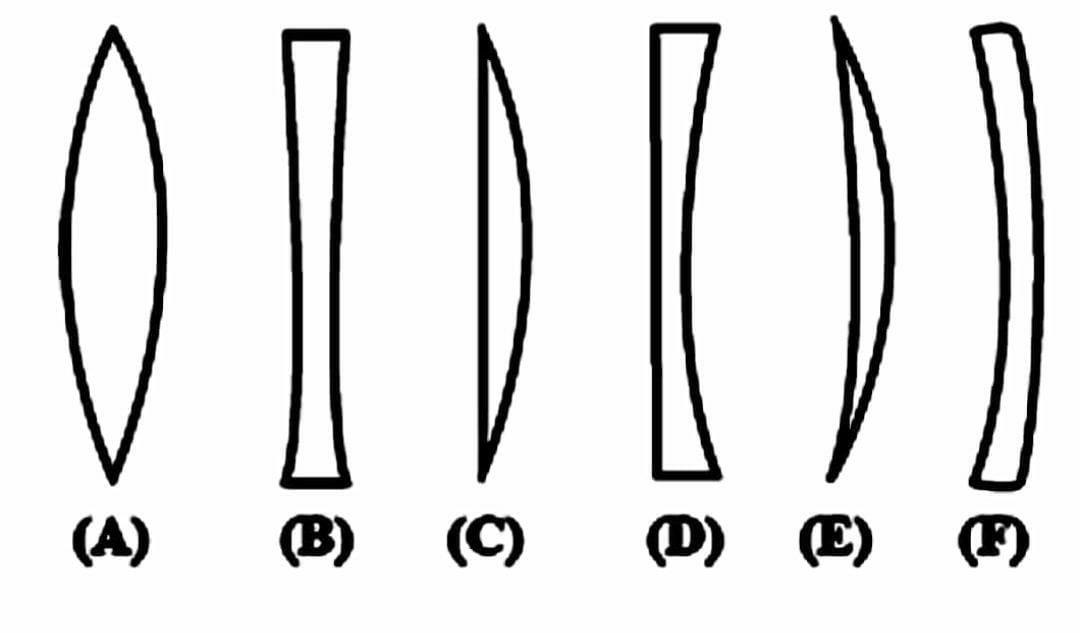
What is the shape of lens C as shown in figure?
Answer
 Verified
521.7k+ views
Hint : Plano-convex lenses have one spherical surface and one flat surface and have a positive focal length. These lenses are intended for non-critical applications that require infinite conjugate (parallel light) imaging or basic imaging. These optic lenses are perfect for focusing elements that need to be used in a variety of situations.
Complete step-by-step solution:
Lens C has a flat side and a convex side, with thicker glass in the middle and thinner glass at the ends. As a result, it's known as a plano-convex lens. Lens C has a plano-convex shape.
For focusing parallel rays of light to a single point, plano-convex lenses are the ideal option. They are capable of focusing, collecting, and collimating light. In circumstances where the object and image are at uneven distances from the lens, the asymmetry of these lenses reduces spherical aberration.
A plano-convex lense's two surfaces work together to focus parallel light rays to a positive focal point. The curved surface of a plano-convex lens has a focusing or de-focusing impact on light rays, but the plane surface does not.
\[f = \dfrac{R}{2}\] is the formula for a plano-convex lens.is the formula for a plano-convex lens.
Note: For focusing parallel rays of light to a single point, plano-convex lenses are the ideal option. They are capable of focusing, collecting, and collimating light. In circumstances where the object and image are at uneven distances from the lens, the asymmetry of these lenses reduces spherical aberration.
Complete step-by-step solution:
Lens C has a flat side and a convex side, with thicker glass in the middle and thinner glass at the ends. As a result, it's known as a plano-convex lens. Lens C has a plano-convex shape.
For focusing parallel rays of light to a single point, plano-convex lenses are the ideal option. They are capable of focusing, collecting, and collimating light. In circumstances where the object and image are at uneven distances from the lens, the asymmetry of these lenses reduces spherical aberration.
A plano-convex lense's two surfaces work together to focus parallel light rays to a positive focal point. The curved surface of a plano-convex lens has a focusing or de-focusing impact on light rays, but the plane surface does not.
\[f = \dfrac{R}{2}\] is the formula for a plano-convex lens.is the formula for a plano-convex lens.
Note: For focusing parallel rays of light to a single point, plano-convex lenses are the ideal option. They are capable of focusing, collecting, and collimating light. In circumstances where the object and image are at uneven distances from the lens, the asymmetry of these lenses reduces spherical aberration.
Recently Updated Pages
Basicity of sulphurous acid and sulphuric acid are

Master Class 12 English: Engaging Questions & Answers for Success
Master Class 12 Social Science: Engaging Questions & Answers for Success
Master Class 12 Maths: Engaging Questions & Answers for Success
Master Class 12 Economics: Engaging Questions & Answers for Success
Master Class 12 Physics: Engaging Questions & Answers for Success
Trending doubts
Which are the Top 10 Largest Countries of the World?
Draw a labelled sketch of the human eye class 12 physics CBSE
Draw ray diagrams each showing i myopic eye and ii class 12 physics CBSE
Give 10 examples of unisexual and bisexual flowers
Give simple chemical tests to distinguish between the class 12 chemistry CBSE
Define Vant Hoff factor How is it related to the degree class 12 chemistry CBSE