




What is the shape of $\text{ Cl}{{\text{F}}_{\text{3 }}}$ molecule?
(A) Trigonal planar
(B) Trigonal pyramidal
(C) T-shaped
(D) Tetrahedral
Answer
 Verified
597.3k+ views
Hint: The valence shell electron pair repulsion (VSEPR) theory is used to determine the shape of molecules. According to VSEPR theory the lone pair-lone pair has the maximum repulsion followed by the bond pair-lone pair and bond pair –bond pair. In $\text{ Cl}{{\text{F}}_{\text{3}}}\text{ }$ two lone pairs are placed in axial plane which minimises the repulsion and stabilises the molecule.
Complete Solution :
In$\text{ Cl}{{\text{F}}_{\text{3 }}}$, the chlorine is a central atom. The electronic configuration of chlorine atom is as below:
$\text{ Cl = 1}{{\text{s}}^{\text{2}}}\text{ 2}{{\text{s}}^{\text{2}}}\text{ 2}{{\text{p}}^{\text{6 }}}\text{3}{{\text{s}}^{\text{2}}}\text{ 3}{{\text{p}}^{\text{5}}}\text{ }$
Chlorine atom has seven valence electrons. In $\text{ Cl}{{\text{F}}_{\text{3 }}}$ molecule, the central chlorine atom is surrounded by three fluorine atoms. Each fluorine atom shares a one electron with chlorine atom and results in three covalent $\text{ Cl}-\text{F }$ bonds.
The $\text{ Cl}{{\text{F}}_{\text{3 }}}$ molecule has 7 valence electrons from chlorine and three from Fluorine. Thus there are a total 10 electrons around the central chlorine atom.
Now let’s determine the electron pair in $\text{ Cl}{{\text{F}}_{\text{3 }}}$ molecule. Divide total number of electrons by 2.
$\text{ Electron pair = }\dfrac{10}{2}=\text{ 5 }{{\text{e}}^{-\text{ }}}$
There are a total of 5 electron pairs in $\text{ Cl}{{\text{F}}_{\text{3 }}}$ molecule. Let’s calculate the number of lone pairs in the $\text{ Cl}{{\text{F}}_{\text{3 }}}$molecule. The lone pair of electrons can be determined by subtraction of the number of bond pairs from the electron pair. As follows:
$\text{ Lone pair = Electron pair} - \text{Lone pair = 5} - \text{3 = 2 }$
Now we know that $\text{ Cl}{{\text{F}}_{\text{3 }}}$ molecule has three bonding pairs and two lone pairs. Now according to VSEPR theory the lone pair –lone pair experience the maximum repulsion which can be reduced by placing two lone pairs in the axial plane. The shape of $\text{ Cl}{{\text{F}}_{\text{3 }}}$ molecule is as shown below:
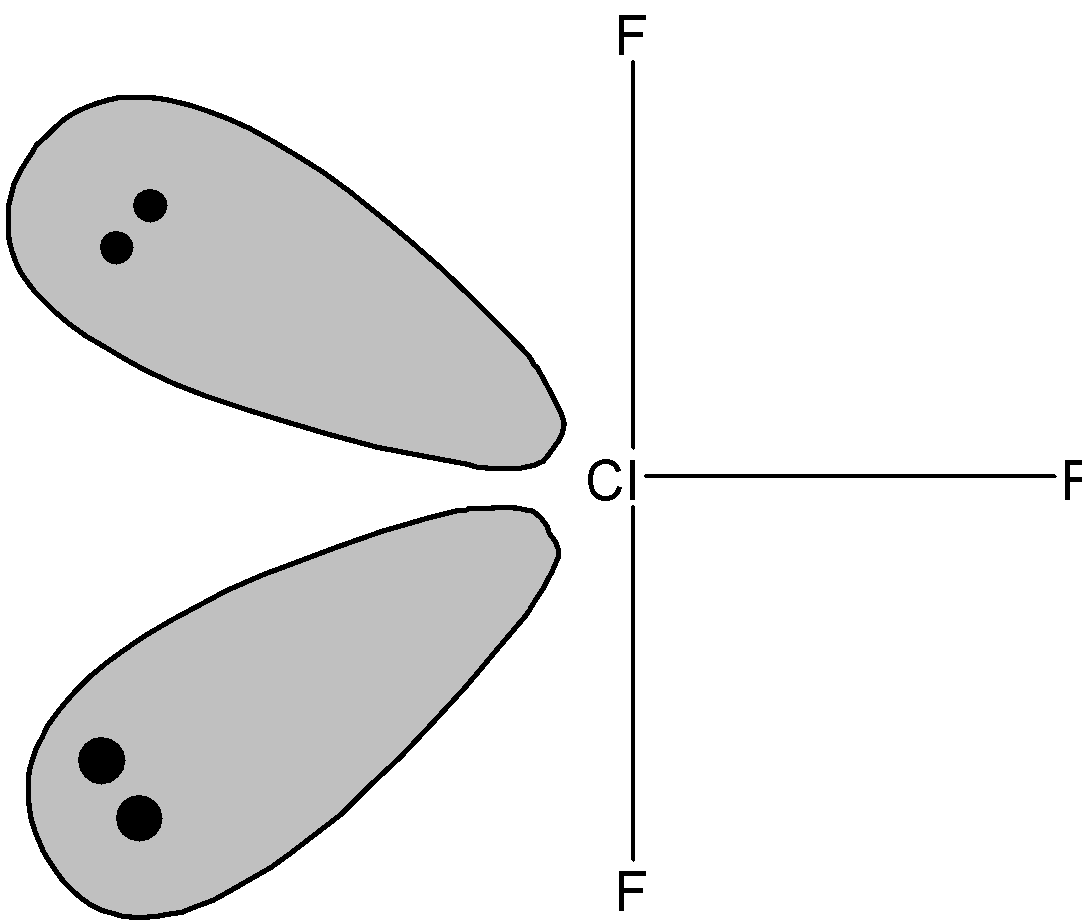
Therefore, $\text{ Cl}{{\text{F}}_{\text{3 }}}$ molecule shows T-shaped geometry.
So, the correct answer is “Option C”.
Note: From local observation, we can say that $\text{ Cl}{{\text{F}}_{\text{3 }}}$ is a trigonal planar molecule. But, one should always consider the lone pair on the central atom. The number of lone pairs can be determined by a formula.
$\begin{align}
& \text{ No}\text{.of LP = BP + }\dfrac{1}{2}\left[ \text{Group attached}-\text{Valency }\pm \text{ Charge} \right] \\
& \Rightarrow \text{No}\text{.of LP }=\text{ 3 + }\dfrac{1}{2}\left[ 5-\text{7} \right] \\
& \therefore \text{No}\text{.of LP in Cl}{{\text{F}}_{\text{3}}}=\text{ 3 }-1\text{ = 2 L}\text{.P}\text{.} \\
\end{align}$
Complete Solution :
In$\text{ Cl}{{\text{F}}_{\text{3 }}}$, the chlorine is a central atom. The electronic configuration of chlorine atom is as below:
$\text{ Cl = 1}{{\text{s}}^{\text{2}}}\text{ 2}{{\text{s}}^{\text{2}}}\text{ 2}{{\text{p}}^{\text{6 }}}\text{3}{{\text{s}}^{\text{2}}}\text{ 3}{{\text{p}}^{\text{5}}}\text{ }$
Chlorine atom has seven valence electrons. In $\text{ Cl}{{\text{F}}_{\text{3 }}}$ molecule, the central chlorine atom is surrounded by three fluorine atoms. Each fluorine atom shares a one electron with chlorine atom and results in three covalent $\text{ Cl}-\text{F }$ bonds.
The $\text{ Cl}{{\text{F}}_{\text{3 }}}$ molecule has 7 valence electrons from chlorine and three from Fluorine. Thus there are a total 10 electrons around the central chlorine atom.
Now let’s determine the electron pair in $\text{ Cl}{{\text{F}}_{\text{3 }}}$ molecule. Divide total number of electrons by 2.
$\text{ Electron pair = }\dfrac{10}{2}=\text{ 5 }{{\text{e}}^{-\text{ }}}$
There are a total of 5 electron pairs in $\text{ Cl}{{\text{F}}_{\text{3 }}}$ molecule. Let’s calculate the number of lone pairs in the $\text{ Cl}{{\text{F}}_{\text{3 }}}$molecule. The lone pair of electrons can be determined by subtraction of the number of bond pairs from the electron pair. As follows:
$\text{ Lone pair = Electron pair} - \text{Lone pair = 5} - \text{3 = 2 }$
Now we know that $\text{ Cl}{{\text{F}}_{\text{3 }}}$ molecule has three bonding pairs and two lone pairs. Now according to VSEPR theory the lone pair –lone pair experience the maximum repulsion which can be reduced by placing two lone pairs in the axial plane. The shape of $\text{ Cl}{{\text{F}}_{\text{3 }}}$ molecule is as shown below:
Therefore, $\text{ Cl}{{\text{F}}_{\text{3 }}}$ molecule shows T-shaped geometry.
So, the correct answer is “Option C”.
Note: From local observation, we can say that $\text{ Cl}{{\text{F}}_{\text{3 }}}$ is a trigonal planar molecule. But, one should always consider the lone pair on the central atom. The number of lone pairs can be determined by a formula.
$\begin{align}
& \text{ No}\text{.of LP = BP + }\dfrac{1}{2}\left[ \text{Group attached}-\text{Valency }\pm \text{ Charge} \right] \\
& \Rightarrow \text{No}\text{.of LP }=\text{ 3 + }\dfrac{1}{2}\left[ 5-\text{7} \right] \\
& \therefore \text{No}\text{.of LP in Cl}{{\text{F}}_{\text{3}}}=\text{ 3 }-1\text{ = 2 L}\text{.P}\text{.} \\
\end{align}$
Recently Updated Pages
Master Class 12 Economics: Engaging Questions & Answers for Success

Master Class 12 English: Engaging Questions & Answers for Success
Master Class 12 Social Science: Engaging Questions & Answers for Success
Master Class 12 Maths: Engaging Questions & Answers for Success
Master Class 12 Physics: Engaging Questions & Answers for Success
Master Class 9 General Knowledge: Engaging Questions & Answers for Success
Trending doubts
One Metric ton is equal to kg A 10000 B 1000 C 100 class 11 physics CBSE
Difference Between Prokaryotic Cells and Eukaryotic Cells
Two of the body parts which do not appear in MRI are class 11 biology CBSE
Find the value of the expression given below sin 30circ class 11 maths CBSE
1 ton equals to A 100 kg B 1000 kg C 10 kg D 10000 class 11 physics CBSE
Draw a diagram of nephron and explain its structur class 11 biology CBSE