




Shanti sweets stall was placing an order for making cardboard boxes for packing their sweets. Two sizes of boxes were required. The bigger of dimensions $25cm\times 20cm\times 5cm$ and the smaller of dimensions $15cm\times 12cm\times 5cm$. For all the overlaps, 5% of the total surface area is required extra. If the cost of the cardboard is Rs.4 for $1000c{{m}^{2}}$. Find the cost of cardboard for supplying 250 boxes of each kind.
Answer
 Verified
611.1k+ views
Hint: For solving this question, we will first find the total surface area of the bigger box using the formula of the total surface of the cuboid. Then we will take 5% of the surface area and add it to the surface area. Then we will multiply the surface area by 250 to get the area required of 250 bigger boxes. Similarly, we will proceed for the smaller box and find the area required for 250 smaller boxes. Then will find the total cardboard sheet for making all the boxes (adding areas of 250 bigger boxes with an area of 250 smaller boxes). At last, we will find the cost of cardboard sheets using a unitary method. Total surface area of the cuboid having length l, breadth b, height h is equal to $2\left( lb+bh+hl \right)$.
Complete step by step answer:
Let us find the total surface area of 1 bigger box.
We are given that the length of the bigger box is 25cm, the breadth of the bigger box is 20cm and height of the bigger box is 5cm. So, l = 25cm, b = 20cm and h = 5cm.
We know that, box is in the shape of a cuboid and the total surface area of the cuboid having length l, breadth b, height h is given by $2\left( lb+bh+hl \right)$.
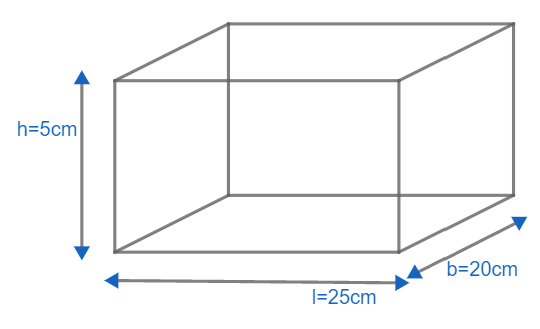
So the total surface area of bigger box becomes,
\[\begin{align}
& 2\left( lb+bh+hl \right) \\
& \Rightarrow 2\left( 25\times 20+25\times 5+20\times 5 \right)c{{m}^{2}} \\
& \Rightarrow 2\left( 500+125+100 \right)c{{m}^{2}} \\
& \Rightarrow 2\left( 725 \right)c{{m}^{2}} \\
& \Rightarrow 1450c{{m}^{2}} \\
\end{align}\]
Now we need 5% area extra for overlaps.
Therefore, an extra area required = 5% of the surface area of the bigger box.
\[\begin{align}
& \Rightarrow 5\%\text{ of }1450 \\
& \Rightarrow \dfrac{5}{100}\times 1450 \\
& \Rightarrow 72.5c{{m}^{2}} \\
\end{align}\]
Hence total area required for one bigger box = total surface area + extra area required.
Therefore, the total area for one bigger box $\Rightarrow \left( 1450+72.5 \right)c{{m}^{2}}=1522.5c{{m}^{2}}$.
Hence the area required for one bigger box is $1522.5c{{m}^{2}}$.
But we want area for 250 boxes, so multiplying the area for one box by 250 we get,
Total area required by 250 boxes $\Rightarrow \text{Area of 1 box}\times 250=\left( 1522.5\times 250 \right)c{{m}^{2}}=380625c{{m}^{2}}$.
So the total area required for 250 bigger boxes is $380625c{{m}^{2}}$.
Now let us find the surface area of the smaller box.
Length of the smaller box is given as 15cm, breadth of the smaller box is given as 12cm and the height of the smaller box is given as 5cm. So, l = 15cm, b = 12cm and h = 5cm.
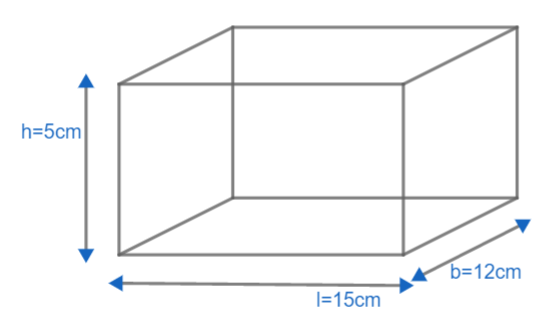
Total surface area of a smaller box = $2\left( lb+bh+hl \right)$.
Putting values of l, b, h we get,
Total surface area of a smaller box,
\[\begin{align}
& 2\left( lb+bh+hl \right) \\
& \Rightarrow 2\left( 15\times 12+15\times 5+12\times 5 \right)c{{m}^{2}} \\
& \Rightarrow 2\left( 180+75+60 \right)c{{m}^{2}} \\
& \Rightarrow 2\left( 315 \right)c{{m}^{2}} \\
& \Rightarrow 630c{{m}^{2}} \\
\end{align}\]
Now we need 5% area extra for overlaps.
Therefore extra area required = 5% of the surface area of the smaller box.
\[\begin{align}
& \Rightarrow 5\%\text{ of }630 \\
& \Rightarrow \dfrac{5}{100}\times 630 \\
& \Rightarrow 31.5c{{m}^{2}} \\
\end{align}\]
Hence total area required for one smaller box = total surface area of one smaller box + extra area required.
$\Rightarrow \left( 630+31.5 \right)c{{m}^{2}}=661.5c{{m}^{2}}$.
Hence the area required for one smaller box is $661.5c{{m}^{2}}$.
But we want area for 250 boxes, so multiplying the area for one box by 250 we get,
Total area required for 250 smaller boxes $\Rightarrow \text{Area of 1 box}\times 250=\left( 250\times 661.5 \right)c{{m}^{2}}=165375c{{m}^{2}}$.
So the total area required for 250 smaller boxes is $165375c{{m}^{2}}$.
Now we need to find the total cardboard sheet required. So,
Total cardboard sheet required = area of 250 bigger boxes + area of 250 smaller boxes.
$\Rightarrow \left( 380625+165375 \right)c{{m}^{2}}=546000c{{m}^{2}}$.
Now we need to find the cost of $546000c{{m}^{2}}$ cardboard sheet.
We are given that the cost of $1000c{{m}^{2}}$ cardboard sheet is Rs.4. So, the cost of $1c{{m}^{2}}$ cardboard sheet becomes $Rs.\dfrac{4}{1000}$.
And therefore, the cost of $546000c{{m}^{2}}$ cardboard sheet become $Rs.\dfrac{4}{1000}\times 546000\Rightarrow Rs.4\times 546=Rs.2184$.
Hence, the cost of cardboard sheet required for 250 such boxes of each kind will be Rs.2184.
Note: Students should not forget to write units after calculating each measurement. Take care while adding or multiplying large numbers. Make sure to calculate surface area and area of cardboard for bigger boxes and smaller boxes separately. Make sure that units are the same for given measurement before calculating the area.
Complete step by step answer:
Let us find the total surface area of 1 bigger box.
We are given that the length of the bigger box is 25cm, the breadth of the bigger box is 20cm and height of the bigger box is 5cm. So, l = 25cm, b = 20cm and h = 5cm.
We know that, box is in the shape of a cuboid and the total surface area of the cuboid having length l, breadth b, height h is given by $2\left( lb+bh+hl \right)$.
So the total surface area of bigger box becomes,
\[\begin{align}
& 2\left( lb+bh+hl \right) \\
& \Rightarrow 2\left( 25\times 20+25\times 5+20\times 5 \right)c{{m}^{2}} \\
& \Rightarrow 2\left( 500+125+100 \right)c{{m}^{2}} \\
& \Rightarrow 2\left( 725 \right)c{{m}^{2}} \\
& \Rightarrow 1450c{{m}^{2}} \\
\end{align}\]
Now we need 5% area extra for overlaps.
Therefore, an extra area required = 5% of the surface area of the bigger box.
\[\begin{align}
& \Rightarrow 5\%\text{ of }1450 \\
& \Rightarrow \dfrac{5}{100}\times 1450 \\
& \Rightarrow 72.5c{{m}^{2}} \\
\end{align}\]
Hence total area required for one bigger box = total surface area + extra area required.
Therefore, the total area for one bigger box $\Rightarrow \left( 1450+72.5 \right)c{{m}^{2}}=1522.5c{{m}^{2}}$.
Hence the area required for one bigger box is $1522.5c{{m}^{2}}$.
But we want area for 250 boxes, so multiplying the area for one box by 250 we get,
Total area required by 250 boxes $\Rightarrow \text{Area of 1 box}\times 250=\left( 1522.5\times 250 \right)c{{m}^{2}}=380625c{{m}^{2}}$.
So the total area required for 250 bigger boxes is $380625c{{m}^{2}}$.
Now let us find the surface area of the smaller box.
Length of the smaller box is given as 15cm, breadth of the smaller box is given as 12cm and the height of the smaller box is given as 5cm. So, l = 15cm, b = 12cm and h = 5cm.
Total surface area of a smaller box = $2\left( lb+bh+hl \right)$.
Putting values of l, b, h we get,
Total surface area of a smaller box,
\[\begin{align}
& 2\left( lb+bh+hl \right) \\
& \Rightarrow 2\left( 15\times 12+15\times 5+12\times 5 \right)c{{m}^{2}} \\
& \Rightarrow 2\left( 180+75+60 \right)c{{m}^{2}} \\
& \Rightarrow 2\left( 315 \right)c{{m}^{2}} \\
& \Rightarrow 630c{{m}^{2}} \\
\end{align}\]
Now we need 5% area extra for overlaps.
Therefore extra area required = 5% of the surface area of the smaller box.
\[\begin{align}
& \Rightarrow 5\%\text{ of }630 \\
& \Rightarrow \dfrac{5}{100}\times 630 \\
& \Rightarrow 31.5c{{m}^{2}} \\
\end{align}\]
Hence total area required for one smaller box = total surface area of one smaller box + extra area required.
$\Rightarrow \left( 630+31.5 \right)c{{m}^{2}}=661.5c{{m}^{2}}$.
Hence the area required for one smaller box is $661.5c{{m}^{2}}$.
But we want area for 250 boxes, so multiplying the area for one box by 250 we get,
Total area required for 250 smaller boxes $\Rightarrow \text{Area of 1 box}\times 250=\left( 250\times 661.5 \right)c{{m}^{2}}=165375c{{m}^{2}}$.
So the total area required for 250 smaller boxes is $165375c{{m}^{2}}$.
Now we need to find the total cardboard sheet required. So,
Total cardboard sheet required = area of 250 bigger boxes + area of 250 smaller boxes.
$\Rightarrow \left( 380625+165375 \right)c{{m}^{2}}=546000c{{m}^{2}}$.
Now we need to find the cost of $546000c{{m}^{2}}$ cardboard sheet.
We are given that the cost of $1000c{{m}^{2}}$ cardboard sheet is Rs.4. So, the cost of $1c{{m}^{2}}$ cardboard sheet becomes $Rs.\dfrac{4}{1000}$.
And therefore, the cost of $546000c{{m}^{2}}$ cardboard sheet become $Rs.\dfrac{4}{1000}\times 546000\Rightarrow Rs.4\times 546=Rs.2184$.
Hence, the cost of cardboard sheet required for 250 such boxes of each kind will be Rs.2184.
Note: Students should not forget to write units after calculating each measurement. Take care while adding or multiplying large numbers. Make sure to calculate surface area and area of cardboard for bigger boxes and smaller boxes separately. Make sure that units are the same for given measurement before calculating the area.
Recently Updated Pages
Master Class 11 English: Engaging Questions & Answers for Success

Master Class 11 Social Science: Engaging Questions & Answers for Success
Master Class 11 Maths: Engaging Questions & Answers for Success
Master Class 11 Biology: Engaging Questions & Answers for Success
Master Class 11 Physics: Engaging Questions & Answers for Success
Master Class 11 Chemistry: Engaging Questions & Answers for Success
Trending doubts
Explain the Treaty of Vienna of 1815 class 10 social science CBSE
What is the Total Duration of Football Match?
The shortest day of the year in India
In which year voting age was reduced from 21 to 18?
10 examples of evaporation in daily life with explanations
What planets have no moons Which one has only one moon class 10 physics CBSE