



Shade the region formed by the graph of 2x – y = 4, x + y = 2 and the y-axis. Write the coordinates of the vertices of the figure obtained.
Answer
 Verified
609.9k+ views
Hint: To solve this question, we will first draw the graph of $2x – y = 4$ and similarly separate draw the graph of $x + y = 2$ and then join these two with the y-axis. We will form a figure and then try to determine the coordinates of the points obtained.
Complete step-by-step solution:
Let us first consider, $2x – y = 4$, and draw its graph.
When $x = 0$, we get,
\[2\times 0-y=4\]
\[\Rightarrow y=-4\]
Therefore, $x = 0, y = – 4.$
And when we put $y = 0,$ we get,
\[2x=4\]
\[\Rightarrow x=\dfrac{4}{2}=2\]
Therefore, $x = 2, y = 0.$
So, we have, $(0, – 4)$ and $(2, 0)$ as the coordinates. So, we will draw the line $2x – y = 4$ using the coordinates $(0, – 4)$ and $(2, 0)$.
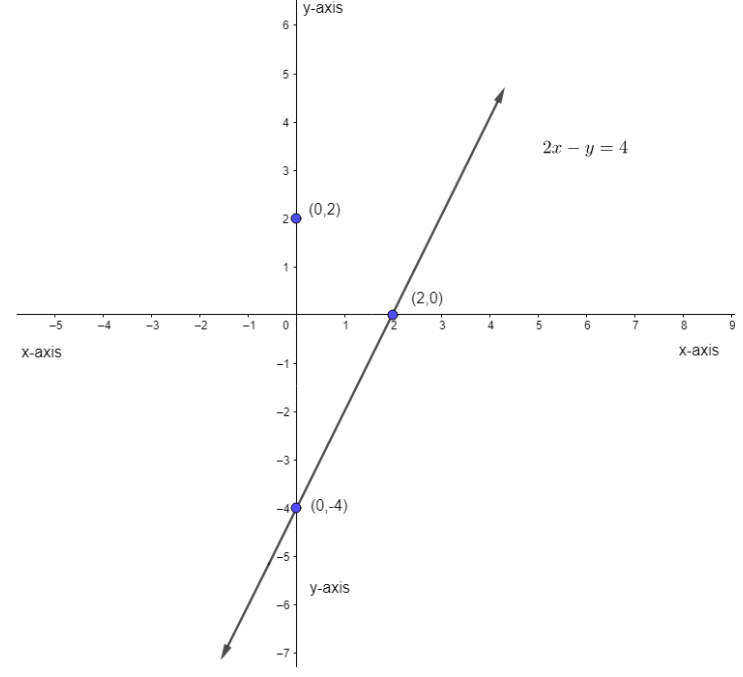
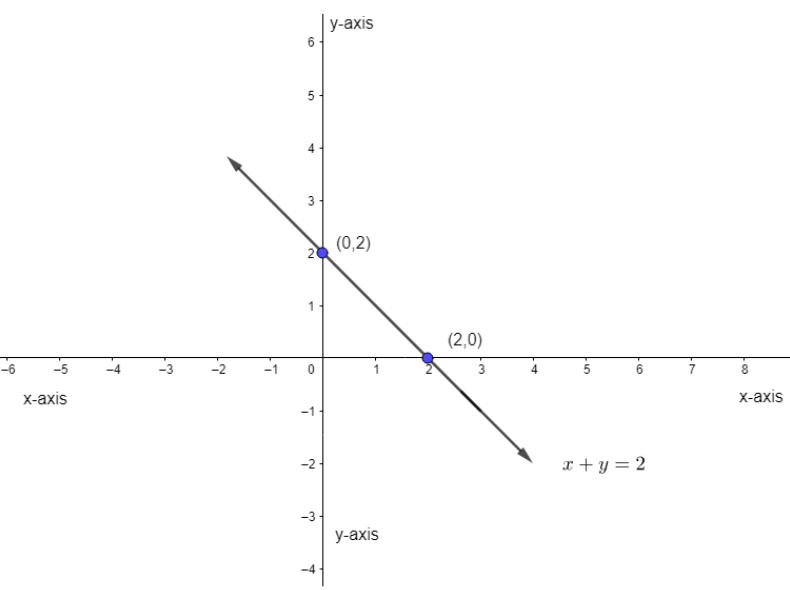
Similarly, we will draw the line $x + y = 2$. When $x = 0, y = 2.$ Therefore, the coordinates we get is (0, 2) is a point on the line $x + y = 2$. And when $y = 0, x = 2$, so $(2, 0)$ is also a point on the line $x + y = 2. $
Let us draw the line $x + y = 2$ using the coordinates $(0, 2)$ and $(2, 0).$ We have,
Now, let us mix the graphs of $2x – y = 4$ and $x + y = 2$ and the y-axis, all together to form a triangle. Doing so, we will get,
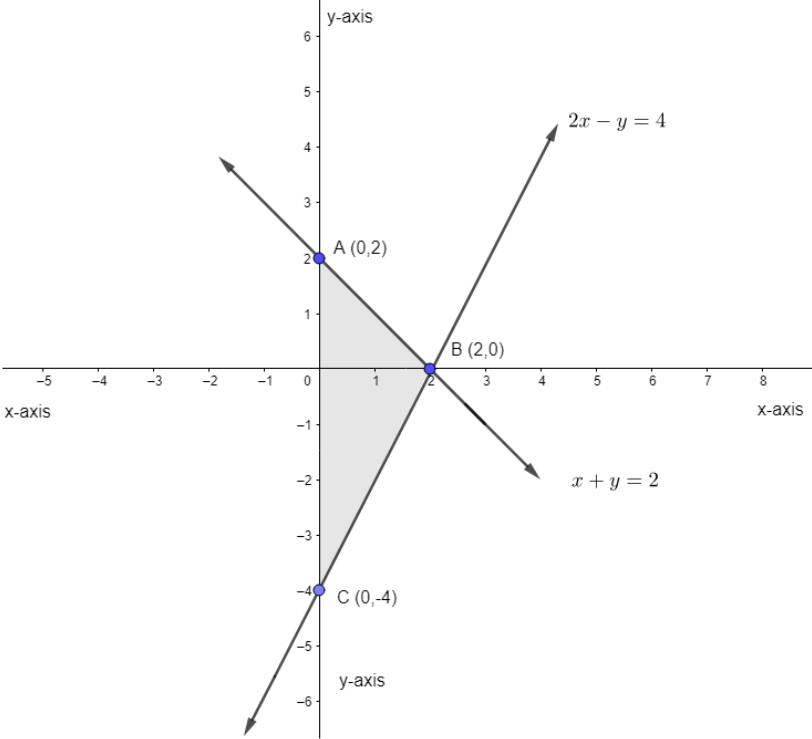
The shaded region is the required figure obtained. Let the vertices be A, B, and C of the triangle formed. Then as observed by the figure, $A = (0, 2), B = (2, 0),$ and $C = (0, – 4)$ and thus the vertices of the figure are obtained.
Note: If in this question, we were given to take the x-axis apart from the y-axis, then we will need one more information that is exactly which part of the x-axis. The part having a positive y-axis or the part having a negative y-axis. So, always remember to check which axis is given.
Complete step-by-step solution:
Let us first consider, $2x – y = 4$, and draw its graph.
When $x = 0$, we get,
\[2\times 0-y=4\]
\[\Rightarrow y=-4\]
Therefore, $x = 0, y = – 4.$
And when we put $y = 0,$ we get,
\[2x=4\]
\[\Rightarrow x=\dfrac{4}{2}=2\]
Therefore, $x = 2, y = 0.$
So, we have, $(0, – 4)$ and $(2, 0)$ as the coordinates. So, we will draw the line $2x – y = 4$ using the coordinates $(0, – 4)$ and $(2, 0)$.
Similarly, we will draw the line $x + y = 2$. When $x = 0, y = 2.$ Therefore, the coordinates we get is (0, 2) is a point on the line $x + y = 2$. And when $y = 0, x = 2$, so $(2, 0)$ is also a point on the line $x + y = 2. $
Let us draw the line $x + y = 2$ using the coordinates $(0, 2)$ and $(2, 0).$ We have,
Now, let us mix the graphs of $2x – y = 4$ and $x + y = 2$ and the y-axis, all together to form a triangle. Doing so, we will get,
The shaded region is the required figure obtained. Let the vertices be A, B, and C of the triangle formed. Then as observed by the figure, $A = (0, 2), B = (2, 0),$ and $C = (0, – 4)$ and thus the vertices of the figure are obtained.
Note: If in this question, we were given to take the x-axis apart from the y-axis, then we will need one more information that is exactly which part of the x-axis. The part having a positive y-axis or the part having a negative y-axis. So, always remember to check which axis is given.
Recently Updated Pages
Master Class 12 Economics: Engaging Questions & Answers for Success

Master Class 12 English: Engaging Questions & Answers for Success
Master Class 12 Social Science: Engaging Questions & Answers for Success
Master Class 12 Maths: Engaging Questions & Answers for Success
Master Class 12 Physics: Engaging Questions & Answers for Success
Master Class 9 General Knowledge: Engaging Questions & Answers for Success
Trending doubts
One Metric ton is equal to kg A 10000 B 1000 C 100 class 11 physics CBSE
Difference Between Prokaryotic Cells and Eukaryotic Cells
Two of the body parts which do not appear in MRI are class 11 biology CBSE
Find the value of the expression given below sin 30circ class 11 maths CBSE
1 ton equals to A 100 kg B 1000 kg C 10 kg D 10000 class 11 physics CBSE
Draw a diagram of nephron and explain its structur class 11 biology CBSE