




Septal nephridia of earthworm are
(a) Responsible for excretion
(b) Present in all body segments
(c) Responsible for keeping the surface moist
(d) Present in 4, 5, 6 segments
Answer
 Verified
629.1k+ views
Hint: Nephridium is a characteristic feature of an earthworm. On the basis of the position of nephritis in the body, it can be divided into-
-Septal Nephridia
-Pharyngeal Nephridia
-Integumentary Nephridia
Complete solution:
The Septal Nephridia of earthworm are ‘responsible for excretion’.
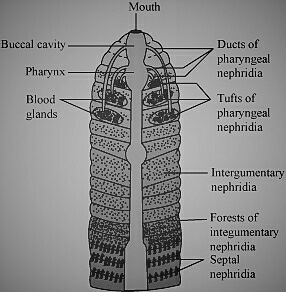
The septal nephridia are the largest nephridia present in an earthworm and are present on both sides of each intersegmental septum after the 15th segment. There are 40-50 septal nephridia present in each septum and they are arranged in two rows. As a result, each septum gets 80-100 septal nephridia. It consists of 3 main parts:
1. Nephridiostome: It is also called Nephrostome. It is funnel-shaped and externally ciliated, opening into the coelomic cavity. It consists of a mouth-like opening, which is surrounded by a larger upper lip and smaller lower lip. Due to the continuous movement of cilia all the nitrogenous substances of the coelomic fluid are absorbed in the nephridium.
2. Body: It represents the main part and remains coiled around its axis.
3. Terminal duct: It is the end part of the main body. All the terminal ducts of a segment further, open into the septal excretory duct. Septal excretory duct collects the excretory products from the body and transfers them to a pair of the supra-intestinal excretory duct.
Note:
1. The earthworm is ureotelic because its nitrogenous waste matter consists of 40% urea, 20% ammonia, 40% amino acid and other nitrogenous compounds.
2. Pharyngeal nephridia- They are found as pairs and lie one pair in each of the 4th, 5th, and 6th segments. They are similar to septal nephridia in structure but they lack nephrostomes.
3. Integumentary nephridia: They are attached to the inner side of the body wall from 7th to the last segment.
-Septal Nephridia
-Pharyngeal Nephridia
-Integumentary Nephridia
Complete solution:
The Septal Nephridia of earthworm are ‘responsible for excretion’.
The septal nephridia are the largest nephridia present in an earthworm and are present on both sides of each intersegmental septum after the 15th segment. There are 40-50 septal nephridia present in each septum and they are arranged in two rows. As a result, each septum gets 80-100 septal nephridia. It consists of 3 main parts:
1. Nephridiostome: It is also called Nephrostome. It is funnel-shaped and externally ciliated, opening into the coelomic cavity. It consists of a mouth-like opening, which is surrounded by a larger upper lip and smaller lower lip. Due to the continuous movement of cilia all the nitrogenous substances of the coelomic fluid are absorbed in the nephridium.
2. Body: It represents the main part and remains coiled around its axis.
3. Terminal duct: It is the end part of the main body. All the terminal ducts of a segment further, open into the septal excretory duct. Septal excretory duct collects the excretory products from the body and transfers them to a pair of the supra-intestinal excretory duct.
Note:
1. The earthworm is ureotelic because its nitrogenous waste matter consists of 40% urea, 20% ammonia, 40% amino acid and other nitrogenous compounds.
2. Pharyngeal nephridia- They are found as pairs and lie one pair in each of the 4th, 5th, and 6th segments. They are similar to septal nephridia in structure but they lack nephrostomes.
3. Integumentary nephridia: They are attached to the inner side of the body wall from 7th to the last segment.
Recently Updated Pages
Master Class 12 Economics: Engaging Questions & Answers for Success

Master Class 12 English: Engaging Questions & Answers for Success
Master Class 12 Social Science: Engaging Questions & Answers for Success
Master Class 12 Maths: Engaging Questions & Answers for Success
Master Class 12 Physics: Engaging Questions & Answers for Success
Master Class 11 Social Science: Engaging Questions & Answers for Success
Trending doubts
One Metric ton is equal to kg A 10000 B 1000 C 100 class 11 physics CBSE
Difference Between Prokaryotic Cells and Eukaryotic Cells
Two of the body parts which do not appear in MRI are class 11 biology CBSE
1 ton equals to A 100 kg B 1000 kg C 10 kg D 10000 class 11 physics CBSE
Draw a diagram of nephron and explain its structur class 11 biology CBSE
10 examples of friction in our daily life