




Select the group of plants that possess stilt roots.
(a) Zea mays, Rhizophora mangle
(b) Pandanus odoratissimus, Ficus benghalensis
(c) Rhizophora mangle, Hedera helix
(d) Ficus benghalensis, Pisum sativum
Answer
 Verified
621.3k+ views
Hint: Stilt roots are adventitious aerial roots that grow obliquely downward from the main stem's basal nodes and fix firmly to the soil. Such supporting roots are found in plants that grow near river banks, ponds, etc. Maize, Red Mangrove, and Sugarcane are examples of plants having stilt roots.
Complete answer:
Stilt roots help to support the body of the plant, just like tent ropes. They are also called as support roots. Also, mechanical support is intended. The scientific name is Zea mays for maize and Red mangrove is Rhizophora mangle.
The presence of stilt roots enables the stem to have greater stability and support which can grow faster. This is very interesting because the light is a very potent limiting factor in tropical forests. And the fact that the plant can reach higher altitudes, spending less energy on developing a thick trunk or stabilizing underground roots makes this species more competitive. But while providing stability, growing in slope has not been shown to result in an advantage.
It is also believed that roots allow new places to colonize (expand) containing much large organic waste, usually branches or dead trunks of other trees. This is because by moving over them the roots can evade them.
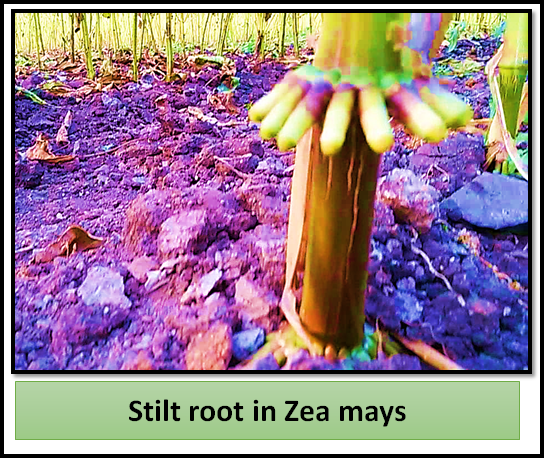
So, the correct answer is, ‘Zea mays, Rhizophora mangle’.
Note: Stilt roots originate from the lower bole and run to the ground obliquely, as in the case of mangroves and a few palms. The stilt roots have been found to increase the survival of the plants when tropical storms are violent, and also facilitate their aeration when floods occur.
Complete answer:
Stilt roots help to support the body of the plant, just like tent ropes. They are also called as support roots. Also, mechanical support is intended. The scientific name is Zea mays for maize and Red mangrove is Rhizophora mangle.
The presence of stilt roots enables the stem to have greater stability and support which can grow faster. This is very interesting because the light is a very potent limiting factor in tropical forests. And the fact that the plant can reach higher altitudes, spending less energy on developing a thick trunk or stabilizing underground roots makes this species more competitive. But while providing stability, growing in slope has not been shown to result in an advantage.
It is also believed that roots allow new places to colonize (expand) containing much large organic waste, usually branches or dead trunks of other trees. This is because by moving over them the roots can evade them.
So, the correct answer is, ‘Zea mays, Rhizophora mangle’.
Note: Stilt roots originate from the lower bole and run to the ground obliquely, as in the case of mangroves and a few palms. The stilt roots have been found to increase the survival of the plants when tropical storms are violent, and also facilitate their aeration when floods occur.
Recently Updated Pages
Master Class 12 Economics: Engaging Questions & Answers for Success

Master Class 12 English: Engaging Questions & Answers for Success
Master Class 12 Social Science: Engaging Questions & Answers for Success
Master Class 12 Maths: Engaging Questions & Answers for Success
Master Class 12 Physics: Engaging Questions & Answers for Success
Master Class 9 General Knowledge: Engaging Questions & Answers for Success
Trending doubts
One Metric ton is equal to kg A 10000 B 1000 C 100 class 11 physics CBSE
Difference Between Prokaryotic Cells and Eukaryotic Cells
Two of the body parts which do not appear in MRI are class 11 biology CBSE
1 ton equals to A 100 kg B 1000 kg C 10 kg D 10000 class 11 physics CBSE
10 examples of friction in our daily life
DNA is not present in A Nucleus B Mitochondria C Chloroplast class 11 biology CBSE