




Select the correct statement about the transpiration process in plants.
(a) It is a necessary evil for plants.
(b) Loss of water takes place through hydathodes in vapor form.
(c) It may also occur through lenticels.
(d) Both A and C.
Answer
 Verified
625.8k+ views
Hint: In most plants leaf surfaces are dotted with numerous pores called stomata on the undersides of the foliage. These are bordered by guard cells and their stomatal accessory cells that open and close the pore. So, a plant can’t avoid transpiration although sometimes it harms the plant itself. Again the loss of water through hydathodes is in the form of liquid and not vapor.
Complete step by step answer:
The process of water movement through a plant and its evaporation from aerial parts, such as leaves, stems, and flowers is called transpiration. We know that water is necessary for plants but only a small amount of water taken up by the roots is used for growth and metabolism and the remaining 97–99.5% is lost by transpiration and guttation.
A huge amount of water absorbed by plants is lost by transpiration and it leads to wilting and injury in plants as well as it has effects on photosynthesis. The plant can’t avoid transpiration despite various detrimental disadvantages because plants have a peculiar structure of leaves which is meant for gaseous exchange during respiration and photosynthesis. Therefore, the process of transpiration is called a “necessary evil” by Curtis or “unavoidable evil” by Steward.
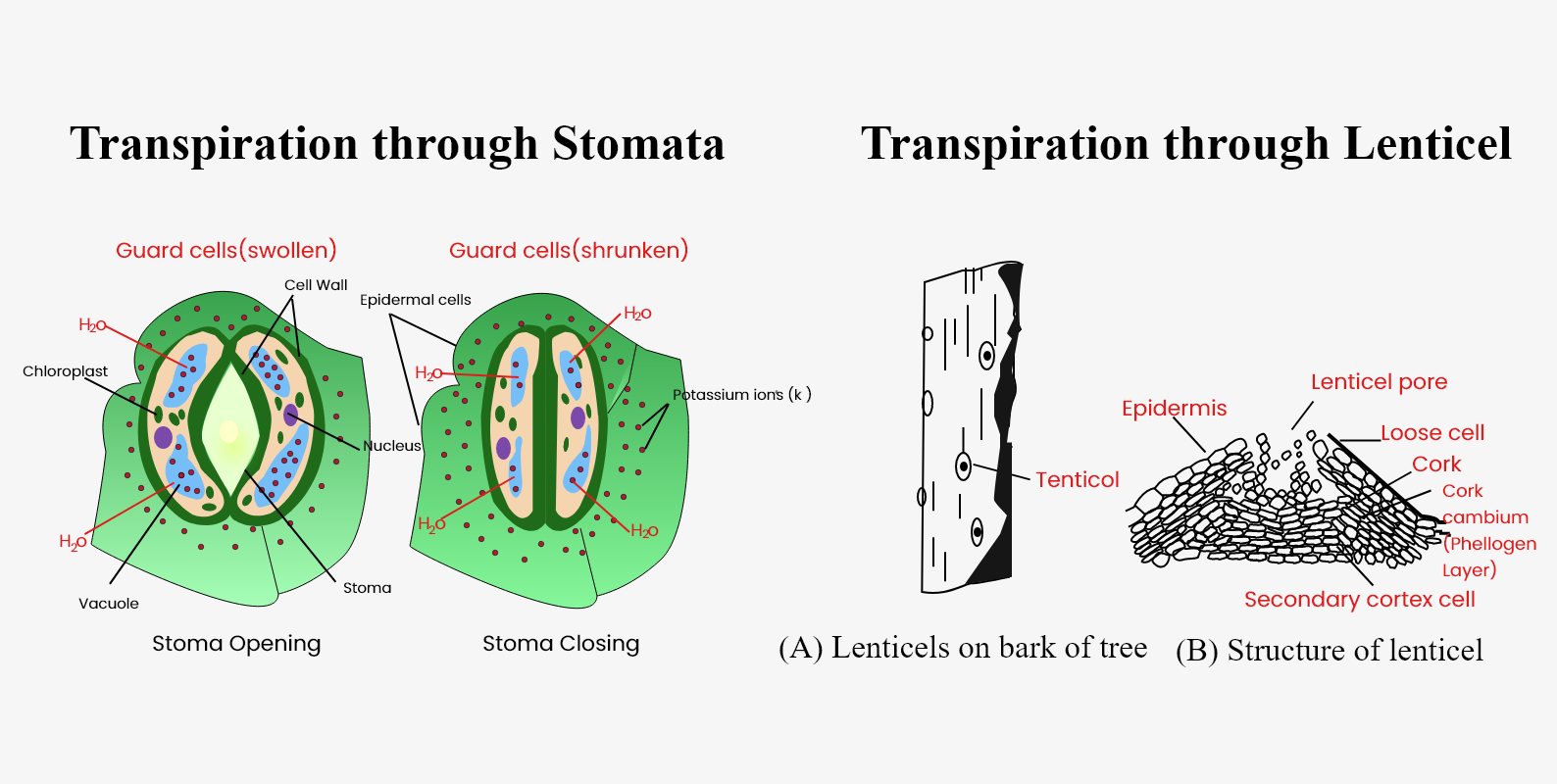
Lenticular transpiration is the loss of water from plants as vapor through the lenticels. Some tiny openings, the lenticels that protrude from the barks in woody stems and twigs as well as in other plant organs. In this process escape of water vapor via the lenticels is too low compared to stomatal transpiration. The lenticular transpiration is very significant in plants subjected to very dry conditions. Under a dry condition, the stomata tend to close thus severely limiting stomatal transpiration. But, this type of transpiration may become important with deciduous trees during winter in temperate countries.
So, the correct answer is, ‘Both A and C’.
Additional information:
1) A scientist named Curtis in 1926 called transpiration as a necessary evil because it provides some beneficial aspects. But on the other hand, many functions and energy get wasted from the absorption of water up to the stage of transpiration.
2) Some factors that affect the rates of transpiration include plant parameters, stomata, boundary layer, cuticles, environmental conditions, relative humidity, temperature, soil water, light, and wind.
3) By measuring the distance traveled by an air bubble in a capillary tube over a given time, the rate of transpiration can be calculated. As a result, it can be assumed as the faster the bubble moves, the greater the rate of water uptake – and so greater the rate of transpiration.
Note: Some advantages of the process of transpiration are that it creates a suction force and helps in the ascent of sap. It helps in evaporating the excess amount of water as well as affects the absorption of water and minerals by roots. Transpiration maintains a suitable temperature for the leaves and also renders a cooling effect to the plant body. On the other hand disadvantages like wilting and growth reduction have also been seen due to the transpiration.
Complete step by step answer:
The process of water movement through a plant and its evaporation from aerial parts, such as leaves, stems, and flowers is called transpiration. We know that water is necessary for plants but only a small amount of water taken up by the roots is used for growth and metabolism and the remaining 97–99.5% is lost by transpiration and guttation.
A huge amount of water absorbed by plants is lost by transpiration and it leads to wilting and injury in plants as well as it has effects on photosynthesis. The plant can’t avoid transpiration despite various detrimental disadvantages because plants have a peculiar structure of leaves which is meant for gaseous exchange during respiration and photosynthesis. Therefore, the process of transpiration is called a “necessary evil” by Curtis or “unavoidable evil” by Steward.
Lenticular transpiration is the loss of water from plants as vapor through the lenticels. Some tiny openings, the lenticels that protrude from the barks in woody stems and twigs as well as in other plant organs. In this process escape of water vapor via the lenticels is too low compared to stomatal transpiration. The lenticular transpiration is very significant in plants subjected to very dry conditions. Under a dry condition, the stomata tend to close thus severely limiting stomatal transpiration. But, this type of transpiration may become important with deciduous trees during winter in temperate countries.
So, the correct answer is, ‘Both A and C’.
Additional information:
1) A scientist named Curtis in 1926 called transpiration as a necessary evil because it provides some beneficial aspects. But on the other hand, many functions and energy get wasted from the absorption of water up to the stage of transpiration.
2) Some factors that affect the rates of transpiration include plant parameters, stomata, boundary layer, cuticles, environmental conditions, relative humidity, temperature, soil water, light, and wind.
3) By measuring the distance traveled by an air bubble in a capillary tube over a given time, the rate of transpiration can be calculated. As a result, it can be assumed as the faster the bubble moves, the greater the rate of water uptake – and so greater the rate of transpiration.
Note: Some advantages of the process of transpiration are that it creates a suction force and helps in the ascent of sap. It helps in evaporating the excess amount of water as well as affects the absorption of water and minerals by roots. Transpiration maintains a suitable temperature for the leaves and also renders a cooling effect to the plant body. On the other hand disadvantages like wilting and growth reduction have also been seen due to the transpiration.
Recently Updated Pages
The given figure shows two endocrine glands marked class 11 biology NEET_UG

Match columnI with columnII and select the correct class 11 biology NEET
Match column I with column II and select the correct class 11 biology NEET_UG
Which floral family has left 9 right + 1 arrangement class 11 biology NEET_UG
Which is not a variety of sheep A Lohi B Beetal C Nellore class 11 biology NEET_UG
Match column I with column II and select the correct class 11 biology NEET_UG
Trending doubts
One Metric ton is equal to kg A 10000 B 1000 C 100 class 11 physics CBSE
What is cell theory Who formulated it class 11 biology CBSE
Phyllotaxy is the arrangement of ALeaflets BLeaves class 11 biology CBSE
Difference Between Prokaryotic Cells and Eukaryotic Cells
The symbiotic association of fungi and algae is called class 11 biology CBSE
Cell theory was formulated by A Schleiden and Schwann class 11 biology CBSE