




Select the correct option:
If 2n = 4, then identify the figures A, B and C, as per the following codes and select the correct option.
Anaphase of meiosis I = (i)
Anaphase of mitosis = (ii)
Anaphase of meiosis II = (iii)
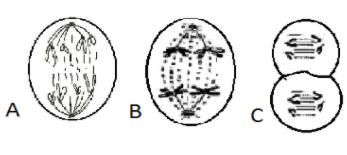
(A) A)-(ii), B)-(i), C)-(iii)
(B) A)-(iii), B)-(ii), C)-(i)
(C) A)-(i), B)-(ii), C)-(iii)
(D) A)-(iii), B)-(ii), C)-(i)
Answer
 Verified
612.9k+ views
Hint: Meiosis is also called as Reductional cell division as the number of chromosomes reduced to half of its parent after one cycle of meiotic cell division, whereas mitosis is called as Equational cell division as the number of chromosomes remains same as of their parents. Anaphase is the third stage of cell division in which the chromosomes migrate towards the opposite poles of the cell due to spindle proteins (Kinesin and Dynein).
Complete answer:
Figure A depicts movement of 4 chromatids to the either poles of the cell, which means there was 4 chromosomes which have split at its centromeric region resulting in the formation of 8 chromatids from which 4 chromatids travel to the either side of the cell, here the daughter cells remains diploid (2n) after cell division. This information reveals that the cell is at anaphase of mitosis i.e Code (ii). Figure B depicts movement of 2 chromosomes to either poles of a cell, indicating the cell is at anaphase, here the chromosomes split to half of its number indicating the cell is undergoing meiosis I as given in code (i). Detailed observation of figure C reveals the formation of membrane groove dividing a cell into two, each new cell have 2 chromatids migrating to its opposite ends which results in decreasing the ploidy of a cell informing the cell is at anaphase stage of meiosis II as given in code (iii).
Hence, the correct answer is Option ‘A’.
Note:Ploidy is the total number of sets of chromosomes which is present in the cell, in humans haploid is the condition where a cell contains one set of chromosomes say 46 in numbers, diploid is the condition where a cell contains two sets of chromosomes, haploid is seen in somatic cells which undergoes mitosis, diploid condition is seen in germ cells which undergoes meiosis.
Complete answer:
Figure A depicts movement of 4 chromatids to the either poles of the cell, which means there was 4 chromosomes which have split at its centromeric region resulting in the formation of 8 chromatids from which 4 chromatids travel to the either side of the cell, here the daughter cells remains diploid (2n) after cell division. This information reveals that the cell is at anaphase of mitosis i.e Code (ii). Figure B depicts movement of 2 chromosomes to either poles of a cell, indicating the cell is at anaphase, here the chromosomes split to half of its number indicating the cell is undergoing meiosis I as given in code (i). Detailed observation of figure C reveals the formation of membrane groove dividing a cell into two, each new cell have 2 chromatids migrating to its opposite ends which results in decreasing the ploidy of a cell informing the cell is at anaphase stage of meiosis II as given in code (iii).
Hence, the correct answer is Option ‘A’.
Note:Ploidy is the total number of sets of chromosomes which is present in the cell, in humans haploid is the condition where a cell contains one set of chromosomes say 46 in numbers, diploid is the condition where a cell contains two sets of chromosomes, haploid is seen in somatic cells which undergoes mitosis, diploid condition is seen in germ cells which undergoes meiosis.
Recently Updated Pages
Master Class 11 English: Engaging Questions & Answers for Success

Master Class 11 Social Science: Engaging Questions & Answers for Success
Master Class 11 Maths: Engaging Questions & Answers for Success
Master Class 11 Chemistry: Engaging Questions & Answers for Success
Master Class 11 Biology: Engaging Questions & Answers for Success
Master Class 11 Physics: Engaging Questions & Answers for Success
Trending doubts
One Metric ton is equal to kg A 10000 B 1000 C 100 class 11 physics CBSE
Difference Between Prokaryotic Cells and Eukaryotic Cells
Find the value of the expression given below sin 30circ class 11 maths CBSE
1 ton equals to A 100 kg B 1000 kg C 10 kg D 10000 class 11 physics CBSE
Two of the body parts which do not appear in MRI are class 11 biology CBSE
What are hard magnetic materials class 11 physics CBSE