




Segments of antigen that are recognized by antibody are
(A)Memory regions
(B)Epitopes
(c)Non-Determinants
(D)Self-limitation
Answer
 Verified
596.4k+ views
Hint: Segments of antigen that are recognized by antibodies are present on the top of the antigen surfaces and are opposite to paratope i,e the part of an antibody that binds to the segments of antigen is called a paratope.
Complete answer:
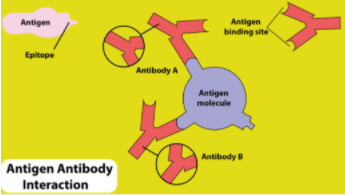
Segments of antigens that are recognized by antibodies are Epitopes. An epitope, which is also also known as an antigenic determinant, is the part of an antigen that is recognized by the immune system of our body cells, specifically by antibodies, B cells, or T cells.
Additional Information: Agglutination is the process in which antigens and antibodies of the blood combined. It is the basic reaction of the immune system in the body. By this process, our body is protected from the upcoming foreign molecules which enter our body, such as pathogens and their chemical toxins. In the blood, the antigens are present and with high affinity bound by antibodies to form an antigen-antibody complex. The immune complex is then taken to cellular systems where it can be destroyed or deactivated. Non-covalent bonds between antibody and the antigen can also be moderated by water molecules between two faces. These indirect bonds are usually seen as participating in the phenomenon of cross-reactivity, i.e. in recognition of various but similar antigens by a single antibody. Antigen and antibody interact through a high-affinity binding similar to the lock and key mechanism. The capability and the strength of the binding of an antibody to an antigen are termed its avidity for that antigen. Since antibodies are usually bivalent or polyvalent, this is the total sum of the powers of individual antibody-antigen interactions. The affinity of that interaction is actually the stability of individual interaction between a single binding site of an antibody to that of its target epitope.
So, the correct answer is ‘Epitopes ’.
Note:
- Each antigen causes the formation of a specific antibody. Antigen and antibody have
complementary reactive sites that fit together like lock-key. Antibodies attach with antigens through poor chemical interactions, and bonding is non-covalent.
Complete answer:
Segments of antigens that are recognized by antibodies are Epitopes. An epitope, which is also also known as an antigenic determinant, is the part of an antigen that is recognized by the immune system of our body cells, specifically by antibodies, B cells, or T cells.
Additional Information: Agglutination is the process in which antigens and antibodies of the blood combined. It is the basic reaction of the immune system in the body. By this process, our body is protected from the upcoming foreign molecules which enter our body, such as pathogens and their chemical toxins. In the blood, the antigens are present and with high affinity bound by antibodies to form an antigen-antibody complex. The immune complex is then taken to cellular systems where it can be destroyed or deactivated. Non-covalent bonds between antibody and the antigen can also be moderated by water molecules between two faces. These indirect bonds are usually seen as participating in the phenomenon of cross-reactivity, i.e. in recognition of various but similar antigens by a single antibody. Antigen and antibody interact through a high-affinity binding similar to the lock and key mechanism. The capability and the strength of the binding of an antibody to an antigen are termed its avidity for that antigen. Since antibodies are usually bivalent or polyvalent, this is the total sum of the powers of individual antibody-antigen interactions. The affinity of that interaction is actually the stability of individual interaction between a single binding site of an antibody to that of its target epitope.
So, the correct answer is ‘Epitopes ’.
Note:
- Each antigen causes the formation of a specific antibody. Antigen and antibody have
complementary reactive sites that fit together like lock-key. Antibodies attach with antigens through poor chemical interactions, and bonding is non-covalent.
Recently Updated Pages
Master Class 11 Social Science: Engaging Questions & Answers for Success

Master Class 11 Physics: Engaging Questions & Answers for Success
Master Class 11 Maths: Engaging Questions & Answers for Success
Master Class 11 Economics: Engaging Questions & Answers for Success
Master Class 11 Computer Science: Engaging Questions & Answers for Success
Master Class 11 Chemistry: Engaging Questions & Answers for Success
Trending doubts
One Metric ton is equal to kg A 10000 B 1000 C 100 class 11 physics CBSE
There are 720 permutations of the digits 1 2 3 4 5 class 11 maths CBSE
1 Quintal is equal to a 110 kg b 10 kg c 100kg d 1000 class 11 physics CBSE
State and prove Bernoullis theorem class 11 physics CBSE
Difference Between Prokaryotic Cells and Eukaryotic Cells
Which among the following are examples of coming together class 11 social science CBSE