




Sea hare is –
(a)Chiton
(b)Nautilus
(c)Aplysia
(d)Cypraea
Answer
 Verified
619.8k+ views
Hint: It is a genus of medium to extremely large sea slugs, specifically sea hares, a single clade of large sea slugs, molluscs of marine gastropods. Compared to most other mollusks, these herbivorous benthic creatures may become very large.
Complete answer:
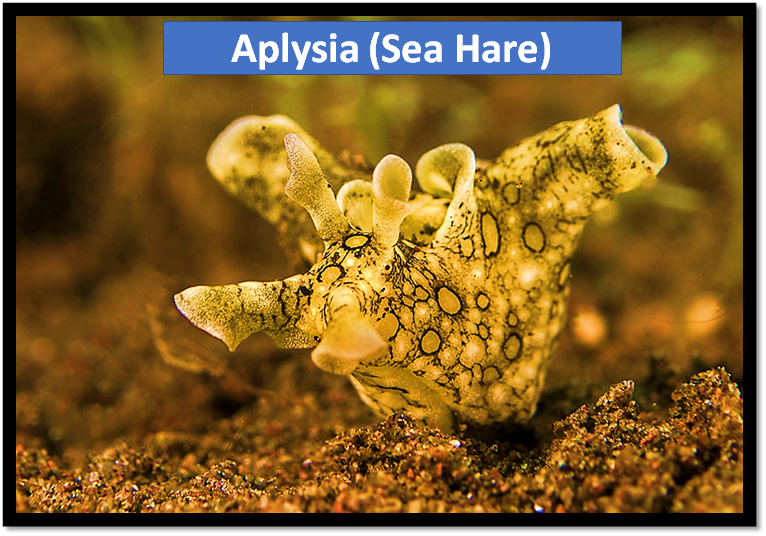
Aplysia is a large sea slug genus. It is also called the hare of the sea. It is a marine gastropod mollusc that belongs to the Aplysiidae family. It has parapodium that is used for swimming, breathing, and locomotion.
It is suspected that when attacked, Aplysia species often release clouds of ink in order to blind the attacker (although very few species are actually considered edible).
Compared to most other mollusks, these herbivorous benthic creatures may become very large. They graze in tropical coastal and subtidal areas, mainly in the Indo-Pacific Ocean (23 species), but can also be found in the Atlantic Ocean (12 species), with only a few species occurring in the Mediterranean.
Additional Information: Chitons, formerly known as Amphineura, are marine molluscs of various sizes in the Polyplacophora class. There are approximately 940 living and 430 fossil species recognized. They are also often referred to as sea cradles or coat-of-mail shells, or as loricates, polyplacophorans, and sometimes Polyplacophora more formally.
In the family Cypraeidae, the cowries, Cypraea is a genus of medium to large sea snails or cowries, marine gastropod molluscs.
The nautilus is a pelagic marine mollusc belonging to the cephalopod family Nautilidae, the only remaining family belonging to the Nautilaceae superfamily and to its smaller yet nearly equal suborder, Nautilina. It consists of six living species in two genera, of which the Nautilus genus is the form.
So, the correct answer is ‘Aplysia’.
Note: Aplysia is a large, almost shell-less marine snail, best known to neuroscientists for its use in understanding the cellular and molecular basis of learning and memory, resulting in Eric Kandel being awarded the 2000 Nobel Prize in Physiology or Medicine.
Complete answer:
Aplysia is a large sea slug genus. It is also called the hare of the sea. It is a marine gastropod mollusc that belongs to the Aplysiidae family. It has parapodium that is used for swimming, breathing, and locomotion.
It is suspected that when attacked, Aplysia species often release clouds of ink in order to blind the attacker (although very few species are actually considered edible).
Compared to most other mollusks, these herbivorous benthic creatures may become very large. They graze in tropical coastal and subtidal areas, mainly in the Indo-Pacific Ocean (23 species), but can also be found in the Atlantic Ocean (12 species), with only a few species occurring in the Mediterranean.
Additional Information: Chitons, formerly known as Amphineura, are marine molluscs of various sizes in the Polyplacophora class. There are approximately 940 living and 430 fossil species recognized. They are also often referred to as sea cradles or coat-of-mail shells, or as loricates, polyplacophorans, and sometimes Polyplacophora more formally.
In the family Cypraeidae, the cowries, Cypraea is a genus of medium to large sea snails or cowries, marine gastropod molluscs.
The nautilus is a pelagic marine mollusc belonging to the cephalopod family Nautilidae, the only remaining family belonging to the Nautilaceae superfamily and to its smaller yet nearly equal suborder, Nautilina. It consists of six living species in two genera, of which the Nautilus genus is the form.
So, the correct answer is ‘Aplysia’.
Note: Aplysia is a large, almost shell-less marine snail, best known to neuroscientists for its use in understanding the cellular and molecular basis of learning and memory, resulting in Eric Kandel being awarded the 2000 Nobel Prize in Physiology or Medicine.
Recently Updated Pages
Master Class 11 English: Engaging Questions & Answers for Success

Master Class 11 Social Science: Engaging Questions & Answers for Success
Master Class 11 Maths: Engaging Questions & Answers for Success
Master Class 11 Biology: Engaging Questions & Answers for Success
Master Class 11 Physics: Engaging Questions & Answers for Success
Master Class 11 Chemistry: Engaging Questions & Answers for Success
Trending doubts
One Metric ton is equal to kg A 10000 B 1000 C 100 class 11 physics CBSE
Difference Between Prokaryotic Cells and Eukaryotic Cells
1 ton equals to A 100 kg B 1000 kg C 10 kg D 10000 class 11 physics CBSE
Find the value of the expression given below sin 30circ class 11 maths CBSE
Two of the body parts which do not appear in MRI are class 11 biology CBSE
What are hard magnetic materials class 11 physics CBSE