




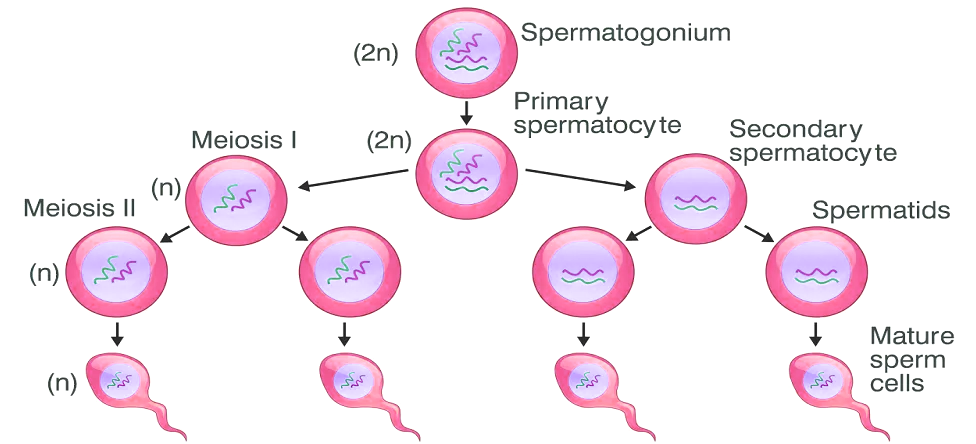
Schematically represent and explain the events of spermatogenesis in humans.
Answer
 Verified
614.1k+ views
Hint: In this process, the spermatogonial cells function as the stem cells that are found in the basement membrane of the seminiferous tubules.
Complete answer: Spermatogenesis is the process of formation of sperms and it occurs in the male gonads testes that are made up of many seminiferous tubules lined by germinal epithelium. Spermatozoa are formed by the division of these cells in the following manner –
1. Multiplication Phase – This is the first phase and in this phase, the mature primordial germ cells divide by mitosis to produce a large number of spermatogonia.
2. Growth Phase – During this phase, the spermatogonium grows to a primary spermatocyte while obtaining nourishment from the nursing cells present in the testes.
3. Maturation Phase – In this phase, each primary spermatocyte undergoes two maturation divisions out of which the first one is reductional where two haploid daughter cells are formed that are called secondary spermatocytes. The second maturation division occurs in both secondary spermatocytes and four haploid spermatids are formed.
4.Spermiogenesis – This is the final step of spermatogenesis where the process of transformation of spermatid to a spermatozoon occurs. The spermatozoa thus formed are known as sperms.
Note: At all stages mentioned above, the spermatogenic cells are in close contact with Sertoli cells. These cells provide structural and metabolic support to the developing sperm cells and are also known as the ‘nurse cells’. They perform many supportive functions like maintaining the necessary environment, secreting a required hormone, protecting spermatids, etc.
Complete answer: Spermatogenesis is the process of formation of sperms and it occurs in the male gonads testes that are made up of many seminiferous tubules lined by germinal epithelium. Spermatozoa are formed by the division of these cells in the following manner –
1. Multiplication Phase – This is the first phase and in this phase, the mature primordial germ cells divide by mitosis to produce a large number of spermatogonia.
2. Growth Phase – During this phase, the spermatogonium grows to a primary spermatocyte while obtaining nourishment from the nursing cells present in the testes.
3. Maturation Phase – In this phase, each primary spermatocyte undergoes two maturation divisions out of which the first one is reductional where two haploid daughter cells are formed that are called secondary spermatocytes. The second maturation division occurs in both secondary spermatocytes and four haploid spermatids are formed.
4.Spermiogenesis – This is the final step of spermatogenesis where the process of transformation of spermatid to a spermatozoon occurs. The spermatozoa thus formed are known as sperms.
Note: At all stages mentioned above, the spermatogenic cells are in close contact with Sertoli cells. These cells provide structural and metabolic support to the developing sperm cells and are also known as the ‘nurse cells’. They perform many supportive functions like maintaining the necessary environment, secreting a required hormone, protecting spermatids, etc.
Recently Updated Pages
Master Class 10 Social Science: Engaging Questions & Answers for Success

Master Class 10 Science: Engaging Questions & Answers for Success
Master Class 10 Maths: Engaging Questions & Answers for Success
Master Class 10 General Knowledge: Engaging Questions & Answers for Success
Master Class 10 Computer Science: Engaging Questions & Answers for Success
Class 10 Question and Answer - Your Ultimate Solutions Guide
Trending doubts
What is the full form of PNG A Petrol Natural Gas B class 10 chemistry CBSE
Explain the Treaty of Vienna of 1815 class 10 social science CBSE
In cricket, how many legal balls are there in a standard over?
Why is there a time difference of about 5 hours between class 10 social science CBSE
Who Won 36 Oscar Awards? Record Holder Revealed
What is the median of the first 10 natural numbers class 10 maths CBSE