




What can you say about the values of \[\sin A\] and \[\cos A\], as the value of angle A increases from \[{{0}^{\circ }}\]to \[{{90}^{\circ }}\]?
Answer
 Verified
621.6k+ views
Hint: We have to know the domain of \[\sin A\] and \[\cos A\] is \[-1\le A\le +1\]. And use \[\sin A\] and \[\cos A\] as a function to put the value of \[{{0}^{\circ }}\] to \[{{90}^{\circ }}\]to make the graph of \[\sin A\] and \[\cos A\]. After that we can see the value of \[\sin A\] increase when we increase the angle \[{{0}^{\circ }}\] to \[{{90}^{\circ }}\] and for the \[\cos A\] the value decrease when the angle increase \[{{0}^{\circ }}\] to \[{{90}^{\circ }}\].
Complete step by step solution:
The sine and cosine of an angle are all defined in terms of trigonometry, but they can also be expressed as functions.
Firstly for \[\sin A\],
\[\sin A\] function can be defined for any number “A” using a diagram like below.
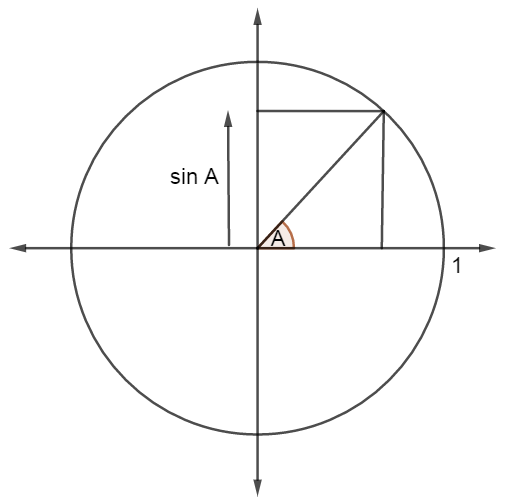
We take a circle with center at the origin, and with radius 1. We then draw a line from the
origin, at A degrees from the horizontal axis, until it meets the circle, so that the line has length
1. We then look at the vertical axis coordinate of the point where the line and the circle meet to find the value of \[\sin A\].
The information from this picture can also be used to see how changing x affects the value of \[\sin A\]. We can use a table of values to plot selected points between \[A={{0}^{\circ }}\] and \[A={{90}^{\circ }}\] and draw a smooth curve between them. We can then extend the graph to the right and to the left, because we know that the graph repeats itself.
For,
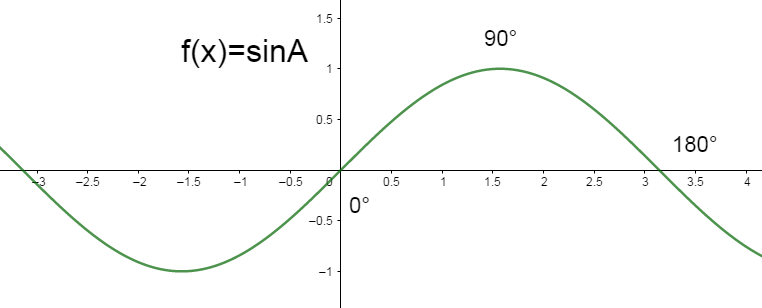
When \[A={{0}^{\circ }}\] , \[\sin A=0\] As we increase A \[{{0}^{\circ }}\] to \[{{90}^{\circ }}\], \[\sin A\] increases to 1. As we increase A further, \[\sin A\] decreases. It becomes zero when \[A={{180}^{\circ }}\].
The function \[\sin A\] has all real numbers in its domain, but its range is \[-1\le A\le +1\].
Now for cosine,
This function can be defined for any number A using a diagram like this.
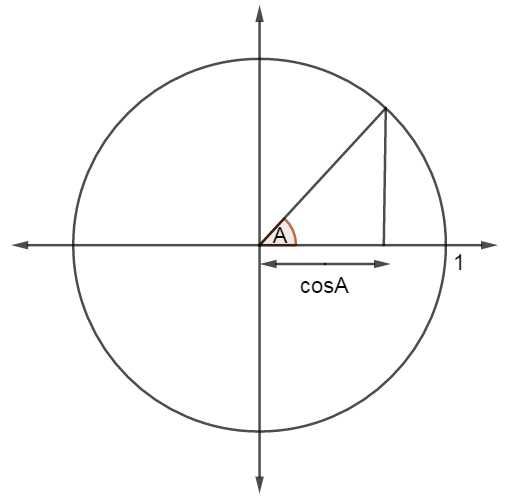
We take a circle diagram similar to the one we used for the sine function. But now we look at the horizontal axis coordinate of the point where the line and the circle meet, to find the value of \[\cos A\].
The information from this picture can also be used to see how changing A affects the value of \[\cos A\]. We can use a table of values to plot selected points between \[A={{0}^{\circ }}\] and \[A={{90}^{\circ }}\] and draw a smooth curve between them. We can then extend the graph to the right and to the left. Because we know that the graph repeats itself.
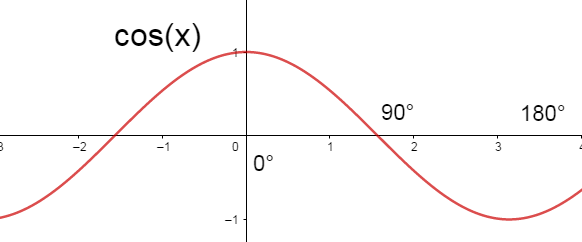
When \[A={{0}^{\circ }}\] , \[\cos A=1\] As we increase A \[{{0}^{\circ }}\] to \[{{90}^{\circ }}\], \[\cos A\] decrease to 0.
The function \[\cos A\] has all real numbers in its domain, but its range is \[-1\le A\le +1\].
Note: We can increase the value of A further and see \[\sin A\] decreases. It becomes zero when \[A={{180}^{\circ }}\]. It then continues to decrease, and becomes −1 when \[A={{270}^{\circ }}\]. After that \[\sin A\]increases and becomes zero again when A reaches \[{{360}^{\circ }}\]. And for \[\cos A\] when we increase the value of A further and see \[\cos A\] decreases. It becomes -1 when \[A={{180}^{\circ }}\] and then increases and becomes 1 when A reaches \[{{360}^{\circ }}\].
Complete step by step solution:
The sine and cosine of an angle are all defined in terms of trigonometry, but they can also be expressed as functions.
Firstly for \[\sin A\],
\[\sin A\] function can be defined for any number “A” using a diagram like below.
We take a circle with center at the origin, and with radius 1. We then draw a line from the
origin, at A degrees from the horizontal axis, until it meets the circle, so that the line has length
1. We then look at the vertical axis coordinate of the point where the line and the circle meet to find the value of \[\sin A\].
The information from this picture can also be used to see how changing x affects the value of \[\sin A\]. We can use a table of values to plot selected points between \[A={{0}^{\circ }}\] and \[A={{90}^{\circ }}\] and draw a smooth curve between them. We can then extend the graph to the right and to the left, because we know that the graph repeats itself.
For,
| A | \[{{0}^{\circ }}\] | \[{{45}^{\circ }}\] | \[{{90}^{\circ }}\] |
| \[\sin A\] | 0 | 0.71 | 1 |
When \[A={{0}^{\circ }}\] , \[\sin A=0\] As we increase A \[{{0}^{\circ }}\] to \[{{90}^{\circ }}\], \[\sin A\] increases to 1. As we increase A further, \[\sin A\] decreases. It becomes zero when \[A={{180}^{\circ }}\].
The function \[\sin A\] has all real numbers in its domain, but its range is \[-1\le A\le +1\].
Now for cosine,
This function can be defined for any number A using a diagram like this.
We take a circle diagram similar to the one we used for the sine function. But now we look at the horizontal axis coordinate of the point where the line and the circle meet, to find the value of \[\cos A\].
The information from this picture can also be used to see how changing A affects the value of \[\cos A\]. We can use a table of values to plot selected points between \[A={{0}^{\circ }}\] and \[A={{90}^{\circ }}\] and draw a smooth curve between them. We can then extend the graph to the right and to the left. Because we know that the graph repeats itself.
| A | \[{{0}^{\circ }}\] | \[{{45}^{\circ }}\] | \[{{90}^{\circ }}\] |
| \[\cos A\] | 1 | 0.71 | 0 |
When \[A={{0}^{\circ }}\] , \[\cos A=1\] As we increase A \[{{0}^{\circ }}\] to \[{{90}^{\circ }}\], \[\cos A\] decrease to 0.
The function \[\cos A\] has all real numbers in its domain, but its range is \[-1\le A\le +1\].
Note: We can increase the value of A further and see \[\sin A\] decreases. It becomes zero when \[A={{180}^{\circ }}\]. It then continues to decrease, and becomes −1 when \[A={{270}^{\circ }}\]. After that \[\sin A\]increases and becomes zero again when A reaches \[{{360}^{\circ }}\]. And for \[\cos A\] when we increase the value of A further and see \[\cos A\] decreases. It becomes -1 when \[A={{180}^{\circ }}\] and then increases and becomes 1 when A reaches \[{{360}^{\circ }}\].
Recently Updated Pages
Master Class 12 Business Studies: Engaging Questions & Answers for Success

Master Class 12 Biology: Engaging Questions & Answers for Success
Master Class 12 Chemistry: Engaging Questions & Answers for Success
Class 12 Question and Answer - Your Ultimate Solutions Guide
Master Class 11 Social Science: Engaging Questions & Answers for Success
Master Class 11 English: Engaging Questions & Answers for Success
Trending doubts
Explain the Treaty of Vienna of 1815 class 10 social science CBSE
Who Won 36 Oscar Awards? Record Holder Revealed
What is the median of the first 10 natural numbers class 10 maths CBSE
Why is it 530 pm in india when it is 1200 afternoon class 10 social science CBSE
What is the full form of POSCO class 10 social science CBSE
The highest temperature in Karnataka is recorded in class 10 social science CBSE