




Sanger’s reagent is used for the identification of:
A) N-terminal of peptide chain
B) C-terminal of peptide chain
C) Side chain of amino acids
D) Molecular weight of the peptide chain
E) Number of amino acids in peptide chain
Answer
 Verified
626.1k+ views
Hint: To solve this we must know that Sanger’s reagent is also known as 1-fluoro-2,4-dinitrobenzene or dinitrofluorobenzene. It is abbreviated as DNBF. It is named after the scientist Frederick Sanger who first used it to detect free amino acids in insulin. Sanger’s reagent can be helpful for the sequencing of proteins.
Complete step-by-step answer:
We know that Sanger’s reagent is also known as 1-fluoro-2,4-dinitrobenzene or dinitrofluorobenzene. It is abbreviated as DNBF. It is named after the scientist Sanger who used it to detect free amino acids in insulin.
Sanger’s reagent is prepared by the reaction of 1-chloro-2,4-dinitrobenzene with potassium fluoride in nitrobenzene. Sanger’s reagent appears as solid yellow coloured crystals.Sanger’s reagent is used for determining the N-terminal amino acid in polypeptide chains, in particular insulin. Sanger’s reagent reacts with amino groups in amino acids to produce dinitrophenyl amino acids. These dinitrophenyl amino acids are stable under acid hydrolysis conditions that break peptide bonds.
The structure of Sanger’s reagent is as follows:
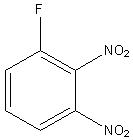
Thus, Sanger’s reagent is used for the identification of N-terminal of peptide chain.
Thus, the correct option is (A) N-terminal of peptide chain.
Note: The pressure applied to a pure solvent so that it does not pass into the given solution by osmosis is known as the osmotic pressure. Remember to calculate the van’t Hoff factor correctly. van’t Hoff factor is the number of ions a compound can form when dissolved in water.
Complete step-by-step answer:
We know that Sanger’s reagent is also known as 1-fluoro-2,4-dinitrobenzene or dinitrofluorobenzene. It is abbreviated as DNBF. It is named after the scientist Sanger who used it to detect free amino acids in insulin.
Sanger’s reagent is prepared by the reaction of 1-chloro-2,4-dinitrobenzene with potassium fluoride in nitrobenzene. Sanger’s reagent appears as solid yellow coloured crystals.Sanger’s reagent is used for determining the N-terminal amino acid in polypeptide chains, in particular insulin. Sanger’s reagent reacts with amino groups in amino acids to produce dinitrophenyl amino acids. These dinitrophenyl amino acids are stable under acid hydrolysis conditions that break peptide bonds.
The structure of Sanger’s reagent is as follows:
Thus, Sanger’s reagent is used for the identification of N-terminal of peptide chain.
Thus, the correct option is (A) N-terminal of peptide chain.
Note: The pressure applied to a pure solvent so that it does not pass into the given solution by osmosis is known as the osmotic pressure. Remember to calculate the van’t Hoff factor correctly. van’t Hoff factor is the number of ions a compound can form when dissolved in water.
Recently Updated Pages
If x a + bt + ct2 where x is in meters and t is in class 11 physics CBSE

A car covers the first half distance between two places class 11 physics CBSE
The resultant of two vectors overrightarrow P and overrightarrow class 11 physics CBSE
Find the value of cos 135 class 11 maths CBSE
A mass M is held in place by an applied force F and class 11 physics CBSE
A solution of glucose in water is labelled as 10 dfracwv class 11 chemistry CBSE
Trending doubts
Find the value of the expression given below sin 30circ class 11 maths CBSE
One Metric ton is equal to kg A 10000 B 1000 C 100 class 11 physics CBSE
Draw a diagram of nephron and explain its structur class 11 biology CBSE
10 examples of friction in our daily life
Proton was discovered by A Thomson B Rutherford C Chadwick class 11 chemistry CBSE
Bond order ofO2 O2+ O2 and O22 is in order A O2 langle class 11 chemistry CBSE