




What is the role of chlorophyll in photosynthesis?
Answer
 Verified
561.9k+ views
Hint: Photosynthesis is the conversion of light energy into chemical energy by phototrophs, which is then used to power cellular processes. Sugars are utilised to store chemical energy and are created from water and carbon dioxide.
Photosynthesis is defined as a process that occurs primarily in chloroplasts and is mediated by photosynthetic pigments such as chlorophyll a, chlorophyll b, carotene, and xanthophyll. Photosynthesis uses carbon dioxide, water, and sunlight to create nutrition in green plants and a few other autotrophic species. As a by-product of photosynthesis, oxygen is produced.
Complete answer:
Chlorophyll is a pigment found in all green plants as well as a few other animals. It is necessary for photosynthesis, which is the conversion of light energy into chemical energy.
In plants, the chlorophyll pigment is responsible for their green colour.
Photosynthesis, which allows plants to absorb energy from light, requires chlorophyll. Chemical energy is converted from light energy. Carbohydrates like sugars are made from carbon dioxide and water with the help of light energy. Almost all photosynthetic organisms, including green plants, cyanobacteria, and algae, have chlorophyll. Chlorophyll absorbs energy during photosynthesis and then converts water and carbon dioxide into oxygen and carbohydrates. A magnesium ion is wrapped in a huge ring structure known as a chlorine in chlorophyll A. The chlorin ring is a pyrrole-derived heterocyclic molecule.
In the chloroplast, chlorophyll, which is a main pigment (photoreceptor), reflects green light while absorbing red and blue light.
As a result, chlorophyll is essential to the complete photosynthesis process.
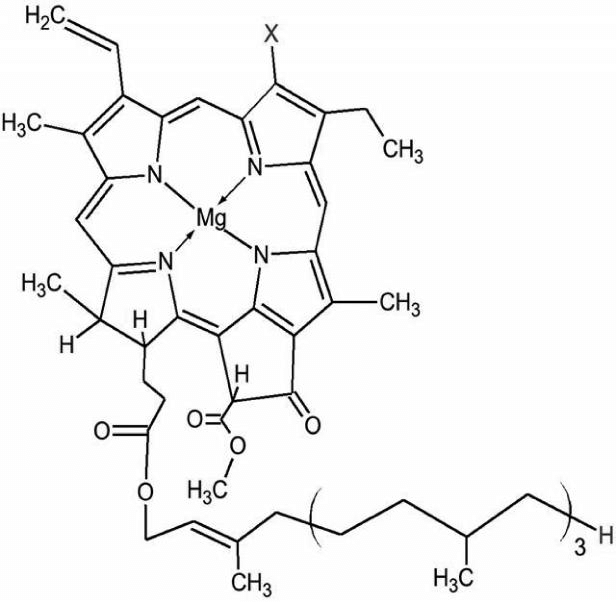
STRUCTURE OF CHLOROPHYLL
Note:
IMPORTANCE OF PHOTOSYNTHESIS-
Photosynthesis is required for all life on Earth to exist. It plays an important role in the food chain because it is through this process that plants make their food, constituting the primary producers.
Photosynthesis is also responsible for the generation of oxygen, which is required for the survival of most organisms.
FACTORS INFLUENCING PHOTOSYNTHESIS-
A variety of factors influence the rate of photosynthesis. The rate of photosynthesis is influenced by light intensity, water, soil pH, carbon dioxide concentration, temperature, and other environmental parameters.
Photosynthesis is defined as a process that occurs primarily in chloroplasts and is mediated by photosynthetic pigments such as chlorophyll a, chlorophyll b, carotene, and xanthophyll. Photosynthesis uses carbon dioxide, water, and sunlight to create nutrition in green plants and a few other autotrophic species. As a by-product of photosynthesis, oxygen is produced.
Complete answer:
Chlorophyll is a pigment found in all green plants as well as a few other animals. It is necessary for photosynthesis, which is the conversion of light energy into chemical energy.
In plants, the chlorophyll pigment is responsible for their green colour.
Photosynthesis, which allows plants to absorb energy from light, requires chlorophyll. Chemical energy is converted from light energy. Carbohydrates like sugars are made from carbon dioxide and water with the help of light energy. Almost all photosynthetic organisms, including green plants, cyanobacteria, and algae, have chlorophyll. Chlorophyll absorbs energy during photosynthesis and then converts water and carbon dioxide into oxygen and carbohydrates. A magnesium ion is wrapped in a huge ring structure known as a chlorine in chlorophyll A. The chlorin ring is a pyrrole-derived heterocyclic molecule.
In the chloroplast, chlorophyll, which is a main pigment (photoreceptor), reflects green light while absorbing red and blue light.
As a result, chlorophyll is essential to the complete photosynthesis process.
STRUCTURE OF CHLOROPHYLL
Note:
IMPORTANCE OF PHOTOSYNTHESIS-
Photosynthesis is required for all life on Earth to exist. It plays an important role in the food chain because it is through this process that plants make their food, constituting the primary producers.
Photosynthesis is also responsible for the generation of oxygen, which is required for the survival of most organisms.
FACTORS INFLUENCING PHOTOSYNTHESIS-
A variety of factors influence the rate of photosynthesis. The rate of photosynthesis is influenced by light intensity, water, soil pH, carbon dioxide concentration, temperature, and other environmental parameters.
Recently Updated Pages
Master Class 11 Social Science: Engaging Questions & Answers for Success

Master Class 11 English: Engaging Questions & Answers for Success
Master Class 11 Accountancy: Engaging Questions & Answers for Success
Master Class 11 Physics: Engaging Questions & Answers for Success
Master Class 11 Computer Science: Engaging Questions & Answers for Success
Master Class 11 Business Studies: Engaging Questions & Answers for Success
Trending doubts
One Metric ton is equal to kg A 10000 B 1000 C 100 class 11 physics CBSE
Find the value of the expression given below sin 30circ class 11 maths CBSE
Draw a diagram of nephron and explain its structur class 11 biology CBSE
10 examples of friction in our daily life
Proton was discovered by A Thomson B Rutherford C Chadwick class 11 chemistry CBSE
The teeth used for biting and cutting food are called class 11 biology CBSE