




What is the resultant magnetic field at a neutral point?
${\text{A}}{\text{.}}$ Zero
${\text{B}}{\text{.}}$ > Zero
${\text{C}}{\text{.}}$ < Zero
${\text{D}}{\text{.}}$ Maximum
Answer
 Verified
647.7k+ views
Hint:- Here, we will proceed by defining the term magnetic field which is widely used in physics. Then, we will define the neutral point along with the net or resultant magnetic field that is there.
Step By Step Answer:
A magnetic field is a vector field that defines the magnetic effect in relative motion of electrical charges and magnetic materials. A charge which moves parallel to a current of other charges is experiencing a force perpendicular to its own velocity. The effects of magnetic fields are usually seen in permanent magnets that attract or repel other magnets from magnetic materials (such as iron). Magnetic fields, including those used in electromagnets, surround and are formed by magnetized material and by moving electrical charges (currents).
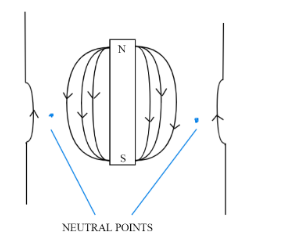
A neutral point of any magnet is defined as a point at which the resultant magnetic field is always zero. When the horizontal component of the earth’s field is balanced with the help of a magnet, this leads to a neutral point. It is obtained when the north pole of the magnet points to the south and the magnet in the magnetic meridian.
The superposition of the magnetic fields due to earth and bar magnet is represented by the curves when the magnetic field of a bar magnet is plotted.
A point where the magnetic fields produced due to the magnet is completely neutralized by the horizontal component of the magnetic field produced due to earth is known as a neutral point. It is also important to note that the field produced due to the bar magnet is equal and opposite to the horizontal component of the magnetic field produced due to earth.
i.e., B = ${{\text{B}}_{\text{H}}}$ where B denotes the magnetic field produced due to bar magnet and ${{\text{B}}_{\text{H}}}$ denotes the horizontal component of the magnetic field produced due to earth.
Therefore, the resultant magnetic field at a neutral point is zero.
Hence, option A is correct.
Note- The magnetic fields exert forces on electrical charges which are moving and torques on nearby magnets. Furthermore, a location-varying magnetic field exerts a force on magnetic materials. The intensity of a magnetic field and its direction differ with the location.
Step By Step Answer:
A magnetic field is a vector field that defines the magnetic effect in relative motion of electrical charges and magnetic materials. A charge which moves parallel to a current of other charges is experiencing a force perpendicular to its own velocity. The effects of magnetic fields are usually seen in permanent magnets that attract or repel other magnets from magnetic materials (such as iron). Magnetic fields, including those used in electromagnets, surround and are formed by magnetized material and by moving electrical charges (currents).
A neutral point of any magnet is defined as a point at which the resultant magnetic field is always zero. When the horizontal component of the earth’s field is balanced with the help of a magnet, this leads to a neutral point. It is obtained when the north pole of the magnet points to the south and the magnet in the magnetic meridian.
The superposition of the magnetic fields due to earth and bar magnet is represented by the curves when the magnetic field of a bar magnet is plotted.
A point where the magnetic fields produced due to the magnet is completely neutralized by the horizontal component of the magnetic field produced due to earth is known as a neutral point. It is also important to note that the field produced due to the bar magnet is equal and opposite to the horizontal component of the magnetic field produced due to earth.
i.e., B = ${{\text{B}}_{\text{H}}}$ where B denotes the magnetic field produced due to bar magnet and ${{\text{B}}_{\text{H}}}$ denotes the horizontal component of the magnetic field produced due to earth.
Therefore, the resultant magnetic field at a neutral point is zero.
Hence, option A is correct.
Note- The magnetic fields exert forces on electrical charges which are moving and torques on nearby magnets. Furthermore, a location-varying magnetic field exerts a force on magnetic materials. The intensity of a magnetic field and its direction differ with the location.
Recently Updated Pages
Basicity of sulphurous acid and sulphuric acid are

Master Class 12 Economics: Engaging Questions & Answers for Success
Master Class 12 Biology: Engaging Questions & Answers for Success
Master Class 11 English: Engaging Questions & Answers for Success
Master Class 11 Physics: Engaging Questions & Answers for Success
Master Class 11 Computer Science: Engaging Questions & Answers for Success
Trending doubts
Draw a labelled sketch of the human eye class 12 physics CBSE
The chemical formula of tear gas is A CO Cl 2 B C 10 class 12 chemistry CBSE
Draw ray diagrams each showing i myopic eye and ii class 12 physics CBSE
Which are the Top 10 Largest Countries of the World?
Differentiate between homogeneous and heterogeneous class 12 chemistry CBSE
Which is the correct genotypic ratio of mendel dihybrid class 12 biology CBSE