




When the resistance of a conductor increases, the current will ________ provided the same potential difference is applied across it.
A. Increase
B. Decrease
C. Remain the same
D. Become double
Answer
 Verified
656.4k+ views
Hint: To deduce relation between current, voltage and resistance, use Kirchhoff’s law. Resistance is inversely proportional to the current passing through the conductor. When the resistance of a conductor increases, collision of electrons increases hence it opposes current to flow through it.
Complete step-by-step answer:
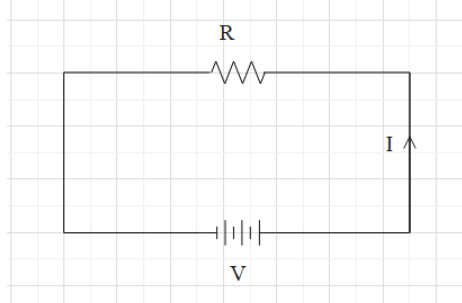
To answer this question, first we should know the relation between resistances, voltage, and current.
Relation between current, resistance and voltage is given by ohm's law and Kirchhoff’s law.
But ohm's law has limitations. So we will go with Kirchhoff’s law,
According to Kirchhoff’s law, it states that sum of product current and resistance is equal to the sum of potential difference applied across circuits.
$V=IR$
where,
I= current flowing through circuit
V= voltage applied across circuit
R= resistance across circuit
We can also write this equation as, if voltage applied is constant.
$I\propto \dfrac{1}{R}$
So, when the resistance of a conductor increases, the current will decrease.
Why it is so, we will see in further.
The atoms are tightly bound and current is carried by negatively charged electrons. When no external potential difference is applied, the electrons move in random direction and collide with atoms. The average number of electrons crossing any section in One Direction is equal to the average number of electrons crossing their section in the opposite direction in a given time. Thus, there is no net Of electrons through any section of the conductors. Hence, there is no electric current.
When potential difference is applied across conductors in the electric field is set up inside the conductor. The negatively charged electrons move in direction opposite to this field. There is a continuous flow of electrons across the cross section of the conductor. Atoms of any material are always in a state of vibration because of thermal energy. While moving, electrons continuously collide with vibrating atoms and their motion is opposed and electron remove with constant velocity called drifted velocity. This opposition gives rise to the resistance of conductors.
Hence the correct answer is (B).
Note: Amplitude of atomic vibration depends on temperature of conductor. At higher temperatures, atoms vibrate with large amplitude and hence motion of electrons is largely opposed due to more frequent collision. This increases resistance of conductor and decreases this current flow in the conductor.
Complete step-by-step answer:
To answer this question, first we should know the relation between resistances, voltage, and current.
Relation between current, resistance and voltage is given by ohm's law and Kirchhoff’s law.
But ohm's law has limitations. So we will go with Kirchhoff’s law,
According to Kirchhoff’s law, it states that sum of product current and resistance is equal to the sum of potential difference applied across circuits.
$V=IR$
where,
I= current flowing through circuit
V= voltage applied across circuit
R= resistance across circuit
We can also write this equation as, if voltage applied is constant.
$I\propto \dfrac{1}{R}$
So, when the resistance of a conductor increases, the current will decrease.
Why it is so, we will see in further.
The atoms are tightly bound and current is carried by negatively charged electrons. When no external potential difference is applied, the electrons move in random direction and collide with atoms. The average number of electrons crossing any section in One Direction is equal to the average number of electrons crossing their section in the opposite direction in a given time. Thus, there is no net Of electrons through any section of the conductors. Hence, there is no electric current.
When potential difference is applied across conductors in the electric field is set up inside the conductor. The negatively charged electrons move in direction opposite to this field. There is a continuous flow of electrons across the cross section of the conductor. Atoms of any material are always in a state of vibration because of thermal energy. While moving, electrons continuously collide with vibrating atoms and their motion is opposed and electron remove with constant velocity called drifted velocity. This opposition gives rise to the resistance of conductors.
Hence the correct answer is (B).
Note: Amplitude of atomic vibration depends on temperature of conductor. At higher temperatures, atoms vibrate with large amplitude and hence motion of electrons is largely opposed due to more frequent collision. This increases resistance of conductor and decreases this current flow in the conductor.
Recently Updated Pages
Which will be the least stable resonating structure class 11 chemistry CBSE

How many 5 digit telephone numbers can be construc-class-11-maths-CBSE
How do you find the angle of the resultant vector class 11 physics CBSE
Draw labelled diagram of the following i Gram seed class 11 biology CBSE
What is the need and importance of classification class 11 biology CBSE
The way in which the sparrows expressed their sorrow class 11 english CBSE
Trending doubts
One Metric ton is equal to kg A 10000 B 1000 C 100 class 11 physics CBSE
Find the value of the expression given below sin 30circ class 11 maths CBSE
1 Quintal is equal to a 110 kg b 10 kg c 100kg d 1000 class 11 physics CBSE
Draw a diagram of nephron and explain its structur class 11 biology CBSE
10 examples of friction in our daily life
Proton was discovered by A Thomson B Rutherford C Chadwick class 11 chemistry CBSE