




Represent graphically by two separate diagrams in the case where two sound waves have the same amplitude but different frequencies.
Answer
 Verified
520.5k+ views
Hint: Frequency, often known as pitch, is the number of times a sound pressure wave repeats itself every second. The relative strength of sound waves (transmitted vibrations), which we perceive as loudness or volume, is referred to as amplitude. The sound pressure level or intensity is referred to as amplitude.
Complete Step By Step Answer:
Following are the two diagrams where the sound waves have the same amplitude but different frequencies. Where x-axis shows the value of amplitude and y-axis shows the value of frequencies.
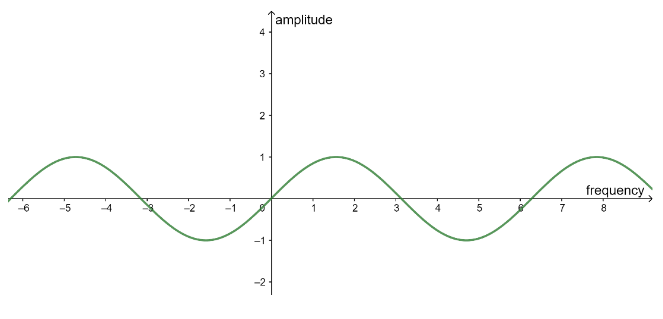
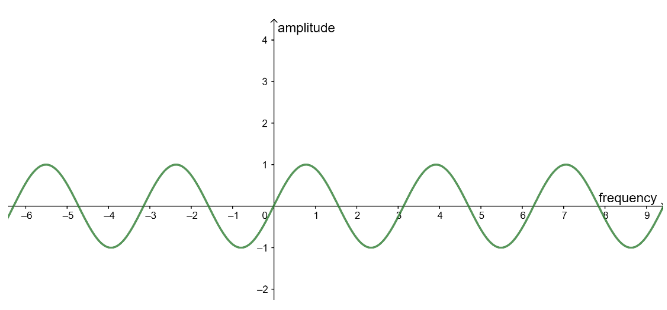
The crests and troughs are the same height in both wave shapes, suggesting the same amplitudes, but the number of crests and troughs per unit of time differs, showing distinct frequencies.
The frequency of a sound determines its pitch, whereas the amplitude of sound waves determines its loudness. If the frequency is high, the wavelength is short and vice-versa. The particles in a sound wave move back and forth rather than up and down.
Like waves of seawater on the ocean, the sound wave creates a pattern of disturbance and outward movement in a wave pattern. The sound energy is carried by the wave across the medium, usually in all directions and less powerfully as it moves away from the source.
Note:
The largest value of upward displacement within a cycle is the crest point of a wave. A crest is a point on a surface wave where the medium's displacement is at its greatest. A trough is the lowest point of the wave in downward displacement.
Complete Step By Step Answer:
Following are the two diagrams where the sound waves have the same amplitude but different frequencies. Where x-axis shows the value of amplitude and y-axis shows the value of frequencies.
The crests and troughs are the same height in both wave shapes, suggesting the same amplitudes, but the number of crests and troughs per unit of time differs, showing distinct frequencies.
The frequency of a sound determines its pitch, whereas the amplitude of sound waves determines its loudness. If the frequency is high, the wavelength is short and vice-versa. The particles in a sound wave move back and forth rather than up and down.
Like waves of seawater on the ocean, the sound wave creates a pattern of disturbance and outward movement in a wave pattern. The sound energy is carried by the wave across the medium, usually in all directions and less powerfully as it moves away from the source.
Note:
The largest value of upward displacement within a cycle is the crest point of a wave. A crest is a point on a surface wave where the medium's displacement is at its greatest. A trough is the lowest point of the wave in downward displacement.
Recently Updated Pages
Master Class 5 English: Engaging Questions & Answers for Success

Master Class 5 Maths: Engaging Questions & Answers for Success
Master Class 5 Social Science: Engaging Questions & Answers for Success
Master Class 5 Science: Engaging Questions & Answers for Success
Class 5 Question and Answer - Your Ultimate Solutions Guide
Master Class 9 General Knowledge: Engaging Questions & Answers for Success
Trending doubts
One Metric ton is equal to kg A 10000 B 1000 C 100 class 11 physics CBSE
What is cell theory Who formulated it class 11 biology CBSE
Phyllotaxy is the arrangement of ALeaflets BLeaves class 11 biology CBSE
Difference Between Prokaryotic Cells and Eukaryotic Cells
The symbiotic association of fungi and algae is called class 11 biology CBSE
Cell theory was formulated by A Schleiden and Schwann class 11 biology CBSE