




What is reflex action? Write its types and two examples of each.
Answer
 Verified
621k+ views
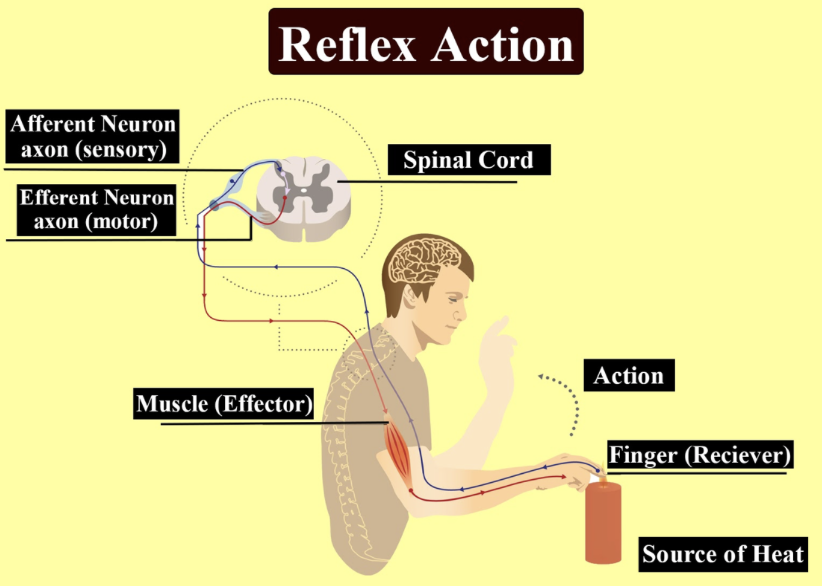
Hint: When a person touches a hot object unintentionally, without thought, they instinctively jerk their hand away. A reflex does not need the input of any thought. A reflex arc is called the path taken by the nerve impulses in a reflex.
Complete answer:
In response to a stimulus, a reflex action, also known as a reflex, is an automatic and nearly instantaneous reaction.
There are two forms of Reflex Action:
1. Unconditioned reflexes: Inborn reflexes are these. These include knee jerk, peristalsis.
2. Conditioned reflexes: These are acquired after birth and involve some kind of learning. These include playing a musical instrument, driving a car.
The reflex arc is considered the anatomical pathway of a reflex. It consists of an afferent (or sensory) nerve and an efferent (motor, secretory, or secreto- motor) nerve, usually one or more interneurons inside the central nervous system.
Additional Information:
- The pupillary light reflex is perhaps the best- known reflex.
- The pupils of both eyes contract if a light is flashed close to one eye. Light is the stimulus; impulses through the optic nerve enter the brain; and autonomic nerves that supply the eye relay the response to the pupillary musculature.
- The cough and sneeze reflexes are other reflexes of the midbrain and medulla oblongata.
- An irritant in the trachea triggers the cough reflex and one in the nose triggers the sneeze reflex.
- In both, several muscles are involved in the reflex response; this includes a brief respiration lapse in order to remove the irritant.
Note:
- In the womb, the first reflexes develop.
- The first reflex can be observed at seven and a half weeks after conception; stimulation around the mouth of the fetus causes the lips to be redirected to the stimulus.
Complete answer:
In response to a stimulus, a reflex action, also known as a reflex, is an automatic and nearly instantaneous reaction.
There are two forms of Reflex Action:
1. Unconditioned reflexes: Inborn reflexes are these. These include knee jerk, peristalsis.
2. Conditioned reflexes: These are acquired after birth and involve some kind of learning. These include playing a musical instrument, driving a car.
The reflex arc is considered the anatomical pathway of a reflex. It consists of an afferent (or sensory) nerve and an efferent (motor, secretory, or secreto- motor) nerve, usually one or more interneurons inside the central nervous system.
Additional Information:
- The pupillary light reflex is perhaps the best- known reflex.
- The pupils of both eyes contract if a light is flashed close to one eye. Light is the stimulus; impulses through the optic nerve enter the brain; and autonomic nerves that supply the eye relay the response to the pupillary musculature.
- The cough and sneeze reflexes are other reflexes of the midbrain and medulla oblongata.
- An irritant in the trachea triggers the cough reflex and one in the nose triggers the sneeze reflex.
- In both, several muscles are involved in the reflex response; this includes a brief respiration lapse in order to remove the irritant.
Note:
- In the womb, the first reflexes develop.
- The first reflex can be observed at seven and a half weeks after conception; stimulation around the mouth of the fetus causes the lips to be redirected to the stimulus.
Recently Updated Pages
The given figure shows two endocrine glands marked class 11 biology NEET_UG

Match columnI with columnII and select the correct class 11 biology NEET
Match column I with column II and select the correct class 11 biology NEET_UG
Which floral family has left 9 right + 1 arrangement class 11 biology NEET_UG
Which is not a variety of sheep A Lohi B Beetal C Nellore class 11 biology NEET_UG
Match column I with column II and select the correct class 11 biology NEET_UG
Trending doubts
Difference Between Prokaryotic Cells and Eukaryotic Cells
Two of the body parts which do not appear in MRI are class 11 biology CBSE
10 examples of friction in our daily life
Draw a diagram of nephron and explain its structur class 11 biology CBSE
One Metric ton is equal to kg A 10000 B 1000 C 100 class 11 physics CBSE
Draw a diagram of a plant cell and label at least eight class 11 biology CBSE