




What is reflex action? Explain the mechanism of reflex action with a suitable example.
Answer
 Verified
610.2k+ views
Hint:
The action is made possible by the neural pathways which act that sudden even before the impulse reaches the brain.
Complete answer:
The reflex action is the sudden reaction or the movement done in response to the stimulus or we can say it is an automatic response done by the neural pathways in response to the stimulus which does not need any thought to respond. This action is made possible by the neural pathways which are called the reflex arcs which can react that sudden even before the impulse reaches the brain.
The whole mechanism is based on some important components which are-
-Receptors: These are situated on sense organs and these functions to receive the stimuli
-Sensory neurons: These brings the sensory impulse from receptors
-Nerve center: Sensory neurons brings impulse here
-Motor neurons: These transfer the impulse to the effector neurons
-Effector neurons: These behave in response to the stimulus
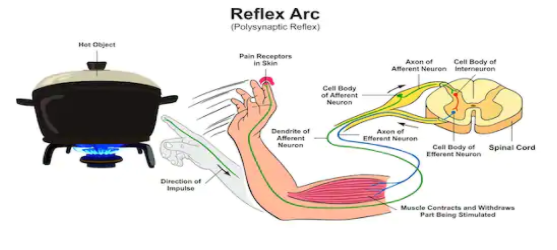
The sensory neurons as the name indicates are the nerve fibres which bring the sensory impulses from the receptor organs to the spinal cord as the ganglion of the spinal cord have sensory neurons. The spinal cord is the nerve centre. Now from the nerve centre, the impulse is relayed by the motor neurons to the effector neurons. These effector neurons now behave in response to the stimulus. Thus, the impulse travels a path during the whole process of the reflex action and that is known as Reflex arc.
If we take the example for this mechanism then that would be touching the heat pan. So, when we touch a heat pan then we feel heat and pain. This acts as a receptor. The sensory neuron in the arms take up this impulse to the spinal cord from where the message gets to the brain and from the spinal cord it gets passed to the motor neuron in the arms and finally it is passed to the effector neuron(muscle in arm) and it cause pain and heat sensation in our hands.
Note: This action is sudden and it is that sudden even before the impulse reaches the brains and this whole mechanism is based on all the components explained above and if you keep the example in mind, it will be easier to crack the question with proper explanation. There can be another example like closing of eyes when strong light is flashed on them.
The action is made possible by the neural pathways which act that sudden even before the impulse reaches the brain.
Complete answer:
The reflex action is the sudden reaction or the movement done in response to the stimulus or we can say it is an automatic response done by the neural pathways in response to the stimulus which does not need any thought to respond. This action is made possible by the neural pathways which are called the reflex arcs which can react that sudden even before the impulse reaches the brain.
The whole mechanism is based on some important components which are-
-Receptors: These are situated on sense organs and these functions to receive the stimuli
-Sensory neurons: These brings the sensory impulse from receptors
-Nerve center: Sensory neurons brings impulse here
-Motor neurons: These transfer the impulse to the effector neurons
-Effector neurons: These behave in response to the stimulus
The sensory neurons as the name indicates are the nerve fibres which bring the sensory impulses from the receptor organs to the spinal cord as the ganglion of the spinal cord have sensory neurons. The spinal cord is the nerve centre. Now from the nerve centre, the impulse is relayed by the motor neurons to the effector neurons. These effector neurons now behave in response to the stimulus. Thus, the impulse travels a path during the whole process of the reflex action and that is known as Reflex arc.
If we take the example for this mechanism then that would be touching the heat pan. So, when we touch a heat pan then we feel heat and pain. This acts as a receptor. The sensory neuron in the arms take up this impulse to the spinal cord from where the message gets to the brain and from the spinal cord it gets passed to the motor neuron in the arms and finally it is passed to the effector neuron(muscle in arm) and it cause pain and heat sensation in our hands.
Note: This action is sudden and it is that sudden even before the impulse reaches the brains and this whole mechanism is based on all the components explained above and if you keep the example in mind, it will be easier to crack the question with proper explanation. There can be another example like closing of eyes when strong light is flashed on them.
Recently Updated Pages
Master Class 11 Social Science: Engaging Questions & Answers for Success

Master Class 11 Physics: Engaging Questions & Answers for Success
Master Class 11 Maths: Engaging Questions & Answers for Success
Master Class 11 Economics: Engaging Questions & Answers for Success
Master Class 11 Computer Science: Engaging Questions & Answers for Success
Master Class 11 Chemistry: Engaging Questions & Answers for Success
Trending doubts
One Metric ton is equal to kg A 10000 B 1000 C 100 class 11 physics CBSE
There are 720 permutations of the digits 1 2 3 4 5 class 11 maths CBSE
1 Quintal is equal to a 110 kg b 10 kg c 100kg d 1000 class 11 physics CBSE
State and prove Bernoullis theorem class 11 physics CBSE
Difference Between Prokaryotic Cells and Eukaryotic Cells
Which among the following are examples of coming together class 11 social science CBSE