




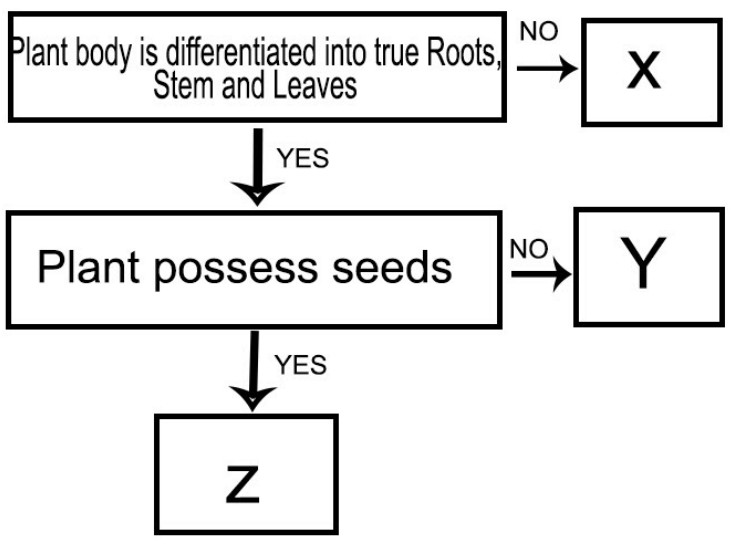
Refer to the given flow chart for the kingdom Plantae. Select the correct statement regarding X, Y, and Z.
(a) X can be Angiosperms
(b) Y can be Angiosperms
(c) Y can be cryptogams such as Pteridophytes
(d) Z can be Gymnosperms only
Answer
 Verified
556.8k+ views
Hint: An angiosperm is a higher plant, i.e. the plant body is differentiated into various parts and has flowers and seeds required for reproduction. Cryptogams are plants that do not reproduce by seeds.
Complete answer:
If a plant body is differentiated into true roots, stem, and leaves, it can be a pteridophyte, gymnosperm, or an angiosperm. If it does not have this level of differentiation, it is either a thallophyta or a bryophyte.
- If this plant possesses seeds, it is either a gymnosperm or an angiosperm. If it does not, it is a pteridophyte or a cryptogam.
- Hence, X can be a thallophyta or a bryophyte, Y can be a cryptogam or more specifically, a pteridophyte, and Z can be a gymnosperm or an angiosperm.
Plants of the kingdom Plantae are classified into five groups based on the level of differentiation into plant parts, the vascular system, and the presence of seeds. The groups are thallophyta, Bryophyta, Pteridophyta, gymnosperms, and angiosperms.
- Thallophytes are characterized by the lack of differentiation of plant parts into roots, stems, etc. They are commonly known as algae and are found in wet places.
- Bryophytes have a plant body differentiated into parts but do not have a vascular system. They are considered to be the first true plants to emerge on the planet.
- Pteridophytes have well-distinguished plant parts as well as vascular tissue for conducting water and minerals. They do not have seeds or flowers, they are known as sporophytes as they reproduce through spores.
- Gymnosperms have distinguished plant parts, vascular tissue, as well as seeds for reproduction. However, the seeds are ‘naked’, they do not have any coverage in the form of fruits. This also means there are no flowers.
- Angiosperms are the most complex forms of plants known to humans. They are flowering, fruiting plants with a well-differentiated plant body. They have vascular tissue and the seeds are protected in various types of fruits.
So, the correct answer is ‘Y can be cryptogams such as Pteridophytes’.
Note:
Kingdom Plantae is divided into two groups, the Cryptogamia, the non-flowering plants, and the Phanerogamia, the flowering plants.
- The different examples of cryptogams are algae, lichens, mosses, and ferns, and also include non-photosynthetic organisms that used to be classified as plants, such as fungi, slime molds, and bacteria.
Complete answer:
If a plant body is differentiated into true roots, stem, and leaves, it can be a pteridophyte, gymnosperm, or an angiosperm. If it does not have this level of differentiation, it is either a thallophyta or a bryophyte.
- If this plant possesses seeds, it is either a gymnosperm or an angiosperm. If it does not, it is a pteridophyte or a cryptogam.
- Hence, X can be a thallophyta or a bryophyte, Y can be a cryptogam or more specifically, a pteridophyte, and Z can be a gymnosperm or an angiosperm.
Plants of the kingdom Plantae are classified into five groups based on the level of differentiation into plant parts, the vascular system, and the presence of seeds. The groups are thallophyta, Bryophyta, Pteridophyta, gymnosperms, and angiosperms.
- Thallophytes are characterized by the lack of differentiation of plant parts into roots, stems, etc. They are commonly known as algae and are found in wet places.
- Bryophytes have a plant body differentiated into parts but do not have a vascular system. They are considered to be the first true plants to emerge on the planet.
- Pteridophytes have well-distinguished plant parts as well as vascular tissue for conducting water and minerals. They do not have seeds or flowers, they are known as sporophytes as they reproduce through spores.
- Gymnosperms have distinguished plant parts, vascular tissue, as well as seeds for reproduction. However, the seeds are ‘naked’, they do not have any coverage in the form of fruits. This also means there are no flowers.
- Angiosperms are the most complex forms of plants known to humans. They are flowering, fruiting plants with a well-differentiated plant body. They have vascular tissue and the seeds are protected in various types of fruits.
So, the correct answer is ‘Y can be cryptogams such as Pteridophytes’.
Note:
Kingdom Plantae is divided into two groups, the Cryptogamia, the non-flowering plants, and the Phanerogamia, the flowering plants.
- The different examples of cryptogams are algae, lichens, mosses, and ferns, and also include non-photosynthetic organisms that used to be classified as plants, such as fungi, slime molds, and bacteria.
Recently Updated Pages
Basicity of sulphurous acid and sulphuric acid are

Master Class 11 English: Engaging Questions & Answers for Success
Master Class 11 Physics: Engaging Questions & Answers for Success
Master Class 11 Computer Science: Engaging Questions & Answers for Success
Master Class 11 Chemistry: Engaging Questions & Answers for Success
Master Class 11 Social Science: Engaging Questions & Answers for Success
Trending doubts
Difference Between Prokaryotic Cells and Eukaryotic Cells
Two of the body parts which do not appear in MRI are class 11 biology CBSE
One Metric ton is equal to kg A 10000 B 1000 C 100 class 11 physics CBSE
10 examples of friction in our daily life
Draw a diagram of nephron and explain its structur class 11 biology CBSE
What will happen if the mucus is not secreted by the class 11 biology CBSE