




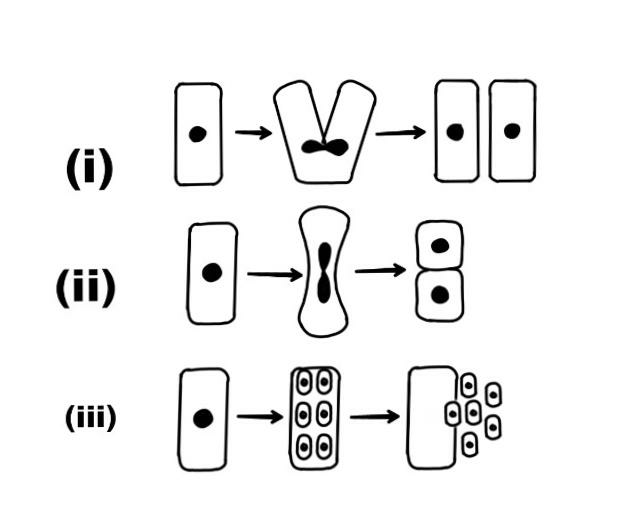
Refer to the given figures which show three different types of fission. Select the option which correctly matches them with the organisms in which they occur.
a)Euglena, Plasmodium, Amoeba
b)Plasmodium, Paramecium. Euglena
c)Euglena, Paramecium, Escherichia
d)Euglena, Paramecium, Amoeba
Answer
 Verified
610.2k+ views
Hint: Fission is a way of reproduction among unicellular organisms. There are three types of fission- longitudinal division, transverse division, binary fission.
Complete answer:
Diagram(1)- Euglena
Diagram indicates binary fission( a sort of cellular division )which is divided longitudinally and this takes place in euglena.
Euglena reproduces asexually. Reproduction begins with the mitosis of the nucleus, followed by the division of the cell itself.
Euglena divide longitudinally, beginning at the front of the cell, with the duplication of flagellar processes, gullet and stigma
Diagram (2) – Paramecium
Paramecium ranges from 50 to 300um in size which varies from species to species.
In paramecium, the cell division takes place through the transverse division of the cell.
Macronucleus splits by a type of amitosis, and the micronuclei undergo mitosis. After division, the same copy of cells is formed.
Diagram(3) – Amoeba
Amoeba reproduces by the common agamogenesis method called binary fission. After replicating its genetic material through mitotic division, the cell divides into two equal-sized daughter cells.
The Correct option is – D
Additional Information :
When a single cell is broken into two or more parts it is known as Fission. It is a form of reproduction.
1.The binary fission in which two or more organisms are produced.
2.The multiple fission in which a single cell produces more than two organisms.
3.Fission is mostly seen in acellular organisms.
Hence the correct answer is option(D)
Note: This all type of division are asexual mode of cell division, which produces daughter cells similar to the parent cell .
This type of reproduction is rapid i.e one parent cell produces two daughter cell,then they again split individually to form more daughter cells ( 4 new cells) and continue.
In asexual mode , there is no need to fuse two different cells , they divide on its own .
Sexual reproduction is a type of reproduction that includes a gamete (such as a sperm or egg cell) with a single pair of chromosomes (haploid) combined with another to produce an organism composed of cells with two sets of chromosomes (diploid).
Complete answer:
Diagram(1)- Euglena
Diagram indicates binary fission( a sort of cellular division )which is divided longitudinally and this takes place in euglena.
Euglena reproduces asexually. Reproduction begins with the mitosis of the nucleus, followed by the division of the cell itself.
Euglena divide longitudinally, beginning at the front of the cell, with the duplication of flagellar processes, gullet and stigma
Diagram (2) – Paramecium
Paramecium ranges from 50 to 300um in size which varies from species to species.
In paramecium, the cell division takes place through the transverse division of the cell.
Macronucleus splits by a type of amitosis, and the micronuclei undergo mitosis. After division, the same copy of cells is formed.
Diagram(3) – Amoeba
Amoeba reproduces by the common agamogenesis method called binary fission. After replicating its genetic material through mitotic division, the cell divides into two equal-sized daughter cells.
The Correct option is – D
Additional Information :
When a single cell is broken into two or more parts it is known as Fission. It is a form of reproduction.
1.The binary fission in which two or more organisms are produced.
2.The multiple fission in which a single cell produces more than two organisms.
3.Fission is mostly seen in acellular organisms.
Hence the correct answer is option(D)
Note: This all type of division are asexual mode of cell division, which produces daughter cells similar to the parent cell .
This type of reproduction is rapid i.e one parent cell produces two daughter cell,then they again split individually to form more daughter cells ( 4 new cells) and continue.
In asexual mode , there is no need to fuse two different cells , they divide on its own .
Sexual reproduction is a type of reproduction that includes a gamete (such as a sperm or egg cell) with a single pair of chromosomes (haploid) combined with another to produce an organism composed of cells with two sets of chromosomes (diploid).
Recently Updated Pages
Master Class 11 Social Science: Engaging Questions & Answers for Success

Master Class 11 English: Engaging Questions & Answers for Success
Master Class 11 Maths: Engaging Questions & Answers for Success
Master Class 11 Chemistry: Engaging Questions & Answers for Success
Master Class 11 Biology: Engaging Questions & Answers for Success
Class 11 Question and Answer - Your Ultimate Solutions Guide
Trending doubts
One Metric ton is equal to kg A 10000 B 1000 C 100 class 11 physics CBSE
Difference Between Prokaryotic Cells and Eukaryotic Cells
Find the value of the expression given below sin 30circ class 11 maths CBSE
1 ton equals to A 100 kg B 1000 kg C 10 kg D 10000 class 11 physics CBSE
Two of the body parts which do not appear in MRI are class 11 biology CBSE
Draw a diagram of nephron and explain its structur class 11 biology CBSE