




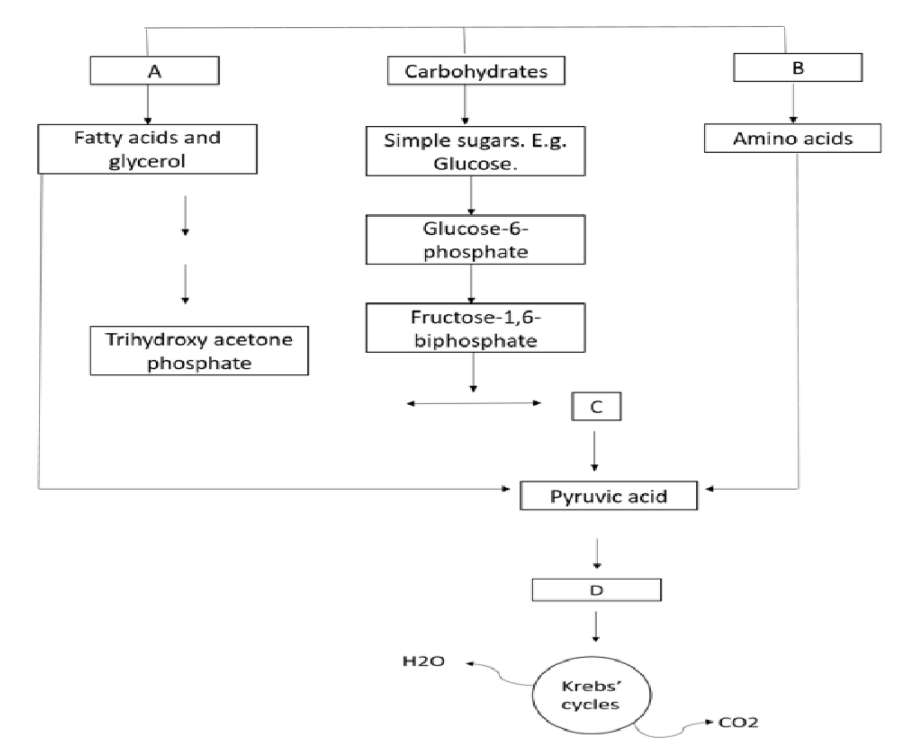
Refer to the given figure and select the correct option for A, B, C and D
A. A- Fats; B- Proteins; C- PGAL; D- Acetyl-CoA
B. A- Fats; B- Proteins; C- PGAL; D- CO2
C. A- Proteins; B- Fats; C- Acetyl-CoA; D- PEP
D. A- Proteins; B- Fats; C- PEP; D- Acetyl-CoA
Answer
 Verified
606.9k+ views
Hint: All cells function as biochemical factories. Biomolecules are constantly synthesized and transformed into some other biomolecules. All these metabolic pathways occur in a series of linked chemical reactions in which one chemical is transformed into another.
Complete Answer:
A. It can be seen that due to the breakdown of ‘A’ we got fatty acids and glycerol. Hence, we can conclude that, with the polymerization of these two products (FA and glycerol) we will get Fats. Thus A represents ‘fats’.
B. As evident proteins are made up of amino acids, it can be concluded that B represents ‘proteins’. A total of 20 different amino acids exist in proteins and hundreds to thousands of These amino acids are attached to each other in long chains to form a protein.
C. In the glycolysis process, during the preparatory phase, the dihydroxyacetone phosphate (a 3 carbon compound) is rapidly and reversibly converted into Glyceraldehyde-3-phosphate (3 carbon compound), in the presence of triose phosphate isomerase. The glyceraldehyde-3- phosphate is also known as 3-phosphoglyceraldehyde (PGAL), is the metabolite that occurs as an intermediate in several central pathways of all organisms. Hence, the correct answer is PGAL.
D. After the formation of pyruvic acid in the glycolysis process, it converts into Acetyl-CoA in the presence of pyruvate dehydrogenase and enters the citric acid cycle or Krebs cycle. During this conversion a CO$_2$ molecule is released out and CoA is added. Acetyl-CoA is the substrate for the citric acid cycle.
Thus the correct option is A, “A- Fats, B- Proteins, C- PGAL, D- Acetyl-CoA”.
Note: This metabolic process serves 2 main functions: generation of energy to drive vital functions and synthesis of biological molecules. Glycolysis and the citric acid cycle produce only 4 ATP per glucose molecule, all by the substrate-level phosphorylation. 2 net ATP from glycolysis and 2 from Krebs cycle.
Complete Answer:
A. It can be seen that due to the breakdown of ‘A’ we got fatty acids and glycerol. Hence, we can conclude that, with the polymerization of these two products (FA and glycerol) we will get Fats. Thus A represents ‘fats’.
B. As evident proteins are made up of amino acids, it can be concluded that B represents ‘proteins’. A total of 20 different amino acids exist in proteins and hundreds to thousands of These amino acids are attached to each other in long chains to form a protein.
C. In the glycolysis process, during the preparatory phase, the dihydroxyacetone phosphate (a 3 carbon compound) is rapidly and reversibly converted into Glyceraldehyde-3-phosphate (3 carbon compound), in the presence of triose phosphate isomerase. The glyceraldehyde-3- phosphate is also known as 3-phosphoglyceraldehyde (PGAL), is the metabolite that occurs as an intermediate in several central pathways of all organisms. Hence, the correct answer is PGAL.
D. After the formation of pyruvic acid in the glycolysis process, it converts into Acetyl-CoA in the presence of pyruvate dehydrogenase and enters the citric acid cycle or Krebs cycle. During this conversion a CO$_2$ molecule is released out and CoA is added. Acetyl-CoA is the substrate for the citric acid cycle.
Thus the correct option is A, “A- Fats, B- Proteins, C- PGAL, D- Acetyl-CoA”.
Note: This metabolic process serves 2 main functions: generation of energy to drive vital functions and synthesis of biological molecules. Glycolysis and the citric acid cycle produce only 4 ATP per glucose molecule, all by the substrate-level phosphorylation. 2 net ATP from glycolysis and 2 from Krebs cycle.
Recently Updated Pages
Master Class 12 Business Studies: Engaging Questions & Answers for Success

Master Class 12 Chemistry: Engaging Questions & Answers for Success
Master Class 12 Biology: Engaging Questions & Answers for Success
Class 12 Question and Answer - Your Ultimate Solutions Guide
Master Class 11 Social Science: Engaging Questions & Answers for Success
Master Class 11 Chemistry: Engaging Questions & Answers for Success
Trending doubts
Which are the Top 10 Largest Countries of the World?
Draw a labelled sketch of the human eye class 12 physics CBSE
Name the crygenes that control cotton bollworm and class 12 biology CBSE
Differentiate between homogeneous and heterogeneous class 12 chemistry CBSE
How many molecules of ATP and NADPH are required information class 12 biology CBSE
In a transcription unit the promoter is said to be class 12 biology CBSE