




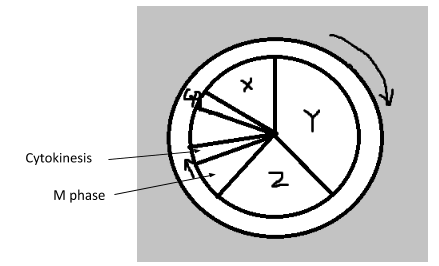
Refer to the given diagram showing cell cycle and answer the questions that follow.
i)If the chromosome number at X is 2n, what will be the number of chromosomes at Y?
ii)Which phase is the longest phase of M phase?
A)i-2n , ii-Telophase
B)i-4n, ii-Metaphase
C)i-2n,ii-Prophase
D)i-4n, ii-Anaphase
Answer
 Verified
614.4k+ views
Hint: Cell cycle is a sequence of events that takes place in a cell leading to cell division into two daughter cells and ultimately leads to cell growth.
Complete answer:
The cell cycle comprises two broad stages- the interphase and M phase. The interphase is also classified into three stages- G1 phase, S phase and G2 phase. There is also a resting phase or G0 phase occupied by cells that have stopped dividing, cells whose progression is stopped in the G1 phase can also enter G0 phase.
G1 phase is where the cell prepares for replication to produce two exact copies of its genetic material that is then distributed to the two daughter cells. In the G1 phase the cell increases in size and starts synthesising proteins, and other constituents that are needed for replication. S phase is the phase where replication takes place producing two copies of the genome. G2 phase is where the cell prepares itself for cell division, here too there is increased synthesis of proteins and also rapid cell growth.
Next is the M phase where nuclear division takes place. It comprises four phases- prophase, prometaphase, metaphase, anaphase and telophase. So if the number of chromosomes at X is 2n, it will also be 2n in Y after which the chromosome number doubles. The longest phase of M phase is Prophase.
Hence, the correct answer is option (C)
Note: The cell cycle is a major event occurring in cells and any malfunctioning of the cell cycle leads to the development of serious diseases. As a result of this the cell cycle is under strict regulation to make sure that no erroneous cell cycle takes place.
Complete answer:
The cell cycle comprises two broad stages- the interphase and M phase. The interphase is also classified into three stages- G1 phase, S phase and G2 phase. There is also a resting phase or G0 phase occupied by cells that have stopped dividing, cells whose progression is stopped in the G1 phase can also enter G0 phase.
G1 phase is where the cell prepares for replication to produce two exact copies of its genetic material that is then distributed to the two daughter cells. In the G1 phase the cell increases in size and starts synthesising proteins, and other constituents that are needed for replication. S phase is the phase where replication takes place producing two copies of the genome. G2 phase is where the cell prepares itself for cell division, here too there is increased synthesis of proteins and also rapid cell growth.
Next is the M phase where nuclear division takes place. It comprises four phases- prophase, prometaphase, metaphase, anaphase and telophase. So if the number of chromosomes at X is 2n, it will also be 2n in Y after which the chromosome number doubles. The longest phase of M phase is Prophase.
Hence, the correct answer is option (C)
Note: The cell cycle is a major event occurring in cells and any malfunctioning of the cell cycle leads to the development of serious diseases. As a result of this the cell cycle is under strict regulation to make sure that no erroneous cell cycle takes place.
Recently Updated Pages
Master Class 11 Social Science: Engaging Questions & Answers for Success

Master Class 11 English: Engaging Questions & Answers for Success
Master Class 11 Accountancy: Engaging Questions & Answers for Success
Master Class 11 Physics: Engaging Questions & Answers for Success
Master Class 11 Computer Science: Engaging Questions & Answers for Success
Master Class 11 Business Studies: Engaging Questions & Answers for Success
Trending doubts
One Metric ton is equal to kg A 10000 B 1000 C 100 class 11 physics CBSE
Find the value of the expression given below sin 30circ class 11 maths CBSE
Draw a diagram of nephron and explain its structur class 11 biology CBSE
10 examples of friction in our daily life
Proton was discovered by A Thomson B Rutherford C Chadwick class 11 chemistry CBSE
The teeth used for biting and cutting food are called class 11 biology CBSE