




Reduction of aromatic nitro compounds using Sn and HCl gives:
Answer
 Verified
589k+ views
Hint: Consider an arbitrary aromatic nitro compound and try to write the reaction mechanism with Sn/HCl. Tin reacts with HCl and forms Tin(IV) chloride. Hence, we can say that ${{H}^{+}}$ ions are releases which react with the nitro functional group of the aromatic compound.
Complete answer:
Nitration of aromatic compounds is used to add nitrogen atoms to the aromatic compound in the form of nitro ($-N{{O}_{2}}$) group. The nitrating mixture consists of hot conc. nitric acid also called hot fuming nitric acid and conc. sulphuric acid.
Sulphuric acid is a stronger acid than nitric acid. Sulphuric acid protonated nitrogen present in the nitric acid. This leads to the formation of nitroso ion($N{{O}_{2}}^{+}$).
Nitroso ion is then added to the benzene ring through electrophilic substitution reaction. This is how aromatic nitro compounds are formed.
We will now consider an aromatic nitro compound and write its reaction with Sn/HCl.
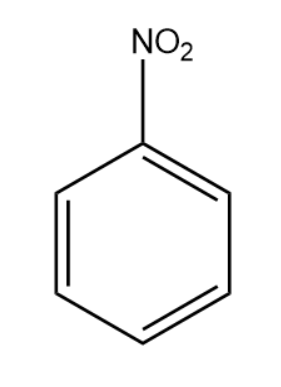
Tin reacts with hydrochloric acid to form Tin(IV) chloride. The ${{H}^{+}}$ ions present react with the nitro group of the aromatic compound.
The oxygen from the nitro group is released in the form of water molecules. In place of oxygen atoms, hydrogen gets substituted leading to formation of aromatic amine.
The reaction is given below:
\[2{{C}_{6}}{{H}_{5}}N{{O}_{2}}\text{ }+\text{ }3Sn\text{ }+\text{ }12HCl\text{ }\to \text{ }2{{C}_{6}}{{H}_{5}}N{{H}_{2}}\text{ }+\text{ }3SnC{{l}_{4}}\text{ }+\text{ }4{{H}_{2}}O\]
The product formed is aniline which is an aromatic primary amine.
Therefore, the correct answer is option (A).
Note:
Electrophilic aromatic substitution is an organic reaction in which the hydrogen that is attached to an organic system is replaced by incoming electrophile.
Some of the important electrophilic aromatic substitutions include aromatic nitration, aromatic halogenation, aromatic sulfonation, and alkylation and acylation through Friedel-Crafts reaction mechanism.
Complete answer:
Nitration of aromatic compounds is used to add nitrogen atoms to the aromatic compound in the form of nitro ($-N{{O}_{2}}$) group. The nitrating mixture consists of hot conc. nitric acid also called hot fuming nitric acid and conc. sulphuric acid.
Sulphuric acid is a stronger acid than nitric acid. Sulphuric acid protonated nitrogen present in the nitric acid. This leads to the formation of nitroso ion($N{{O}_{2}}^{+}$).
Nitroso ion is then added to the benzene ring through electrophilic substitution reaction. This is how aromatic nitro compounds are formed.
We will now consider an aromatic nitro compound and write its reaction with Sn/HCl.
Tin reacts with hydrochloric acid to form Tin(IV) chloride. The ${{H}^{+}}$ ions present react with the nitro group of the aromatic compound.
The oxygen from the nitro group is released in the form of water molecules. In place of oxygen atoms, hydrogen gets substituted leading to formation of aromatic amine.
The reaction is given below:
\[2{{C}_{6}}{{H}_{5}}N{{O}_{2}}\text{ }+\text{ }3Sn\text{ }+\text{ }12HCl\text{ }\to \text{ }2{{C}_{6}}{{H}_{5}}N{{H}_{2}}\text{ }+\text{ }3SnC{{l}_{4}}\text{ }+\text{ }4{{H}_{2}}O\]
The product formed is aniline which is an aromatic primary amine.
Therefore, the correct answer is option (A).
Note:
Electrophilic aromatic substitution is an organic reaction in which the hydrogen that is attached to an organic system is replaced by incoming electrophile.
Some of the important electrophilic aromatic substitutions include aromatic nitration, aromatic halogenation, aromatic sulfonation, and alkylation and acylation through Friedel-Crafts reaction mechanism.
Recently Updated Pages
If x a + bt + ct2 where x is in meters and t is in class 11 physics CBSE

A car covers the first half distance between two places class 11 physics CBSE
The resultant of two vectors overrightarrow P and overrightarrow class 11 physics CBSE
Find the value of cos 135 class 11 maths CBSE
A mass M is held in place by an applied force F and class 11 physics CBSE
A solution of glucose in water is labelled as 10 dfracwv class 11 chemistry CBSE
Trending doubts
Find the value of the expression given below sin 30circ class 11 maths CBSE
One Metric ton is equal to kg A 10000 B 1000 C 100 class 11 physics CBSE
Draw a diagram of nephron and explain its structur class 11 biology CBSE
10 examples of friction in our daily life
Proton was discovered by A Thomson B Rutherford C Chadwick class 11 chemistry CBSE
Bond order ofO2 O2+ O2 and O22 is in order A O2 langle class 11 chemistry CBSE