




Reaction of aniline with acetyl chloride in the presence of \[{\rm{NaOH}}\] gives:
A) acetanilide
B) P-chloroaniline
C) a red eye
D) aniline hydrochloride
Answer
 Verified
650.1k+ views
Hint: It is known that the nucleophilic reaction of the nitrogen of aromatic amines which bears a lone pair of electrons with haloalkanes and with the acid chlorides is regarded as the nucleophilic substitution reaction.
Complete answer:
Generally, we know that \[{{\rm{S}}_{\rm{N}}}1\] and \[{{\rm{S}}_{\rm{N}}}2\] are the mechanisms for the nucleophilic substitution reaction in which the bond breaking of the carbon with leaving group and the formation of a new bond with a nucleophile. \[{{\rm{S}}_{\rm{N}}}1\] mechanism is a unimolecular reaction where it involves one species in the rate defining step, whereas \[{{\rm{S}}_{\rm{N}}}2\] is a bimolecular reaction, it involves two species.
We know that aniline is the primary aromatic amine. The reaction in which aniline reacts with acid chlorides, the final product of the reaction will be N-substituted amine.
Therefore, when we treat aniline with acetyl chloride in the presence of \[{\rm{NaOH}}\], the formation of acetanilide takes place.
We can write the chemical equation for the reaction carried as follows.
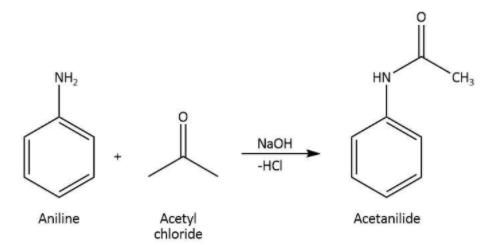
Hence, we can conclude that the correct option is A.
Note: It is known that the reaction of aromatic amine with aliphatic acid chloride or the aliphatic acid anhydride results in the formation of amides. The acetylation reaction is best carried out with acetic anhydride rather than acetyl chloride.
Complete answer:
Generally, we know that \[{{\rm{S}}_{\rm{N}}}1\] and \[{{\rm{S}}_{\rm{N}}}2\] are the mechanisms for the nucleophilic substitution reaction in which the bond breaking of the carbon with leaving group and the formation of a new bond with a nucleophile. \[{{\rm{S}}_{\rm{N}}}1\] mechanism is a unimolecular reaction where it involves one species in the rate defining step, whereas \[{{\rm{S}}_{\rm{N}}}2\] is a bimolecular reaction, it involves two species.
We know that aniline is the primary aromatic amine. The reaction in which aniline reacts with acid chlorides, the final product of the reaction will be N-substituted amine.
Therefore, when we treat aniline with acetyl chloride in the presence of \[{\rm{NaOH}}\], the formation of acetanilide takes place.
We can write the chemical equation for the reaction carried as follows.
Hence, we can conclude that the correct option is A.
Note: It is known that the reaction of aromatic amine with aliphatic acid chloride or the aliphatic acid anhydride results in the formation of amides. The acetylation reaction is best carried out with acetic anhydride rather than acetyl chloride.
Recently Updated Pages
Which of the following graphs shows the variation of class 12 physics CBSE

Draw a labelled diagram of the human male reproductive class 12 biology CBSE
Describe the experiment to compare the emf of two cells class 12 physics CBSE
What is standard hydrogen electrode
What is conventional current and electric current class 12 physics CBSE
2Bromopentane is treated with an alcoholic KOH solution class 12 chemistry CBSE
Trending doubts
Draw a labelled sketch of the human eye class 12 physics CBSE
Which are the Top 10 Largest Countries of the World?
A member of Simon commission later became Prime Minister class 12 social science CBSE
Draw ray diagrams each showing i myopic eye and ii class 12 physics CBSE
Give one example of a reptile that is viviparous class 12 biology CBSE
Which is the correct genotypic ratio of mendel dihybrid class 12 biology CBSE