




Reaction of 1,4 dibromobutane with Mg turnings in ether gives the bis Grignard’s reagent $BrMgC{H_2}C{H_2}C{H_2}C{H_2}MgBr$. What is the reaction of meso-2,3 dibromobutane with $Mg$ under the same condition.
A. Trans-2-butene
B. cis-2-butene
Answer
 Verified
564k+ views
Hint: Meso compounds are superimposable on their mirror image and in spite of having two or more stereogenic centers, the molecule is not chiral. Meso compounds have multiple chiral centers. A compound having a total of n chiral centers cannot obtain the theoretical maximum of ${2^n}$ stereoisomers if one of the stereoisomers is meso.
Complete answer:
Grignard Reagent has a generic formula R-Mg-X, R is an organic group and X is a halogen.
According to the question, bis-Grignard’s reagent is formed on a reaction of 1,4-dibomobutane with Mg turnings in ether.
$BrC{H_2}C{H_2}C{H_2}C{H_2}Br\xrightarrow[{Dry{\text{ }}ether}]{{Mg}}BrMgC{H_2}C{H_2}C{H_2}C{H_2}MgBr$
When meso-2,3-dibromobutane reacts with Mg one of the product formed is meso-$C{H_3}CH(MgBr)CH(MgBr)C{H_3}$ and the other product formed will be a Trans-2-butene.
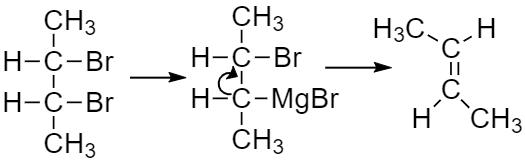
If the reaction takes place at one of the carbon then MgBr will act as Grignard reagent and the adjacent carbon will be a nucleophile and the reaction will take place as ${S_N}2$ a reaction, the structure that has a better leaving group as one of its substituents and gives least steric hindrance to approaching nucleophile for it undergoes ${S_N}2$ reaction at a faster rate.
The halogen will be removed and the product formed will be an alkene (Tran -2-butene in this case).
Therefore the correct answer is option B.
Note:
Cis-trans isomerism is configurational isomerism. The prefix “cis” is a Latin term which means “this side of” and the prefix “Trans” means “the other side of”.
The functional groups are on the same side of the carbon-carbon bond in the cis position but the functional groups are present on the opposite sides of the bond in Trans orientation. The cis isomer is usually polar but it may not be polar in Trans isomer because dipoles of opposite groups cancel each other.
Complete answer:
Grignard Reagent has a generic formula R-Mg-X, R is an organic group and X is a halogen.
According to the question, bis-Grignard’s reagent is formed on a reaction of 1,4-dibomobutane with Mg turnings in ether.
$BrC{H_2}C{H_2}C{H_2}C{H_2}Br\xrightarrow[{Dry{\text{ }}ether}]{{Mg}}BrMgC{H_2}C{H_2}C{H_2}C{H_2}MgBr$
When meso-2,3-dibromobutane reacts with Mg one of the product formed is meso-$C{H_3}CH(MgBr)CH(MgBr)C{H_3}$ and the other product formed will be a Trans-2-butene.
If the reaction takes place at one of the carbon then MgBr will act as Grignard reagent and the adjacent carbon will be a nucleophile and the reaction will take place as ${S_N}2$ a reaction, the structure that has a better leaving group as one of its substituents and gives least steric hindrance to approaching nucleophile for it undergoes ${S_N}2$ reaction at a faster rate.
The halogen will be removed and the product formed will be an alkene (Tran -2-butene in this case).
Therefore the correct answer is option B.
Note:
Cis-trans isomerism is configurational isomerism. The prefix “cis” is a Latin term which means “this side of” and the prefix “Trans” means “the other side of”.
The functional groups are on the same side of the carbon-carbon bond in the cis position but the functional groups are present on the opposite sides of the bond in Trans orientation. The cis isomer is usually polar but it may not be polar in Trans isomer because dipoles of opposite groups cancel each other.
Recently Updated Pages
If x a + bt + ct2 where x is in meters and t is in class 11 physics CBSE

A car covers the first half distance between two places class 11 physics CBSE
The resultant of two vectors overrightarrow P and overrightarrow class 11 physics CBSE
Find the value of cos 135 class 11 maths CBSE
A mass M is held in place by an applied force F and class 11 physics CBSE
A solution of glucose in water is labelled as 10 dfracwv class 11 chemistry CBSE
Trending doubts
Find the value of the expression given below sin 30circ class 11 maths CBSE
One Metric ton is equal to kg A 10000 B 1000 C 100 class 11 physics CBSE
Draw a diagram of nephron and explain its structur class 11 biology CBSE
10 examples of friction in our daily life
Proton was discovered by A Thomson B Rutherford C Chadwick class 11 chemistry CBSE
Bond order ofO2 O2+ O2 and O22 is in order A O2 langle class 11 chemistry CBSE