




What is the R.D.S. of pinacol – pinacolone rearrangement?
A.I step
B.II step
C.III step
D.IV step
Answer
 Verified
601.8k+ views
Hint: In pinacol – pinacolone rearrangement reaction, the acids lead to protonation of the hydroxyl group, then removal of water leads to formation of carbocation. Here, 1,2-rearrangement occurs leading to formation of a ketone compound.
Complete answer:
- Pinacol contains alcohol functional group, while pinacolone contains ketone functional group.
- Pinacol is a compound which has two hydroxyl groups each attached to an adjacent carbon atom.
- Pinacolone is an organic compound containing ketone functional groups. It is a colorless liquid and has an odor of peppermint or camphor.
- The pinacol – pinacolone rearrangement reaction is the conversion of an alcohol having two adjacent alcohol groups (pinacol) to a ketone (pinacolone) by the action of an acid (catalyst).
- The reaction mechanism can be explained by the following four steps:
Step 1 – Protonation of a hydroxyl group
In this step, proton or hydrogen ions coming from acid get attached to a hydroxyl group of pinacol.
Step 2 – Loss of water molecule
Here, the water molecule gets detached to give carbocation. The formation of carbocation is slow hence this is rate determining step.
Step 3 – Methyl migration
The methyl group migrates from one carbon to another atom. It gets attached to a positively charged carbon atom of carbocation.
Step 4 – Deprotonation
The proton which got attached in the first step got detached as this proton was generated by an acid catalyst during the reaction. When protons get detached from carbocation, final product pinacolone is formed.
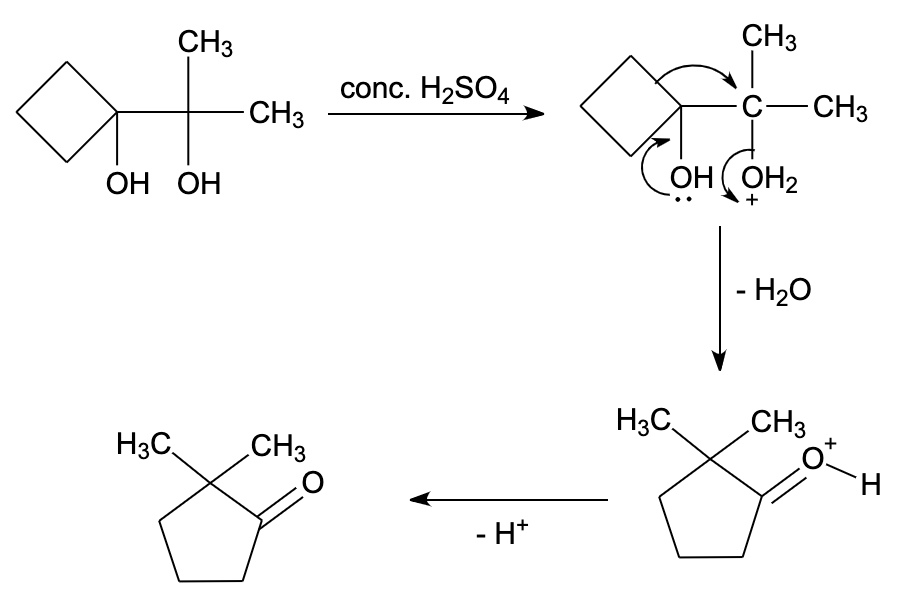
Therefore, the correct option is (B) .
Note:
This rearrangement reaction is regioselective in nature, which means that only the more stable carbocation yields a major product. Also, the rearrangement occurs because of the relative stability of the resulting oxonium ion.
Complete answer:
- Pinacol contains alcohol functional group, while pinacolone contains ketone functional group.
- Pinacol is a compound which has two hydroxyl groups each attached to an adjacent carbon atom.
- Pinacolone is an organic compound containing ketone functional groups. It is a colorless liquid and has an odor of peppermint or camphor.
- The pinacol – pinacolone rearrangement reaction is the conversion of an alcohol having two adjacent alcohol groups (pinacol) to a ketone (pinacolone) by the action of an acid (catalyst).
- The reaction mechanism can be explained by the following four steps:
Step 1 – Protonation of a hydroxyl group
In this step, proton or hydrogen ions coming from acid get attached to a hydroxyl group of pinacol.
Step 2 – Loss of water molecule
Here, the water molecule gets detached to give carbocation. The formation of carbocation is slow hence this is rate determining step.
Step 3 – Methyl migration
The methyl group migrates from one carbon to another atom. It gets attached to a positively charged carbon atom of carbocation.
Step 4 – Deprotonation
The proton which got attached in the first step got detached as this proton was generated by an acid catalyst during the reaction. When protons get detached from carbocation, final product pinacolone is formed.
Therefore, the correct option is (B) .
Note:
This rearrangement reaction is regioselective in nature, which means that only the more stable carbocation yields a major product. Also, the rearrangement occurs because of the relative stability of the resulting oxonium ion.
Recently Updated Pages
Which will be the least stable resonating structure class 11 chemistry CBSE

How many 5 digit telephone numbers can be construc-class-11-maths-CBSE
How do you find the angle of the resultant vector class 11 physics CBSE
Draw labelled diagram of the following i Gram seed class 11 biology CBSE
1 Quintal is equal to a 110 kg b 10 kg c 100kg d 1000 class 11 physics CBSE
What is the need and importance of classification class 11 biology CBSE
Trending doubts
One Metric ton is equal to kg A 10000 B 1000 C 100 class 11 physics CBSE
Find the value of the expression given below sin 30circ class 11 maths CBSE
Draw a diagram of nephron and explain its structur class 11 biology CBSE
10 examples of friction in our daily life
Proton was discovered by A Thomson B Rutherford C Chadwick class 11 chemistry CBSE
The teeth used for biting and cutting food are called class 11 biology CBSE