




What is the ratio in which the x-axis divides the line segment joining the points (1, 2) and (2, 3)?
(a). 3:2
(b). 2:3
(c). – 3:2
(d). – 2:3
Answer
 Verified
630.9k+ views
Hint: The section formula for the point (x, y) which divides the line segment joining the points \[({x_1},{y_1})\] and \[({x_2},{y_2})\] in the ratio m:n is given as \[(x,y) = \left( {\dfrac{{m{x_2} + n{x_1}}}{{m + n}},\dfrac{{m{y_2} + n{y_1}}}{{m + n}}} \right)\]. Use this formula to find the ratio in which the x-axis divides the line segment joining the points (1, 2) and (2, 3).
Complete step-by-step answer:
We need to find the ratio in which the x-axis divides the line segment joining the points (1, 2) and (2, 3).
Any point on the x-axis has its y coordinate equal to zero. Hence, let us assume a point (x, 0) that divides the line segment joining the points (1, 2) and (2, 3).
The section formula for the point (x, y) which divides the line segment joining the points \[({x_1},{y_1})\] and \[({x_2},{y_2})\] in the ratio m:n is given as follows:
\[(x,y) = \left( {\dfrac{{m{x_2} + n{x_1}}}{{m + n}},\dfrac{{m{y_2} + n{y_1}}}{{m + n}}} \right)\]
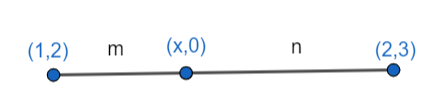
Let the ratio in which the point (x, 0) divides the line segment joining the points (1, 2) and (2, 3) be m:n. then we have:
\[(x,0) = \left( {\dfrac{{m(2) + n(1)}}{{m + n}},\dfrac{{m(3) + n(2)}}{{m + n}}} \right)\]
Simplifying, we have:
\[(x,0) = \left( {\dfrac{{2m + n}}{{m + n}},\dfrac{{3m + 2n}}{{m + n}}} \right)\]
The corresponding coordinates are equal. Equating the y-coordinates, we have:
\[\dfrac{{3m + 2n}}{{m + n}} = 0\]
Simplifying, we have:
\[3m + 2n = 0\]
\[3m = - 2n\]
Finding the ratio of m and n, we have:
\[\dfrac{m}{n} = \dfrac{{ - 2}}{3}\]
Hence, the x-axis divides the line segment joining the points (1, 2) and (2, 3) in the ratio – 2:3.
Hence, the correct answer is option (d).
Note: You can also find the equation of the line segment joining the points (1, 2) and (2, 3) and then find the point of intersection with the x-axis. Then use distance between two points formula \[\sqrt {{{({x_2} - {x_1})}^2} + {{({y_2} - {y_1})}^2}} \] to find the ratio.
Complete step-by-step answer:
We need to find the ratio in which the x-axis divides the line segment joining the points (1, 2) and (2, 3).
Any point on the x-axis has its y coordinate equal to zero. Hence, let us assume a point (x, 0) that divides the line segment joining the points (1, 2) and (2, 3).
The section formula for the point (x, y) which divides the line segment joining the points \[({x_1},{y_1})\] and \[({x_2},{y_2})\] in the ratio m:n is given as follows:
\[(x,y) = \left( {\dfrac{{m{x_2} + n{x_1}}}{{m + n}},\dfrac{{m{y_2} + n{y_1}}}{{m + n}}} \right)\]
Let the ratio in which the point (x, 0) divides the line segment joining the points (1, 2) and (2, 3) be m:n. then we have:
\[(x,0) = \left( {\dfrac{{m(2) + n(1)}}{{m + n}},\dfrac{{m(3) + n(2)}}{{m + n}}} \right)\]
Simplifying, we have:
\[(x,0) = \left( {\dfrac{{2m + n}}{{m + n}},\dfrac{{3m + 2n}}{{m + n}}} \right)\]
The corresponding coordinates are equal. Equating the y-coordinates, we have:
\[\dfrac{{3m + 2n}}{{m + n}} = 0\]
Simplifying, we have:
\[3m + 2n = 0\]
\[3m = - 2n\]
Finding the ratio of m and n, we have:
\[\dfrac{m}{n} = \dfrac{{ - 2}}{3}\]
Hence, the x-axis divides the line segment joining the points (1, 2) and (2, 3) in the ratio – 2:3.
Hence, the correct answer is option (d).
Note: You can also find the equation of the line segment joining the points (1, 2) and (2, 3) and then find the point of intersection with the x-axis. Then use distance between two points formula \[\sqrt {{{({x_2} - {x_1})}^2} + {{({y_2} - {y_1})}^2}} \] to find the ratio.
Recently Updated Pages
Master Class 12 Social Science: Engaging Questions & Answers for Success

Master Class 12 Physics: Engaging Questions & Answers for Success
Master Class 12 Maths: Engaging Questions & Answers for Success
Master Class 12 Economics: Engaging Questions & Answers for Success
Master Class 12 Chemistry: Engaging Questions & Answers for Success
Master Class 12 Business Studies: Engaging Questions & Answers for Success
Trending doubts
Explain the structure of megasporangium class 12 biology CBSE
What are the major means of transport Explain each class 12 social science CBSE
How many chromosomes are found in human ovum a 46 b class 12 biology CBSE
The diagram of the section of a maize grain is given class 12 biology CBSE
No of 5 membered ring in left Caleft EDTA right right2 class 12 chemistry CBSE
How many 176Omega resistors in parallel are required class 12 physics CBSE