




Raphides are found in
(a) Citrus
(b) Colocasia
(c) Both A and B
(d) None of these
Answer
 Verified
617.7k+ views
Hint: Raphides are commonly found in monocot families. One such genus of flowering plants showing raphides is seen in the family Araceae. Plants belonging to this genus are native to South-Eastern Asia and the Indian subcontinent.
Complete step by step answer:
Raphides are found in Colocasia, which is a monocot. Let's begin the explanation by understanding what raphides are. Raphides are needle-shaped crystals of calcium oxalate monohydrate. They can also be made up of calcium carbonate like aragonite. They can be seen in more than 200 families of plants. Some examples include Actinidia (Kiwifruit) , Colocasia (Cocoyam) , Monstera (Swiss cheese plant) etc.
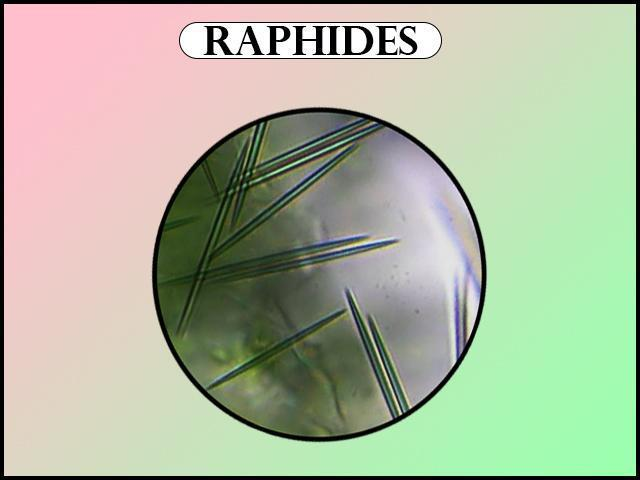
So, the correct answer is ‘Colocasia’.
Additional Information:
- Raphides seem to be a defence reaction against plant predators, as they're likely to tear and harm the soft tissues of the throat or oesophagus of a plant predator chewing on the plant's leaves.
- The venomous process is of two stages - mechanical pricking and injection of harmful protease.
- Ingestion of a plant containing raphides, for example, certain house plants can typically cause immediate numbing. This is shortly followed by painful oedema, vesicle formation and dysphagia.
- Raphides can be destroyed in an acidic environment or chemical solvents like ether, but not by simple boiling.
- Plants that have large amounts of raphides are acrid and unpalatable in general.
Notes:
- Raphides are present in highly specialised cells called idioblasts. If consumed in high quantities raphides can lead to kidney stones.
- Druses are similar to raphides. However, they differ in the way that raphides are needle- shaped, whereas druses are globular or star- shaped.
- Citrus plants have thorns on their body as a defence mechanism. Citrus fruits show several important pharmaceutical functions such as antimicrobial, anti-inflammatory and anticarcinogenic activities.
Complete step by step answer:
Raphides are found in Colocasia, which is a monocot. Let's begin the explanation by understanding what raphides are. Raphides are needle-shaped crystals of calcium oxalate monohydrate. They can also be made up of calcium carbonate like aragonite. They can be seen in more than 200 families of plants. Some examples include Actinidia (Kiwifruit) , Colocasia (Cocoyam) , Monstera (Swiss cheese plant) etc.
So, the correct answer is ‘Colocasia’.
Additional Information:
- Raphides seem to be a defence reaction against plant predators, as they're likely to tear and harm the soft tissues of the throat or oesophagus of a plant predator chewing on the plant's leaves.
- The venomous process is of two stages - mechanical pricking and injection of harmful protease.
- Ingestion of a plant containing raphides, for example, certain house plants can typically cause immediate numbing. This is shortly followed by painful oedema, vesicle formation and dysphagia.
- Raphides can be destroyed in an acidic environment or chemical solvents like ether, but not by simple boiling.
- Plants that have large amounts of raphides are acrid and unpalatable in general.
Notes:
- Raphides are present in highly specialised cells called idioblasts. If consumed in high quantities raphides can lead to kidney stones.
- Druses are similar to raphides. However, they differ in the way that raphides are needle- shaped, whereas druses are globular or star- shaped.
- Citrus plants have thorns on their body as a defence mechanism. Citrus fruits show several important pharmaceutical functions such as antimicrobial, anti-inflammatory and anticarcinogenic activities.
Recently Updated Pages
Master Class 12 Economics: Engaging Questions & Answers for Success

Master Class 12 English: Engaging Questions & Answers for Success
Master Class 12 Social Science: Engaging Questions & Answers for Success
Master Class 12 Maths: Engaging Questions & Answers for Success
Master Class 12 Physics: Engaging Questions & Answers for Success
Master Class 9 General Knowledge: Engaging Questions & Answers for Success
Trending doubts
One Metric ton is equal to kg A 10000 B 1000 C 100 class 11 physics CBSE
Difference Between Prokaryotic Cells and Eukaryotic Cells
Two of the body parts which do not appear in MRI are class 11 biology CBSE
1 ton equals to A 100 kg B 1000 kg C 10 kg D 10000 class 11 physics CBSE
Draw a diagram of nephron and explain its structur class 11 biology CBSE
10 examples of friction in our daily life