




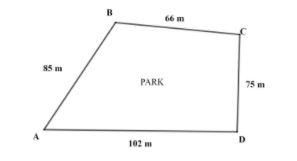
Raghu walks around a park every day. How far does he walk in one round?
A. $198\text{ m}$
B. $\text{298 m}$
C. $228\text{ m}$
D. $\text{328 m}$
Answer
 Verified
588.9k+ views
Hint: For finding out the distance walked around the park by Raghu , we will find out the perimeter of the park. We will do this by adding up all the sides given in the figure that is $P=AB+BC+CD+DA$. After adding the sides the resultant value will be our answer.
Complete step-by-step answer:
We are given a park where the sides of the park are as follows:
$\begin{align}
& AB=85\text{ m} \\
& BC=66\text{ m} \\
& CD=75\text{ m} \\
& DA=102\text{ m} \\
\end{align}$
We know that perimeter is defined as the length of the outline of a shape. If we want to find out the perimeter of a rectangle or square or any other quadrilateral shape (shapes with four sides and four vertices), all you have to do is add all the sides and get the perimeter of that shape.
Now to find out the total distance walked we will find out the perimeter of the park. Since we are given all the sides of the park the perimeter of the park will be as follows:
$P=AB+BC+CD+DA$ , where $P$ is the perimeter of the given park.
Now we will put the values of the sides in this equation, then we will get:
$\begin{align}
& P=\left( 85+66+75+102 \right)\text{ m} \\
& P=328\text{ m} \\
\end{align}$
Therefore, the total distance walked by Raghu around the park will be $328\text{ m}$ .
So, the correct answer is “Option D”.
Note: Any two dimensional figure will have its perimeter as sum of all its sides except the circle (the perimeter of a circle is called the circumference, it is equal to $2\pi r$, where $r$ is the radius of the circle.) If a given figure or polygon is regular means if its all sides are equal then the perimeter will be $n\times a$ , where n is the number of sides and a is the length of the side.
Complete step-by-step answer:
We are given a park where the sides of the park are as follows:
$\begin{align}
& AB=85\text{ m} \\
& BC=66\text{ m} \\
& CD=75\text{ m} \\
& DA=102\text{ m} \\
\end{align}$
We know that perimeter is defined as the length of the outline of a shape. If we want to find out the perimeter of a rectangle or square or any other quadrilateral shape (shapes with four sides and four vertices), all you have to do is add all the sides and get the perimeter of that shape.
Now to find out the total distance walked we will find out the perimeter of the park. Since we are given all the sides of the park the perimeter of the park will be as follows:
$P=AB+BC+CD+DA$ , where $P$ is the perimeter of the given park.
Now we will put the values of the sides in this equation, then we will get:
$\begin{align}
& P=\left( 85+66+75+102 \right)\text{ m} \\
& P=328\text{ m} \\
\end{align}$
Therefore, the total distance walked by Raghu around the park will be $328\text{ m}$ .
So, the correct answer is “Option D”.
Note: Any two dimensional figure will have its perimeter as sum of all its sides except the circle (the perimeter of a circle is called the circumference, it is equal to $2\pi r$, where $r$ is the radius of the circle.) If a given figure or polygon is regular means if its all sides are equal then the perimeter will be $n\times a$ , where n is the number of sides and a is the length of the side.
Recently Updated Pages
Master Class 10 Computer Science: Engaging Questions & Answers for Success

Master Class 10 General Knowledge: Engaging Questions & Answers for Success
Master Class 10 English: Engaging Questions & Answers for Success
Master Class 10 Social Science: Engaging Questions & Answers for Success
Master Class 10 Maths: Engaging Questions & Answers for Success
Master Class 10 Science: Engaging Questions & Answers for Success
Trending doubts
What is the median of the first 10 natural numbers class 10 maths CBSE
Which women's tennis player has 24 Grand Slam singles titles?
Who is the Brand Ambassador of Incredible India?
Why is there a time difference of about 5 hours between class 10 social science CBSE
Write a letter to the principal requesting him to grant class 10 english CBSE
State and prove converse of BPT Basic Proportionality class 10 maths CBSE