




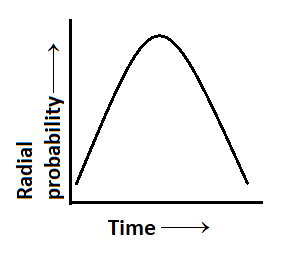
Radial probability distribution curve is shown for s-orbital. The curve is:
A. 1s
B. 2s
C. 3s
D. 4s
Answer
 Verified
675.9k+ views
Hint: This curve helps to find out the points in space where the probability density of finding an electron is maximum from the nucleus and also points where electron density is zero. Those points where the probability density of finding an electron is 0 are called nodes.
Formula: Total number of radial nodes =$n - l - 1$ where n is the principal quantum number and \[l\] is the azimuthal quantum number. For s-orbital, value of $l = 0$.
Complete Step by Step Solution:
Probability density at a point is defined as “probability per unit volume in limit that volume is infinitesimally”.
Radial probability distribution at a given radius is the probability density of an electron in an infinitesimally thin spherical shell at that radius and is a function of radial distance from the nucleus. There are also many points where the value of radial probability distribution is zero and those points are known as radial nodes.
As we have already mentioned above the formula for calculating total number of radial nodes is “\[n - l - 1\]”. So, by using the above formula we can easily calculate the radial node for all the above 4 options.
In 1s, the value of n = 1 and the value of l = 0. So, on applying the above formula the total number of radial nodes is 1 - 0 - 1 = 0.
For 2s, value of n = 2 and value of l = 0. So, total number of radial nodes is
2 - 0 - 1 = 1.
Similarly for 3s, value of n = 3 and value of l = 0. So, total number of radial nodes is
3 - 0 - 1 = 1.
For 4s, value of n = 4, and value of l = 0. So, total number of radial nodes is
4 - 0 - 1 = 1.
Also, for the above given curve, we can easily see that there is no radial node i.e. the total number of radial nodes is 0.
Hence, from the above arguments and calculations we can conclude that option A is the correct option.
Note: It should be remembered that the radial node is calculated from the Schrodinger wave equation and we should know how to calculate it from the Schrodinger wave equation.
Formula: Total number of radial nodes =$n - l - 1$ where n is the principal quantum number and \[l\] is the azimuthal quantum number. For s-orbital, value of $l = 0$.
Complete Step by Step Solution:
Probability density at a point is defined as “probability per unit volume in limit that volume is infinitesimally”.
Radial probability distribution at a given radius is the probability density of an electron in an infinitesimally thin spherical shell at that radius and is a function of radial distance from the nucleus. There are also many points where the value of radial probability distribution is zero and those points are known as radial nodes.
As we have already mentioned above the formula for calculating total number of radial nodes is “\[n - l - 1\]”. So, by using the above formula we can easily calculate the radial node for all the above 4 options.
In 1s, the value of n = 1 and the value of l = 0. So, on applying the above formula the total number of radial nodes is 1 - 0 - 1 = 0.
For 2s, value of n = 2 and value of l = 0. So, total number of radial nodes is
2 - 0 - 1 = 1.
Similarly for 3s, value of n = 3 and value of l = 0. So, total number of radial nodes is
3 - 0 - 1 = 1.
For 4s, value of n = 4, and value of l = 0. So, total number of radial nodes is
4 - 0 - 1 = 1.
Also, for the above given curve, we can easily see that there is no radial node i.e. the total number of radial nodes is 0.
Hence, from the above arguments and calculations we can conclude that option A is the correct option.
Note: It should be remembered that the radial node is calculated from the Schrodinger wave equation and we should know how to calculate it from the Schrodinger wave equation.
Recently Updated Pages
Which will be the least stable resonating structure class 11 chemistry CBSE

How many 5 digit telephone numbers can be construc-class-11-maths-CBSE
How do you find the angle of the resultant vector class 11 physics CBSE
Draw labelled diagram of the following i Gram seed class 11 biology CBSE
1 Quintal is equal to a 110 kg b 10 kg c 100kg d 1000 class 11 physics CBSE
What is the need and importance of classification class 11 biology CBSE
Trending doubts
Find the value of the expression given below sin 30circ class 11 maths CBSE
One Metric ton is equal to kg A 10000 B 1000 C 100 class 11 physics CBSE
10 examples of friction in our daily life
Draw a diagram of a plant cell and label at least eight class 11 biology CBSE
Proton was discovered by A Thomson B Rutherford C Chadwick class 11 chemistry CBSE
10 examples of diffusion in everyday life