



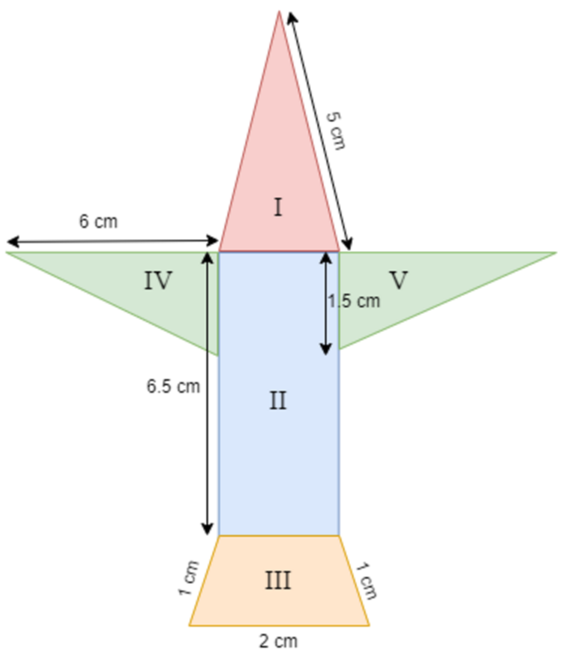
Radha made a picture of an airplane with colored paper as shown in Fig. Find the total area of the paper used.
Answer
 Verified
591.6k+ views
Hint: The given figure is divided into five parts, part I is an isosceles triangle, part IV and part V are two right-angled triangles. Part II is a rectangle and part III is a trapezium.
Complete step-by-step solution
According to the question,
The given figure is divided into five different parts and in order to find the area of the figure we need to find the area of each part.
Area of first part = Area of isosceles triangle $ = \dfrac{b}{4}\sqrt {4{a^2} - {b^2}} $
Where b is the unequal side and a is the equal sides
Now substituting the value in the above equation, we get
Area of isosceles triangle $ = \dfrac{1}{4}\sqrt {4 \times {5^2} - 1} $
$ \Rightarrow $ Area of isosceles triangle $ = \dfrac{1}{4}\sqrt {100 - 1} = \dfrac{{\sqrt {99} }}{4} \approx 2.48$ …………… (i)
We know that Area of second part = Area of rectangle$ = l \times b$
Substituting the values, we get
Area of rectangle $ = 6.5cm \times 1cm = 6.5c{m^2}$ …………(ii)
Also, Area of third part = Area of trapezium
Since, Area of trapezium $ = \dfrac{1}{2}$ (sum of II sides) $ \times $ (distance between them)
Distance between II sides
$ = \sqrt {{1^2} - {{\left( {\dfrac{1}{2}} \right)}^2}} $
$ = \sqrt {1 - \dfrac{1}{4}} = \sqrt {\dfrac{3}{4}} = \dfrac{{\sqrt 3 }}{2}$
$ \Rightarrow $ Area of trapezium $ = \dfrac{1}{2}(2 + 1) \times \dfrac{{\sqrt 3 }}{2}c{m^2}$ $ = \dfrac{{3\sqrt 3 }}{4}c{m^2} = 1.3c{m^2}$ …………… (iii)
Area of fourth part $ = \dfrac{1}{2} \times base \times height$
Substituting the values, we get
Area of fourth part $ = \dfrac{1}{2} \times 1.5cm \times 6cm = 4.5c{m^2}$ …………… (iv)
Area of fifth part = Area of fourth part $ = 4.5c{m^2}$ ……………. (v)
Now, area of given figure = (i) + (ii) + (iii) + (iv) + (v) = (2.48 + 6.5 + 1.3 + 4.5 + 4.5)$c{m^2}$ $ = 19.28c{m^2}$
Therefore, the area of the given figure is $19.28c{m^2}$.
Note: To solve this type of question one must know the formulas of mensuration. For example, Area of isosceles triangle$ = \dfrac{b}{4}\sqrt {4{a^2} - {b^2}} $, where a is the equal sides and b is the base.
Area of trapezium $ = \dfrac{1}{2}$(sum of II sides) $ \times $ (distance between them).
Complete step-by-step solution
According to the question,
The given figure is divided into five different parts and in order to find the area of the figure we need to find the area of each part.
Area of first part = Area of isosceles triangle $ = \dfrac{b}{4}\sqrt {4{a^2} - {b^2}} $
Where b is the unequal side and a is the equal sides
Now substituting the value in the above equation, we get
Area of isosceles triangle $ = \dfrac{1}{4}\sqrt {4 \times {5^2} - 1} $
$ \Rightarrow $ Area of isosceles triangle $ = \dfrac{1}{4}\sqrt {100 - 1} = \dfrac{{\sqrt {99} }}{4} \approx 2.48$ …………… (i)
We know that Area of second part = Area of rectangle$ = l \times b$
Substituting the values, we get
Area of rectangle $ = 6.5cm \times 1cm = 6.5c{m^2}$ …………(ii)
Also, Area of third part = Area of trapezium
Since, Area of trapezium $ = \dfrac{1}{2}$ (sum of II sides) $ \times $ (distance between them)
Distance between II sides
$ = \sqrt {{1^2} - {{\left( {\dfrac{1}{2}} \right)}^2}} $
$ = \sqrt {1 - \dfrac{1}{4}} = \sqrt {\dfrac{3}{4}} = \dfrac{{\sqrt 3 }}{2}$
$ \Rightarrow $ Area of trapezium $ = \dfrac{1}{2}(2 + 1) \times \dfrac{{\sqrt 3 }}{2}c{m^2}$ $ = \dfrac{{3\sqrt 3 }}{4}c{m^2} = 1.3c{m^2}$ …………… (iii)
Area of fourth part $ = \dfrac{1}{2} \times base \times height$
Substituting the values, we get
Area of fourth part $ = \dfrac{1}{2} \times 1.5cm \times 6cm = 4.5c{m^2}$ …………… (iv)
Area of fifth part = Area of fourth part $ = 4.5c{m^2}$ ……………. (v)
Now, area of given figure = (i) + (ii) + (iii) + (iv) + (v) = (2.48 + 6.5 + 1.3 + 4.5 + 4.5)$c{m^2}$ $ = 19.28c{m^2}$
Therefore, the area of the given figure is $19.28c{m^2}$.
Note: To solve this type of question one must know the formulas of mensuration. For example, Area of isosceles triangle$ = \dfrac{b}{4}\sqrt {4{a^2} - {b^2}} $, where a is the equal sides and b is the base.
Area of trapezium $ = \dfrac{1}{2}$(sum of II sides) $ \times $ (distance between them).
Recently Updated Pages
Basicity of sulphurous acid and sulphuric acid are

Master Class 9 Social Science: Engaging Questions & Answers for Success
Master Class 9 Science: Engaging Questions & Answers for Success
Master Class 9 Maths: Engaging Questions & Answers for Success
Master Class 9 General Knowledge: Engaging Questions & Answers for Success
Class 9 Question and Answer - Your Ultimate Solutions Guide
Trending doubts
Find the sum of series 1 + 2 + 3 + 4 + 5 + + 100 class 9 maths CBSE
Distinguish between Conventional and nonconventional class 9 social science CBSE
Find the mode and median of the data 13 16 12 14 1-class-9-maths-CBSE
Describe the 4 stages of the Unification of German class 9 social science CBSE
What is the role of Mahatma Gandhi in national movement
What was the Treaty of Constantinople of 1832 class 9 social science CBSE