




Quasi-fluid nature of membrane is due to
A) Phospholipid
B) Integral protein
C) Peripheral protein
D) Sugar moiety
Answer
 Verified
644.7k+ views
Hint: Plasma membrane is best described by the Fluid Mosaic Model, which suggests the quasi fluid nature of the plasma membrane.
Complete Answer:
Think of a structure holding each and every type of living cell intact along with acting as deciding manager for the entry and exit of molecules, what strikes to your mind is the cell membrane or the plasma membrane.
Plasma membrane is described as a selectively permeable boundary that allows the restricted and required entry and exit across the cell. Various models have been proposed for describing the structure of plasma membranes, the best suited is the fluid mosaic model provided by Singer and Nicolson in 1972.
According to this model of the plasma membrane:
1) Plasma membrane is not a regular structure. It is a mosaic of molecules like lipids (primarily phospholipids), proteins, carbohydrate moiety and cholesterol.
2) It suggests that the fluid nature of the plasma membrane is because of the phospholipids. 3) Fluid nature means that when a needle is pricked in the plasma membrane, it will not break. When the needle is removed, the plasma membrane will remain intact.
4) The proteins are present on the outer surface, on the inner surface and across the membrane (transmembrane proteins).
5) The phospholipids show movements like lateral movement, flip-flop, etc.
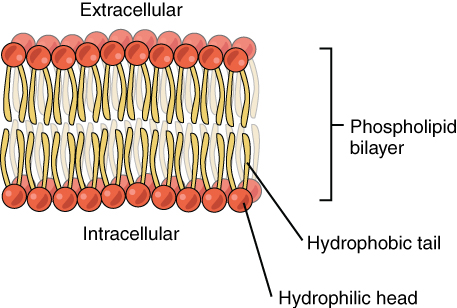
Phospholipids of plasma membranes are amphipathic structures. It means they have both water-loving (hydrophilic) and water-fearin (hydrophobic) structures. The diagram is shown below:
Therefore, the correct answer is option A.
Note: The hydrophobic tails of the phospholipids are present within the internal pockets while the hydrophilic heads face the cytoplasm on the inside and extracellular matrix on the outside.
Complete Answer:
Think of a structure holding each and every type of living cell intact along with acting as deciding manager for the entry and exit of molecules, what strikes to your mind is the cell membrane or the plasma membrane.
Plasma membrane is described as a selectively permeable boundary that allows the restricted and required entry and exit across the cell. Various models have been proposed for describing the structure of plasma membranes, the best suited is the fluid mosaic model provided by Singer and Nicolson in 1972.
According to this model of the plasma membrane:
1) Plasma membrane is not a regular structure. It is a mosaic of molecules like lipids (primarily phospholipids), proteins, carbohydrate moiety and cholesterol.
2) It suggests that the fluid nature of the plasma membrane is because of the phospholipids. 3) Fluid nature means that when a needle is pricked in the plasma membrane, it will not break. When the needle is removed, the plasma membrane will remain intact.
4) The proteins are present on the outer surface, on the inner surface and across the membrane (transmembrane proteins).
5) The phospholipids show movements like lateral movement, flip-flop, etc.
Phospholipids of plasma membranes are amphipathic structures. It means they have both water-loving (hydrophilic) and water-fearin (hydrophobic) structures. The diagram is shown below:
Therefore, the correct answer is option A.
Note: The hydrophobic tails of the phospholipids are present within the internal pockets while the hydrophilic heads face the cytoplasm on the inside and extracellular matrix on the outside.
Recently Updated Pages
Basicity of sulphurous acid and sulphuric acid are

Master Class 11 English: Engaging Questions & Answers for Success
Master Class 11 Physics: Engaging Questions & Answers for Success
Master Class 11 Computer Science: Engaging Questions & Answers for Success
Master Class 11 Chemistry: Engaging Questions & Answers for Success
Master Class 11 Social Science: Engaging Questions & Answers for Success
Trending doubts
Difference Between Prokaryotic Cells and Eukaryotic Cells
Two of the body parts which do not appear in MRI are class 11 biology CBSE
One Metric ton is equal to kg A 10000 B 1000 C 100 class 11 physics CBSE
10 examples of friction in our daily life
Draw a diagram of nephron and explain its structur class 11 biology CBSE
What will happen if the mucus is not secreted by the class 11 biology CBSE