




QRS stands for
a. Auricle Repolarisation
b. Ventricular Repolarization
c. Auricle Diastole
d. Cardiac Cycle
Answer
 Verified
614.7k+ views
Hint: The QRS complex is the arrangement of three of the graphical deflections seen on a characteristic electrocardiogram (ECG). It is generally the central and most visually evident part of the tracing. It corresponds to the contraction of the large ventricular muscles and depolarization phenomenon in the human heart.
Complete answer:
QRS represents ventricular depolarization. In adults, the QRS wave on average lasts 0.12-0.20 seconds. Ventricular repolarization is an intricate electrical occurrence which represents a key stage in electrical cardiac activity. It is put across on the surface electrocardiogram by the interval amid the start of the QRS complex and the last part of the T wave or U wave.
There is no particularly visible wave representing auricle repolarization in the ECG because it takes place during ventricular depolarization. Auricle Diastole, in the cardiac cycle, is the phase of relaxation of the heart muscle; go along with the filling of the chambers with blood.
The cardiac cycle is the performance of the human heart from the finishing of one heartbeat to the beginning of the next cardiac cycle.
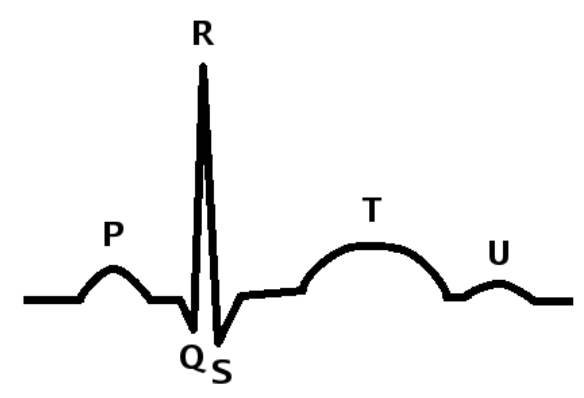
Hence, the correct answer is option (B).
Note: Any aberration of conduction takes longer and is responsible for "extended" QRS complexes. In the bundle branch block, there can be a strange second rising deflection within the QRS complex. For diagnosing abnormalities, the duration, amplitude, and morphology of the QRS complex are of use. Examples are ventricular hypertrophy, myocardial infarction, electrolyte derangements, cardiac arrhythmias, conduction abnormalities, and other disease states.
Complete answer:
QRS represents ventricular depolarization. In adults, the QRS wave on average lasts 0.12-0.20 seconds. Ventricular repolarization is an intricate electrical occurrence which represents a key stage in electrical cardiac activity. It is put across on the surface electrocardiogram by the interval amid the start of the QRS complex and the last part of the T wave or U wave.
There is no particularly visible wave representing auricle repolarization in the ECG because it takes place during ventricular depolarization. Auricle Diastole, in the cardiac cycle, is the phase of relaxation of the heart muscle; go along with the filling of the chambers with blood.
The cardiac cycle is the performance of the human heart from the finishing of one heartbeat to the beginning of the next cardiac cycle.
Hence, the correct answer is option (B).
Note: Any aberration of conduction takes longer and is responsible for "extended" QRS complexes. In the bundle branch block, there can be a strange second rising deflection within the QRS complex. For diagnosing abnormalities, the duration, amplitude, and morphology of the QRS complex are of use. Examples are ventricular hypertrophy, myocardial infarction, electrolyte derangements, cardiac arrhythmias, conduction abnormalities, and other disease states.
Recently Updated Pages
Master Class 11 Social Science: Engaging Questions & Answers for Success

Master Class 11 Chemistry: Engaging Questions & Answers for Success
Master Class 9 General Knowledge: Engaging Questions & Answers for Success
Master Class 9 Maths: Engaging Questions & Answers for Success
Master Class 9 Science: Engaging Questions & Answers for Success
Master Class 9 English: Engaging Questions & Answers for Success
Trending doubts
One Metric ton is equal to kg A 10000 B 1000 C 100 class 11 physics CBSE
Difference Between Prokaryotic Cells and Eukaryotic Cells
Two of the body parts which do not appear in MRI are class 11 biology CBSE
1 ton equals to A 100 kg B 1000 kg C 10 kg D 10000 class 11 physics CBSE
10 examples of friction in our daily life
Name the Largest and the Smallest Cell in the Human Body ?